
Chandrayaan-5/LUPEX: the ISRO-JAXA lunar polar mission
Why in news: JAXA unveiled the LUPEX rover prototype and ran a test demonstration at the Chofu Aerospace Centre, Japan, on 25 November 2026.
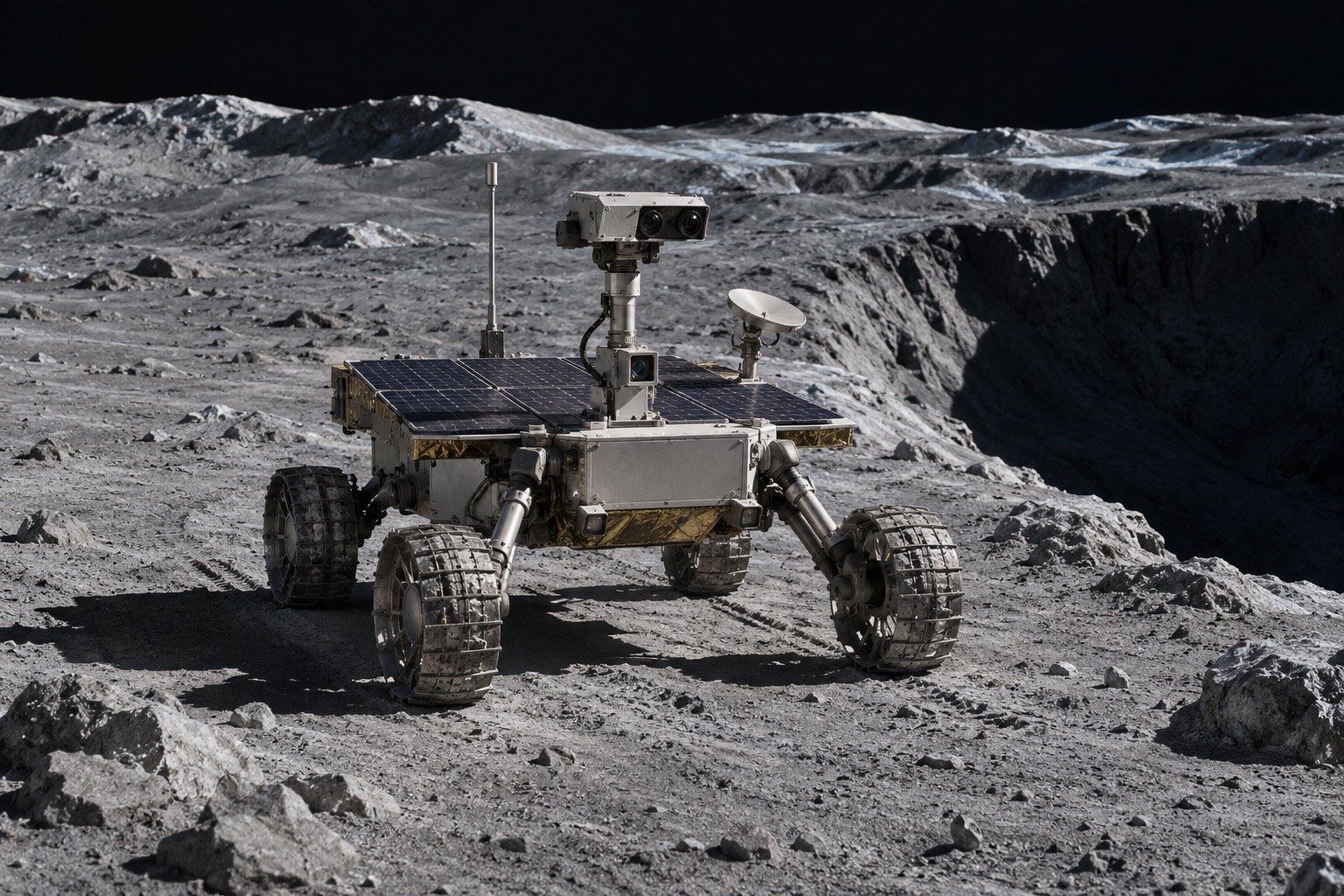
Chandrayaan-5, the Lunar Polar Exploration (LUPEX) mission, is a joint mission of the Indian Space Research Organisation (ISRO) and the Japan Aerospace Exploration Agency (JAXA). It will study water and other volatiles near a shadowed region at the lunar south pole. The Union government gave it financial sanction in March 2025. JAXA unveiled a rover prototype on 25 November 2026.
Syllabus: GS3 · Science & Technology; GS3 · IT, Space, Biotech & IPR; GS2 · Groupings & Agreements
Why this matters for UPSC
GS3 science and technology: India's lunar programme and space cooperation with Japan. Prelims can ask who builds what in LUPEX; Mains, the value of space partnerships.
In short
Chandrayaan-5, or the Lunar Polar Exploration (LUPEX) mission, is a joint ISRO-JAXA lander-rover mission to measure water and other volatiles near a shadowed region at the lunar south pole.
LUPEX will be judged by how reliably it measures polar water; early agreement on interfaces and the landing site will protect its schedule.
Why it matters
Engineers planning long stays on the Moon need to know whether water found there can be used, because hauling everything from Earth makes such missions far harder. LUPEX is built to answer that by measuring how much water lies at the south pole and in what form. For India, the mission adds experience of landing and driving near the poles, a region PIB calls largely unexplored. It also gives the India-Japan partnership a working project in science, with costs and skills shared between the two agencies. Success would move India along its plan for sample return and, later, an Indian landing on the Moon.
Prelims pointers
- Permanently Shadowed Regions lie at both the north and south lunar poles, where the Sun stays low; crater interiors are typical examples.
- Chandrayaan-4 is India's first lunar sample return mission, planned for 2027 with no JAXA role; Chandrayaan-5 is the ISRO-JAXA lander-rover mission.
- Chandrayaan-4 targets about 84 to 86 degrees south latitude, a region PIB calls geologically diverse and close to Permanently Shadowed Regions.
- Chandrayaan-1 flew in 2008, Chandrayaan-2 (orbiter-based exploration) in 2019 and Chandrayaan-3 (lander-rover in-situ exploration) in 2023.
- NASA's Neutron Spectrometer searches for water beneath the surface; ESA's EMS-L studies the exosphere: the two are different agencies' instruments.
- ISRO's payloads on LUPEX, per JAXA, are a Ground Penetrating Radar, a Sample Analysis Package and a Mid-Infrared Imaging Spectrometer.
- JAXA's SLIM (Smart Lander for Investigating Moon) project supplied landing technology that LUPEX plans to build on.
Practise a UPSC-style question
With reference to the Chandrayaan-5/LUPEX mission, consider the following statements:
1. ISRO is responsible for the lander and for a few of the mission's scientific instruments.
2. The rover for the mission is being designed and built by the Japan Aerospace Exploration Agency.
3. The spacecraft is to be carried to space on JAXA's H3 launch vehicle.
Which of the statements given above is/are correct?
- (a) 1 and 2 only
- (b) 2 and 3 only
- (c) 1 and 3 only
- (d) 1, 2 and 3
Show the answer
Answer: (d) 1, 2 and 3
Answer: (d) 1, 2 and 3. All three statements describe the agreed split of work between ISRO and JAXA.
Statement 1: correct. ISRO develops the lunar lander and also a few of the scientific instruments, as ISRO and PIB state.
Statement 2: correct. The rover is JAXA's part of the mission; the ISRO page adds that Mitsubishi Heavy Industries of Japan makes it.
Statement 3: correct. JAXA will launch the mission on its H3-24L rocket, carrying the ISRO-made lander with the rover on it.
Eliminate: statement 2 is correct, so the code without it goes. Out: (c).
Eliminate: statement 3 is correct, so the code without it goes. Out: (a).
Eliminate: statement 1 is correct, so the last code without it goes. Out: (b).
Trap: Swapped attribution. A student who assumes India, the senior partner in the Chandrayaan name, also builds the rover or the rocket may wrongly doubt statements 2 and 3.
Remember: ISRO lander, JAXA rover, JAXA's H3 rocket.
More Explainers
- Human spaceflight analog missions and crew training on Earth Sci-Tech
- Didarganj Yakshi and Mauryan art: pillars, capitals, yakshas and the polish National
- E-Waste (Management) Rules, 2022: registration, EPR targets and certificates Environment
- Kyasanur Forest Disease: the tick-borne monkey fever of the Western Ghats Sci-Tech
- Cash transfers and subsidies: what they cost State finances Economy
- India's Tibet policy: Panchsheel, the 1959 asylum and succession World & IR
- Moral rights of authors under Section 57 of the Copyright Act, 1957 Polity
- The Post Office Act, 2023: India's new postal law Polity
- Antiquities and Art Treasures Act, 1972: how India guards and retrieves antiquities National
- AI training vs inference, and what the IndiaAI Mission funds Sci-Tech
- Kalinga's maritime heritage: Boita Bandana and Bali Jatra National
- Eighth Schedule: India's 22 Scheduled Languages Polity