
Antiquities and Art Treasures Act, 1972: how India guards and retrieves antiquities
Why in news: On 26 November 2026 the ASI handed three bronzes repatriated from the USA and the Netherlands to the Idol Wing CID, Tamil Nadu Police.
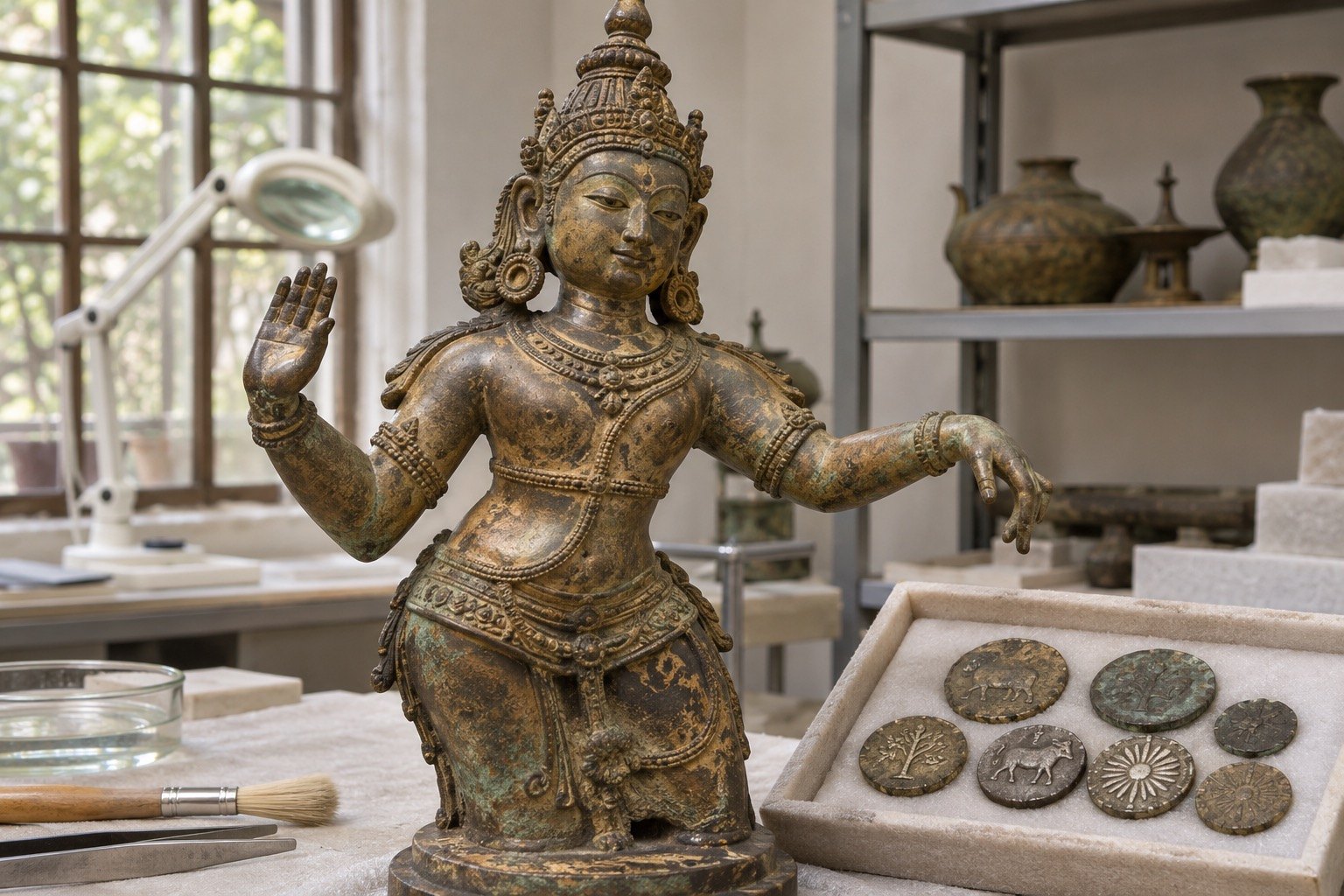
Under the Antiquities and Art Treasures Act, 1972, old sculptures, coins and manuscripts may leave India only through the Centre, under a permit. Stolen pieces found abroad are claimed back through Indian Missions. On 26 November 2026 the Archaeological Survey of India (ASI) handed three such bronzes to Tamil Nadu's Idol Wing CID.
Syllabus: GS1 · Art & Culture; Prelims · Current Affairs & IR; GS2 · Groupings & Agreements
Why this matters for UPSC
GS1 art and culture, GS2 international agreements: the 1972 Act and the 1970 UNESCO Convention. Prelims asks age tests and export rules; Mains asks why repatriation stays slow.
In short
The Antiquities and Art Treasures Act, 1972 makes the export of India's old art a state monopoly; repatriation reaches pieces already abroad through diplomacy and the 1970 UNESCO Convention.
India's export ban guards what remains at home; lasting recovery needs fuller records of temple objects and more bilateral agreements built on the 1970 Convention.
Why it matters
A village temple in Tamil Nadu that loses a bronze loses a piece of its own past. Two of the three bronzes handed back in November 2026 had been photographed in their temples in the 1950s, and such old records help prove where an object came from. Once a piece leaves India, its return depends on another government's goodwill and on talks between the two countries. A firm export ban gives customs officers a clear reason to stop a smuggler at the exit, and a treaty with a buyer country lets that country's customs seize a piece and offer it back. The larger question is fairness, since many Indian objects left during colonial rule and nobody holds a full list of them.
Prelims pointers
- Under the 1972 Act the Centre may, by notification, reserve the business of selling antiquities to itself or an agency it authorises, ending private licences.
- The Customs Act, 1962 applies to any export of an antiquity or art treasure that the 1972 Act bars; confiscation follows unless the Centre directs otherwise.
- The Antiquities and Art Treasures Act, 1972 differs from the Antiquities (Export Control) Act, 1947: anyone convicted under the 1947 law waits ten years for a dealer's licence.
- The 1972 Act lets the Centre compulsorily acquire antiquities and art treasures so that they are preserved in public places.
- India and the USA are both States party to the 1970 UNESCO Convention; their 2024 agreement drew on Article 9 of that Convention.
- The India-USA Cultural Property Agreement limits US imports of Indian archaeological material dated 1.7 million years ago to 1770 CE, and ethnological material up to 1947 CE.
Practise a UPSC-style question
With reference to the Antiquities and Art Treasures Act, 1972, consider the following statements:
1. A manuscript of historical value counts as an antiquity once it has existed for at least 75 years.
2. The work of a living artist may be declared an art treasure if its aesthetic value is high.
3. A private dealer holding a licence from a licensing officer may export an antiquity.
Which of the statements given above is/are correct?
- (a) 1 only
- (b) 2 only
- (c) 3 only
- (d) 1, 2 and 3
Show the answer
Answer: (a) 1 only
Answer: (a) 1 only. Only the manuscript rule is right; the other two misread the Act.
Statement 1: correct. The 1972 Act treats a manuscript, record or document of scientific, historical, literary or aesthetic value as an antiquity at 75 years.
Statement 2: incorrect. The Act bars declaring any work an art treasure while its author is alive.
Statement 3: incorrect. Only the Central Government or an agency it authorises may export, under a permit; a dealer's licence covers selling, not export.
Eliminate: statement 2 is surest wrong, since no living artist's work qualifies. Out: (b), (d).
Eliminate: statement 3 confuses a selling licence with an export permit. Out: (c).
Trap: Swapped attribution. Statement 3 pins the export power, which the Act keeps with the Centre, on a licensed private dealer.
Remember: 100 years for an antiquity, 75 for a manuscript; export only by the Centre.
More Explainers
- Human spaceflight analog missions and crew training on Earth Sci-Tech
- Didarganj Yakshi and Mauryan art: pillars, capitals, yakshas and the polish National
- E-Waste (Management) Rules, 2022: registration, EPR targets and certificates Environment
- Kyasanur Forest Disease: the tick-borne monkey fever of the Western Ghats Sci-Tech
- Cash transfers and subsidies: what they cost State finances Economy
- India's Tibet policy: Panchsheel, the 1959 asylum and succession World & IR
- Moral rights of authors under Section 57 of the Copyright Act, 1957 Polity
- The Post Office Act, 2023: India's new postal law Polity
- AI training vs inference, and what the IndiaAI Mission funds Sci-Tech
- Chandrayaan-5/LUPEX: the ISRO-JAXA lunar polar mission Sci-Tech
- Kalinga's maritime heritage: Boita Bandana and Bali Jatra National
- Eighth Schedule: India's 22 Scheduled Languages Polity