
High-Level Committee on Demographic Changes: mandate and method
Why in news: On 14 October 2026 the committee's chairman launched demography.mha.gov.in, a portal seeking inputs from governments, institutions and citizens.
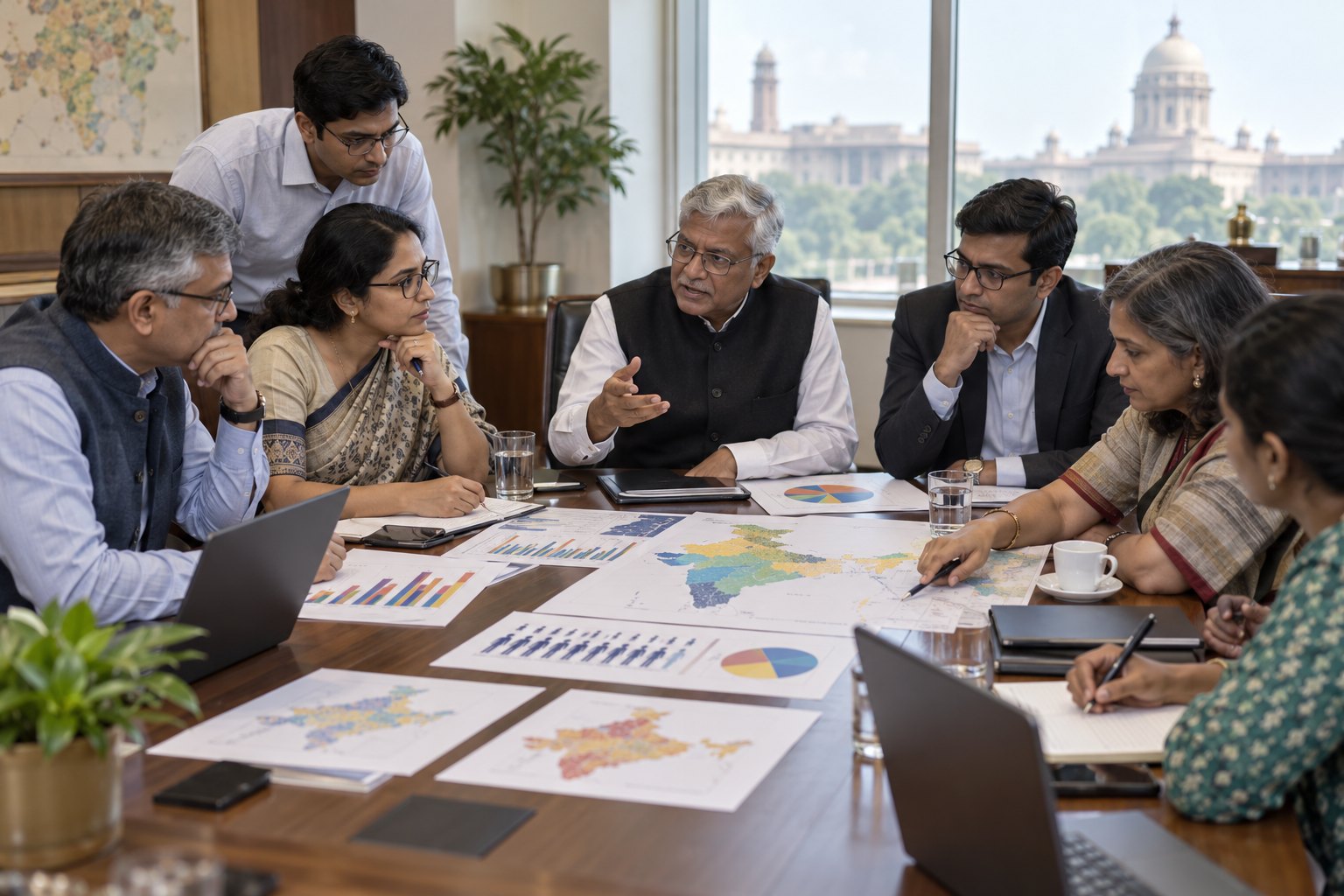
The High-Level Committee on Demographic Changes is a Ministry of Home Affairs panel, constituted on 26 May 2026 under retired Supreme Court judge Prakash Prabhakar Naolekar, to study the nature, causes and consequences of demographic change and recommend measures. On 14 October 2026 it opened a portal inviting governments, organisations and citizens to send inputs.
Syllabus: GS2 · Federalism & Local Government; GS2 · Executive & Judiciary; GS1 · Women, Population & Urbanisation
Why this matters for UPSC
GS2 (executive bodies, Centre-State relations) and GS3 (border management), with GS1 population: Prelims can ask the committee's parent ministry and the Immigration and Foreigners Act, 2025; Mains, how demographic change should be measured and managed.
In short
The High-Level Committee on Demographic Changes (HLCDC) is an expert panel the Ministry of Home Affairs constituted on 26 May 2026 to study demographic change and recommend policy responses.
The committee's worth will rest on verified data and due process, keeping unlawful entry apart from lawful mobility while respecting States' role.
Why it matters
People living in border districts, fast-growing towns and tribal areas are the subjects of this study, and its findings could change how they are counted, identified and served. If the committee recommends a permanent system for identifying and deporting illegal immigrants, residents may face new document checks, so the line between a citizen who has moved within India and a foreigner without papers becomes decisive. States run the police and much of local administration, so any new system needs their cooperation. Because India has not counted its population since 2011, the quality of the evidence the panel gathers will decide whether its conclusions on schools, ration shops, housing and jobs rest on measurement or on impressions.
Prelims pointers
- Seventh Schedule, Union List entry 17: citizenship, naturalisation and aliens; entry 81: inter-State migration and inter-State quarantine.
- Article 11 lets Parliament make any provision on acquisition and termination of citizenship.
- Immigration and Foreigners Act, 2025 repealed four laws: the Passport (Entry into India) Act, 1920, Registration of Foreigners Act, 1939, Foreigners Act, 1946 and a 2000 carriers' liability Act.
- Section 16 of the 2025 Act places the burden of proving one is not a foreigner on the person concerned.
- Section 5 of the 2025 Act constitutes the Bureau of Immigration under Central Government control.
- Census is Union List entry 69; the population census runs under the Census Act, 1948 and the Census Rules, 1990.
- Public order (entry 1) and police (entry 2) are in the State List; Article 355 makes the Union protect States against external aggression and internal disturbance.
Practise a UPSC-style question
With reference to the High-Level Committee on Demographic Changes, consider the following statements:
1. Its Member Secretary is a Joint Secretary of the Ministry of Statistics and Programme Implementation.
2. It was constituted by the Ministry of Home Affairs after approval by the Union Cabinet.
3. Its terms of reference include recommending a system to identify, detain and deport illegal immigrants.
Which of the statements given above is/are correct?
- (a) 1 and 2 only
- (b) 2 and 3 only
- (c) 1 and 3 only
- (d) 1, 2 and 3
Show the answer
Answer: (b) 2 and 3 only
Answer: (b) 2 and 3 only. The panel is an MHA body, and its mandate covers identification and deportation.
Statement 1: incorrect. The Member Secretary is the Joint Secretary (Foreigners-I) of the Ministry of Home Affairs, per PIB, 26 May 2026.
Statement 2: correct. The Union Cabinet approved the proposal in September 2025 and the MHA constituted the committee in May 2026.
Statement 3: correct. One term of reference is a permanent, legal, fair and time-bound system to identify, detain and deport illegal immigrants.
Eliminate: statement 1 is wrong, since foreigners work sits in the MHA. Out: (a), (c), (d).
Trap: Swapped attribution. The Member Secretary is moved to a statistics ministry because the panel studies population data, but its secretariat is the MHA's foreigners wing.
Remember: HLCDC = MHA panel; Member Secretary from Foreigners-I; Census Commissioner a member.
More Explainers
- State Legislative Councils: Articles 168-172 and the graduates' and teachers' seats Polity
- Whales and dolphins in Indian waters: legal protection, IUCN status and strandings Environment
- The Aligarh Movement, AMU and the Article 30 minority test Polity
- Environmental clearance by States: SEIAA, SEAC and the EIA Notification, 2006 Environment
- Software vulnerabilities: CVE, CVSS, coordinated disclosure and CERT-In's role Sci-Tech
- Drug trafficking law in India: NDPS Act, PIT-NDPS, NCB and NCORD National
- Choosing the UN Secretary-General: Article 97, UNSC veto and straw polls World & IR
- UN Convention against Torture, and why India has not ratified it Polity
- NavIC: why India's navigation constellation cannot give a standalone position Sci-Tech
- International Energy Agency: membership, 90-day oil stocks and India's status World & IR
- PM Surya Ghar: Muft Bijli Yojana and the rooftop solar subsidy Economy
- HFSS foods: FSSAI's draft limits and front-of-pack warning labels National