
Fire safety governance: State subject, National Building Code, Model Fire Bill
Why in news: The Home Ministry has asked the MCD to plan a fire and structural audit of every Delhi house, with a report due by end-October 2026.
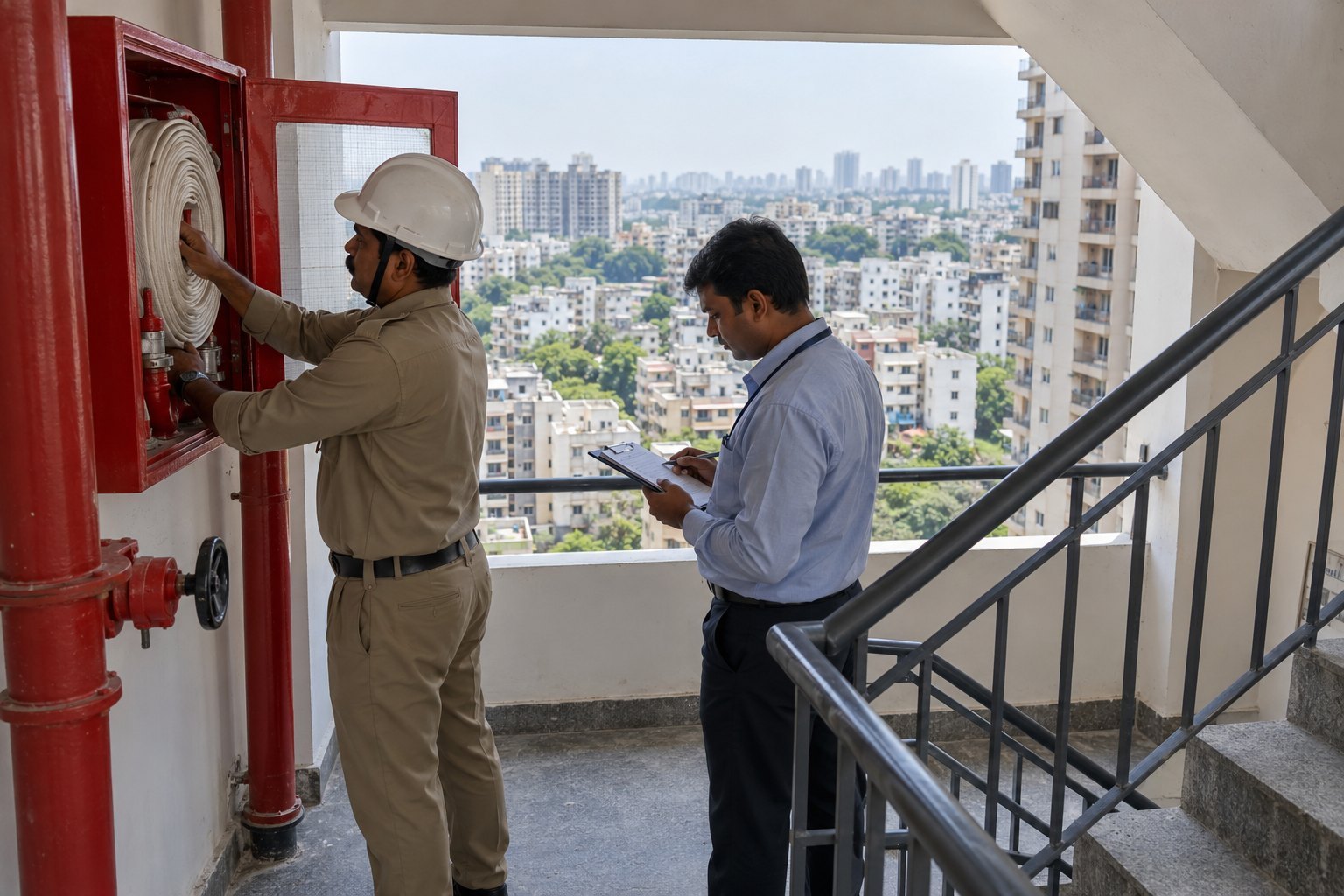
Fire service is a State subject and a municipal function in the Twelfth Schedule under Article 243W. The Centre steers it through the National Building Code, binding only through State bye-laws, a 2019 Model Fire Bill and a 2023 modernisation scheme. The Home Ministry has now asked Delhi's civic body to plan a fire and structural audit of every home.
Syllabus: GS2 · Federalism & Local Government; Prelims · Polity & Governance; GS1 · Women, Population & Urbanisation
Why this matters for UPSC
GS III disaster management and GS II federalism: Prelims can ask about the Twelfth Schedule, Article 243W, the National Building Code's publisher and status, or the 2023 fire services scheme; Mains, why fire safety enforcement keeps failing.
In short
Fire safety in India is a State subject and a municipal function under Article 243W, while the Centre shapes it through a building code, a model law and funds.
India's fire safety gap lies in enforcement more than rules: binding bye-laws, certified buildings and funded local fire services should make audits routine.
Why it matters
A family in a crowded lane, a patient in a hospital ward and a worker in a factory all rely on fire rules that differ from State to State. Because the national code is only advice until a State adopts it, a building can be checked closely in one city and barely at all in another. Where fire engines cannot enter narrow lanes, a small blaze can turn deadly before help arrives. Central money helps States buy ladders and build stations, but only firm local laws, regular inspections and trained staff stop fires before they start. The larger issue is how fast-growing cities keep safety rules in step with taller, denser and more crowded buildings.
Prelims pointers
- The Twelfth Schedule was added by the Constitution (Seventy-fourth Amendment) Act, 1992, in force from 1 June 1993; it has 18 items.
- NBC 2016 Part 4 covers all high-rise and assembly buildings, and educational or institutional buildings 9 metres or taller.
- The Model Bill treats fire services as emergency services for disasters other than fire and ties fire plans to District Disaster Management Plans.
- Scheme funds: 35% for expansion (5% of it for capacity building), 50% for modernisation and 15% for State-specific demands.
- Under the scheme, States bear 25% of project cost; North-Eastern and Himalayan States bear 10%.
- MoHFW's 2020 healthcare fire guidelines ask hospitals above 500 beds to bring every department and shift into a drill at least once a year.
Practise a UPSC-style question
With reference to fire services in India, consider the following statements:
1. Fire services are listed in the Twelfth Schedule of the Constitution among the matters for Municipalities.
2. The Twelfth Schedule was added to the Constitution by the Constitution (Seventy-third Amendment) Act, 1992.
3. Article 243W enables a State Legislature, by law, to endow Municipalities with powers over Twelfth Schedule matters.
Which of the statements given above is/are correct?
- (a) 1 and 2 only
- (b) 2 and 3 only
- (c) 1 and 3 only
- (d) 1, 2 and 3
Show the answer
Answer: (c) 1 and 3 only
Answer: (c) 1 and 3 only. The Twelfth Schedule came with the Seventy-fourth Amendment, so statement 2 fails.
Statement 1: correct. Item 7 of the Twelfth Schedule reads "Fire services", and the Home Ministry calls fire service a municipal function under Article 243W.
Statement 2: incorrect. The Twelfth Schedule was added by the Constitution (Seventy-fourth Amendment) Act, 1992; the Seventy-third added the Eleventh Schedule for Panchayats.
Statement 3: correct. Article 243W says a State Legislature may, by law, endow Municipalities with powers, including on matters in the Twelfth Schedule.
Eliminate: Judge statement 2 first: the Twelfth Schedule belongs to the Seventy-fourth Amendment, so statement 2 is incorrect. Out: (a), (b), (d).
Trap: Near-miss figure. The amendment number is moved by one, to the Seventy-third, which came the same year for Panchayats.
Remember: 73rd Amendment: Panchayats, Eleventh Schedule; 74th: Municipalities, Twelfth Schedule, item 7 fire services.
More Explainers
- State Legislative Councils: Articles 168-172 and the graduates' and teachers' seats Polity
- Whales and dolphins in Indian waters: legal protection, IUCN status and strandings Environment
- The Aligarh Movement, AMU and the Article 30 minority test Polity
- Environmental clearance by States: SEIAA, SEAC and the EIA Notification, 2006 Environment
- Software vulnerabilities: CVE, CVSS, coordinated disclosure and CERT-In's role Sci-Tech
- Drug trafficking law in India: NDPS Act, PIT-NDPS, NCB and NCORD National
- Choosing the UN Secretary-General: Article 97, UNSC veto and straw polls World & IR
- UN Convention against Torture, and why India has not ratified it Polity
- NavIC: why India's navigation constellation cannot give a standalone position Sci-Tech
- International Energy Agency: membership, 90-day oil stocks and India's status World & IR
- PM Surya Ghar: Muft Bijli Yojana and the rooftop solar subsidy Economy
- HFSS foods: FSSAI's draft limits and front-of-pack warning labels National