
Financial inclusion schemes: PMJDY, PMJJBY, PMSBY and APY
Why in news: On 19 October 2026 the Department of Financial Services announced a saturation campaign of bank camps from 21 October to 31 December 2026.
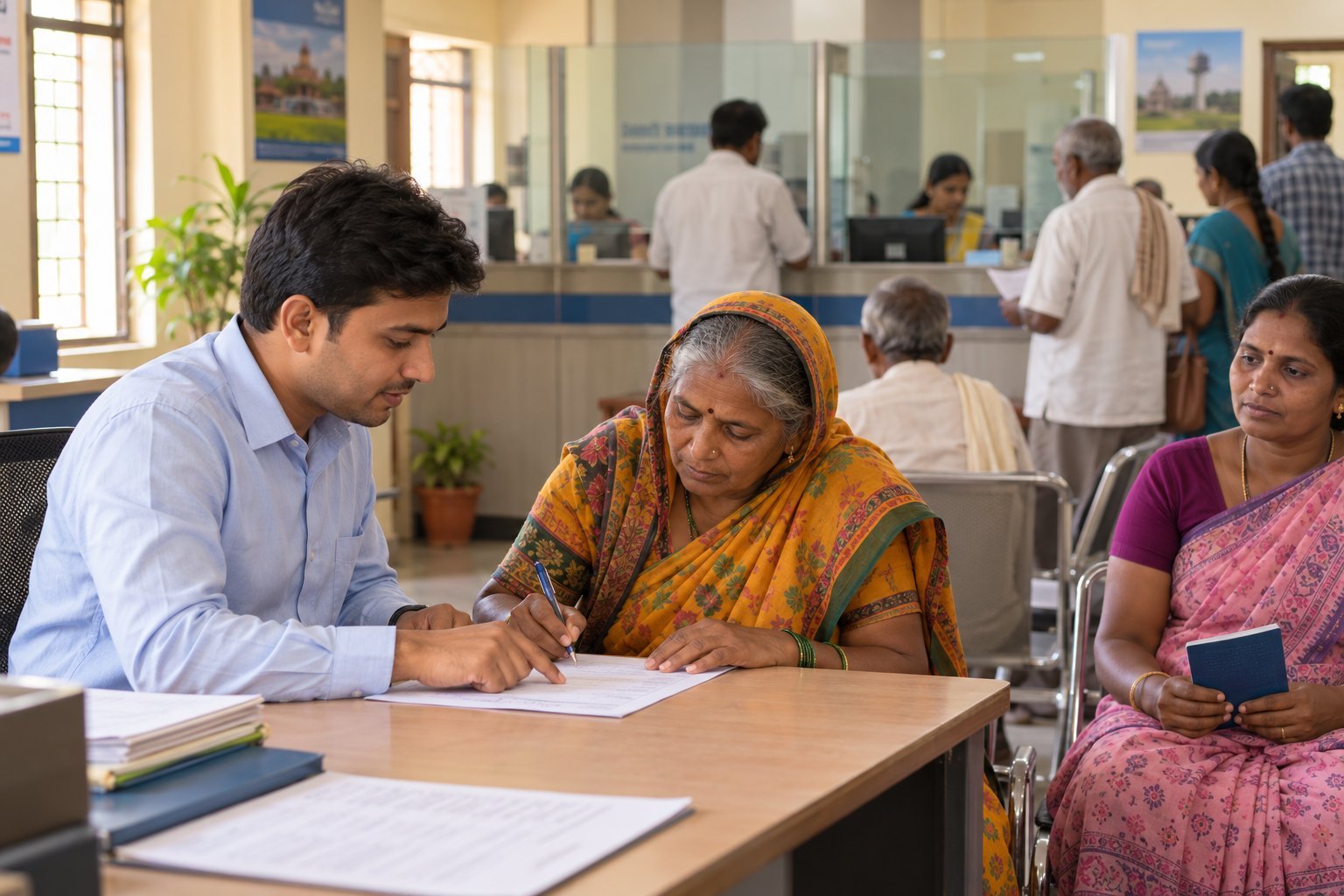
Four Union schemes form the base of India's financial inclusion: Jan Dhan (2014) gives every unbanked adult a basic bank account, PMJJBY and PMSBY offer low-premium life and accident cover, and the Atal Pension Yojana guarantees a pension from 60. Banks will hold camps nationwide from 21 October to enrol people in all four.
Syllabus: GS3 · Inclusive Growth; Prelims · Economy & Social Development; GS2 · Welfare of Vulnerable Sections
Why this matters for UPSC
GS2 (welfare schemes for vulnerable sections) and GS3 (inclusive growth): Prelims can ask the ages, premiums and cover of PMJJBY, PMSBY and APY and the FI-Index's parameters; Mains, whether account access has turned into real use.
In short
Financial inclusion means bringing every adult into the formal financial system; India builds it on four Union schemes: a basic bank account, two micro-insurance covers and a guaranteed pension.
Accounts are now near-universal; the test ahead is use, renewal and claims, so saturation drives must turn enrolment into lasting financial security.
Why it matters
A bank account lets a farm worker or a street vendor receive government money directly, save safely and later borrow, instead of keeping cash at home or paying a middleman. A few rupees a year buys a family protection against the sudden loss of an earning member, and a small monthly saving becomes a pension in old age, when informal workers have nothing else. Each of these only helps if it is kept alive: an account left unused, an insurance cover not renewed or a nominee never recorded can leave a family without the money it is owed. The larger issue is whether inclusion means owning a product or actually using it.
Prelims pointers
- PMJJBY and PMSBY covers run from 1 June to 31 May; a 30-day lien period applies to PMJJBY from enrolment.
- PMJJBY late joiners pay a pro-rata premium: Rs 342 from September, Rs 228 from December, Rs 114 from March.
- PMSBY pays Rs 2 lakh for death or loss of both eyes, hands or feet, and Rs 1 lakh for loss of one eye, hand or foot.
- If an APY subscriber dies before 60, the spouse may keep contributing until the subscriber would have turned 60.
- PMJDY overdraft is available from age 18 to 65; overdraft up to Rs 2,000 carries no conditions (Cabinet, 2018).
- FI-Index weights: Access 35%, Usage 45%, Quality 20%, across 97 indicators; Quality covers financial literacy, consumer protection and service deficiencies.
- Re-KYC under the RBI's KYC Master Direction: at least every two years for high-risk, eight for medium-risk and ten for low-risk customers.
Practise a UPSC-style question
With reference to the Jan Suraksha insurance schemes, consider the following statements:
1. Pradhan Mantri Jeevan Jyoti Bima Yojana gives a cover of Rs 2 lakh on death from any cause to account holders aged 18 to 50.
2. Pradhan Mantri Suraksha Bima Yojana is offered through Life Insurance Corporation and other life insurers at a premium of Rs 20 a year.
Which of the statements given above is/are correct?
- (a) 1 only
- (b) 2 only
- (c) Both 1 and 2
- (d) Neither 1 nor 2
Show the answer
Answer: (a) 1 only
Answer: (a) 1 only. PMJJBY's age band and cover are right; PMSBY runs through general insurers, not life insurers.
Statement 1: correct. PMJJBY pays Rs 2 lakh on death due to any cause and is open to bank or post office account holders aged 18 to 50 (Ministry of Finance, May 2026).
Statement 2: incorrect. PMSBY costs Rs 20 a year, but it is offered through public sector general insurance companies and other general insurers; LIC and life insurers run PMJJBY.
Eliminate: Judge statement 2 first: an accident cover is sold by general insurers, so statement 2 is incorrect. Out: (b), (c).
Eliminate: Statement 1 matches PMJJBY's 18-50 band and Rs 2 lakh cover, so it is correct. Out: (d).
Trap: Swapped attribution. The true premium of PMSBY is paired with the insurers of PMJJBY, so the statement reads right at a glance.
Remember: PMJJBY: life, LIC, 18-50, Rs 436. PMSBY: accident, general insurers, 18-70, Rs 20.
More Explainers
- State Legislative Councils: Articles 168-172 and the graduates' and teachers' seats Polity
- Whales and dolphins in Indian waters: legal protection, IUCN status and strandings Environment
- The Aligarh Movement, AMU and the Article 30 minority test Polity
- Environmental clearance by States: SEIAA, SEAC and the EIA Notification, 2006 Environment
- Software vulnerabilities: CVE, CVSS, coordinated disclosure and CERT-In's role Sci-Tech
- Drug trafficking law in India: NDPS Act, PIT-NDPS, NCB and NCORD National
- Choosing the UN Secretary-General: Article 97, UNSC veto and straw polls World & IR
- UN Convention against Torture, and why India has not ratified it Polity
- NavIC: why India's navigation constellation cannot give a standalone position Sci-Tech
- International Energy Agency: membership, 90-day oil stocks and India's status World & IR
- PM Surya Ghar: Muft Bijli Yojana and the rooftop solar subsidy Economy
- HFSS foods: FSSAI's draft limits and front-of-pack warning labels National