
Fair and Remunerative Price of cane and Minimum Selling Price of sugar
Why in news: On 14 October 2026 the Centre constituted a committee under Prof. Ramesh Chand to examine cane farmers' returns and the sugar Minimum Selling Price.
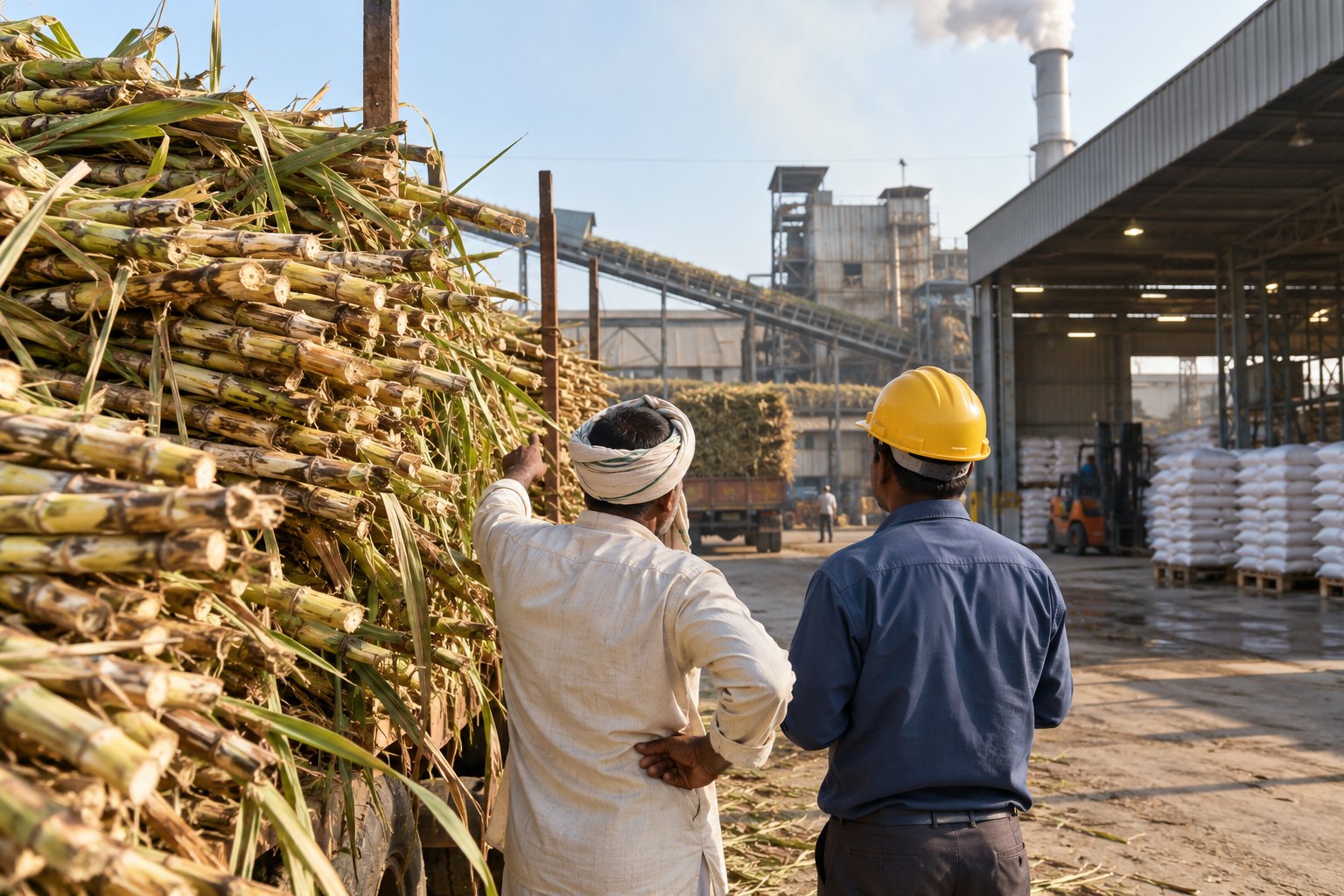
The Fair and Remunerative Price (FRP) is the floor price sugar mills must pay farmers for cane, fixed by the Centre on the advice of the Commission for Agricultural Costs and Prices. The ex-mill Minimum Selling Price (MSP) is the floor below which mills may not sell sugar. A committee constituted on 14 October 2026 will examine both.
Syllabus: GS3 · Agriculture & Irrigation; GS3 · MSP, Subsidies & Food Security; GS3 · Food Processing
Why this matters for UPSC
GS3 agricultural pricing and farm support: Prelims can ask who recommends and approves the FRP, the law behind it and how the recovery rate moves it; Mains, how cane pricing balances growers, mills and consumers.
In short
India prices cane and sugar separately: the Centre fixes a Fair and Remunerative Price that mills must pay growers, and an ex-mill floor below which mills cannot sell sugar.
Cane pricing must keep the grower's floor secure while letting mill revenue track sugar and by-products; honest recovery testing and weighment are the first reforms.
Why it matters
A cane grower in Karnataka or Maharashtra sells to one nearby mill and cannot bargain much, so the FRP decides most of what a season's crop earns. If the mill under-weighs the load, or reports a lower recovery than the cane really gave, the payment falls even when the price on paper is fair. Mills face the opposite squeeze: they must pay a fixed cane price while the sugar they sell can fall in a glut, and that gap shows up as unpaid dues to farmers. Consumers sit at the other end, since a higher floor for sugar can mean dearer sugar at the shop. The larger question is how a state-set price can keep growers, mills and households all whole.
Prelims pointers
- Clause 3(3-A), Sugarcane (Control) Order, 1966: a mill paying cane price after 14 days owes interest at 15% a year on the delay.
- The same Order lets State Governments reserve cane-growing areas for a factory; Maharashtra has no cane area reservation system.
- CACP began on 8 January 1965 as the Agricultural Prices Commission and took its present name in 1985.
- Factors for cane price under clause 3: cost of production, returns from alternative crops, fair consumer price, sugar realisation, recovery and, since 2009-10, a margin for risk and profit.
- The Revenue Sharing Formula, recommended by the Rangarajan Committee (2012), has been adopted only by Maharashtra and Karnataka, per CACP.
- Sugar season runs October to September; the Sugarcane (Control) Order defines its own year as July to June.
Practise a UPSC-style question
With reference to the Fair and Remunerative Price (FRP) of sugarcane in India, consider the following statements:
1. It is fixed on the recommendation of the Commission for Agricultural Costs and Prices.
2. It is fixed under the Sugarcane (Control) Order, 1966, issued under the Essential Commodities Act, 1955.
3. Mills pay a premium over the FRP when cane recovery is above the basic recovery rate.
Which of the statements given above is/are correct?
- (a) 1 and 2 only
- (b) 2 and 3 only
- (c) 1 and 3 only
- (d) 1, 2 and 3
Show the answer
Answer: (d) 1, 2 and 3
Answer: (d) 1, 2 and 3. All three describe how the cane FRP works.
Statement 1: correct. The CACP recommends the FRP after consulting States and industry; the CCEA approves it.
Statement 2: correct. Clause 3 of the Sugarcane (Control) Order, 1966, made under section 3 of the Essential Commodities Act, 1955, empowers the Centre to fix the cane price.
Statement 3: correct. The FRP is tied to a basic recovery of 10.25%; each 0.1 point above it earns a premium (Rs 3.56 a quintal for 2026-27).
Eliminate: Statement 2 is surest, since the Order itself cites the Essential Commodities Act. Out: (c).
Eliminate: Statement 1 holds, as every FRP decision cites the CACP. Out: (b).
Eliminate: Statement 3 holds, since the FRP is recovery-linked. Out: (a).
Trap: Sounds right. A student who confuses the FRP with a flat support price may reject statement 3, though the recovery premium is its defining feature.
Remember: FRP: CACP recommends, CCEA approves, Sugarcane (Control) Order, 1966 gives the power, recovery sets the premium.
More Explainers
- State Legislative Councils: Articles 168-172 and the graduates' and teachers' seats Polity
- Whales and dolphins in Indian waters: legal protection, IUCN status and strandings Environment
- The Aligarh Movement, AMU and the Article 30 minority test Polity
- Environmental clearance by States: SEIAA, SEAC and the EIA Notification, 2006 Environment
- Software vulnerabilities: CVE, CVSS, coordinated disclosure and CERT-In's role Sci-Tech
- Drug trafficking law in India: NDPS Act, PIT-NDPS, NCB and NCORD National
- Choosing the UN Secretary-General: Article 97, UNSC veto and straw polls World & IR
- UN Convention against Torture, and why India has not ratified it Polity
- NavIC: why India's navigation constellation cannot give a standalone position Sci-Tech
- International Energy Agency: membership, 90-day oil stocks and India's status World & IR
- PM Surya Ghar: Muft Bijli Yojana and the rooftop solar subsidy Economy
- HFSS foods: FSSAI's draft limits and front-of-pack warning labels National