
Energy storage in India: pumped storage and battery systems
Why in news: NTPC Renewable Energy Ltd invited bids in October 2026 for up to 2,000 MW/12,000 MWh of pumped storage.
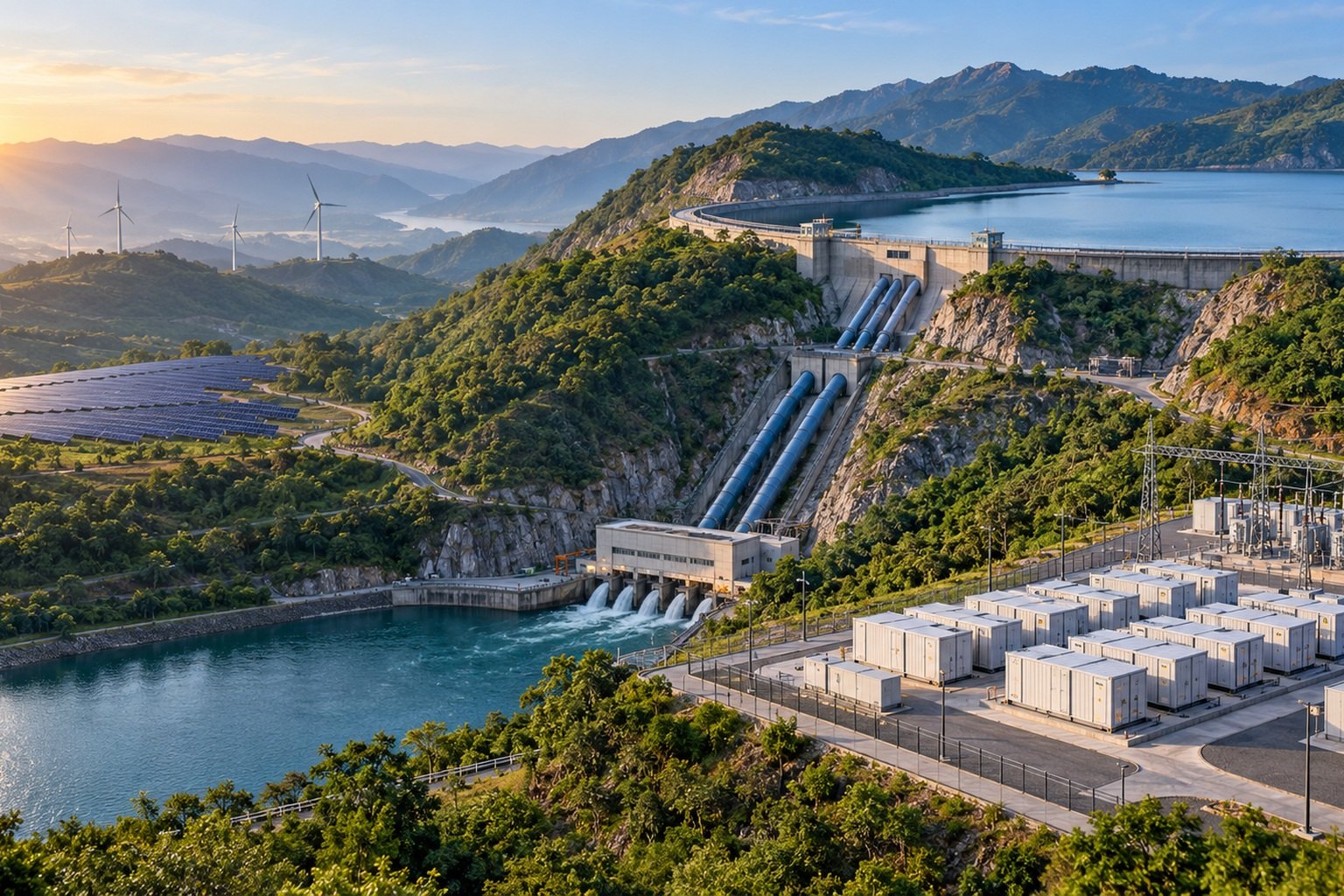
Energy storage banks surplus solar and wind power for later use. Pumped storage projects pump water uphill and release it through turbines; battery energy storage systems hold power in cells. India backs batteries with Viability Gap Funding and a manufacturing incentive. NTPC Renewable Energy sought bids in October 2026 for up to 2,000 MW of pumped storage.
Syllabus: Prelims · Environment & Ecology; GS3 · Infrastructure; GS3 · Science & Technology
Why this matters for UPSC
GS3 infrastructure and energy: Prelims can ask how pumped storage works, what Advanced Chemistry Cells are, and the terms of the VGF and PLI schemes; Mains, how storage integrates renewable energy into the grid.
In short
Energy storage holds surplus electricity, chiefly solar and wind, and returns it at peak demand. India relies on pumped storage projects (PSPs) and battery energy storage systems (BESS).
Storage decides whether India's renewable capacity becomes round-the-clock power; pumped storage for long duration and domestic cells for batteries must grow together.
Why it matters
When the sun sets, solar plants stop just as homes switch on lights, fans and televisions. Without storage, a distribution company must run costly coal or gas plants for the evening peak, or cut supply. Stored daytime power fills that gap, so a household can get steady evening electricity at a lower cost. Storage also lets more solar and wind join the grid without blackouts, which cuts coal burning and the air pollution that comes with it. Battery factories built at home mean fewer imported cells and more jobs. The larger question is energy security: India's climate goals depend on clean power that is available at every hour.
Prelims pointers
- PLI for ACC: implemented by the Ministry of Heavy Industries; each manufacturer sets up at least 5 GWh and reaches 60% domestic value addition within five years.
- PLI for ACC: the facility must be commissioned within two years; incentives are then paid over five years and rise with energy density and cycles.
- VGF for BESS (2023): at least 85% of each project's capacity must be offered to distribution companies; developers are chosen by competitive bidding.
- CEA concurrence: off-stream closed-loop PSPs are exempt whatever their cost; other hydro schemes above ₹3,000 crore need it (notification of 1 August 2025).
- MoEFCC (2023): PSPs on existing reservoirs may be appraised under category B2, without a full environmental impact assessment, subject to conditions.
- Harmonised Master List of Infrastructure (Ministry of Finance): energy storage systems added in October 2022, easing long-tenure, lower-cost loans.
- Electricity (Rights of Consumers) Rules, 2020, amended December 2022: diesel generator users must shift to cleaner backup such as storage.
Practise a UPSC-style question
With reference to pumped storage projects in India, consider the following statements:
1. Surplus grid power pumps water from a lower reservoir to an upper reservoir, and the water generates power when released at peak demand.
2. Off-stream closed-loop pumped storage projects are exempt from concurrence of the Central Electricity Authority, whatever their capital cost.
Which of the statements given above is/are correct?
- (a) 1 only
- (b) 2 only
- (c) Both 1 and 2
- (d) Neither 1 nor 2
Show the answer
Answer: (c) Both 1 and 2
Answer: (c) Both 1 and 2. Both the working principle and the 2025 exemption are stated correctly.
Statement 1: correct. A pumped storage system uses surplus grid power to lift water to the upper reservoir and regenerates power from it during peak demand (Ministry of Power, 2023).
Statement 2: correct. The Government exempted off-stream closed-loop pumped storage schemes from CEA concurrence irrespective of capital expenditure (Ministry of Power, 2025).
Eliminate: Statement 1 is the textbook working of pumped storage, so it is correct. Out: (b), (d).
Eliminate: Statement 2 matches the exemption the Ministry of Power announced for closed-loop projects. Out: (a).
Trap: Wrong scope. The phrase 'whatever their capital cost' looks like an overreach, but the exemption really does apply irrespective of the cost; the ₹3,000 crore threshold is for other hydro schemes.
Remember: Pumped storage pumps up with surplus power and generates at peak; closed-loop off-stream PSPs need no CEA concurrence.
More Explainers
- State Legislative Councils: Articles 168-172 and the graduates' and teachers' seats Polity
- Whales and dolphins in Indian waters: legal protection, IUCN status and strandings Environment
- The Aligarh Movement, AMU and the Article 30 minority test Polity
- Environmental clearance by States: SEIAA, SEAC and the EIA Notification, 2006 Environment
- Software vulnerabilities: CVE, CVSS, coordinated disclosure and CERT-In's role Sci-Tech
- Drug trafficking law in India: NDPS Act, PIT-NDPS, NCB and NCORD National
- Choosing the UN Secretary-General: Article 97, UNSC veto and straw polls World & IR
- UN Convention against Torture, and why India has not ratified it Polity
- NavIC: why India's navigation constellation cannot give a standalone position Sci-Tech
- International Energy Agency: membership, 90-day oil stocks and India's status World & IR
- PM Surya Ghar: Muft Bijli Yojana and the rooftop solar subsidy Economy
- HFSS foods: FSSAI's draft limits and front-of-pack warning labels National