
Electing the UN Security Council's non-permanent members
Why in news: Tajikistan's Foreign Minister told the UN General Assembly on 26 September 2026 that it seeks the 2028-29 seat India is contesting.
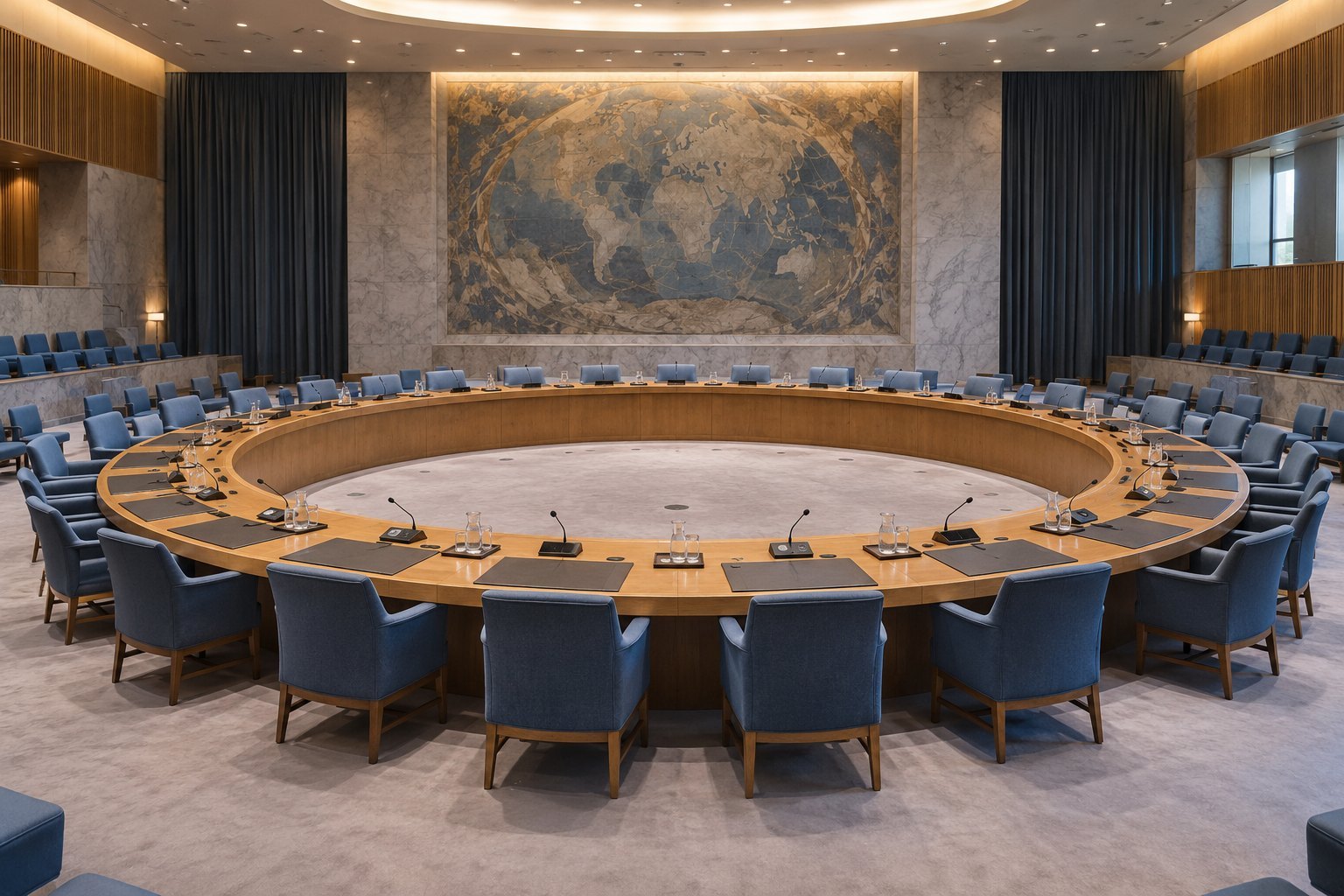
The UN General Assembly elects the Security Council's ten non-permanent members, five each year, for two-year terms by a two-thirds majority under Articles 18 and 23 of the UN Charter; a retiring member cannot seek immediate re-election. India, an eight-time member, faces Tajikistan for the Asia-Pacific seat for 2028-29 in a June 2027 ballot.
Syllabus: Prelims · Current Affairs & IR; GS2 · Groupings & Agreements; GS2 · International Institutions
Why this matters for UPSC
GS2 international institutions: Prelims asks how the UN Security Council is composed and elected under Articles 18, 23 and 27 of the UN Charter; Mains asks about India's bid for a seat and Council reform.
In short
The UN Security Council's ten non-permanent members are elected by the General Assembly, five a year, for two-year terms, balancing contribution to peace against equitable geographical distribution.
Elected seats keep the Council partly representative; India must win two-thirds of the Assembly while pressing reform that would make such contests less decisive.
Why it matters
A seat at the Security Council table decides who writes and votes on sanctions, peacekeeping mandates and ceasefire resolutions that reach far beyond New York. An Indian soldier serving in a UN mission works under a mandate the Council sets, and a country outside the Council can only speak when invited, never vote. Because most UN members will never hold a permanent seat, the elected seats are their main route in, and a contest between two candidates from one region forces every other government to choose. The race also tests whether India's argument for a larger, reformed Council carries weight with the wider membership.
Prelims pointers
- Permanent members: China, France, the Russian Federation, the United Kingdom and the United States; Article 23's text still names the Republic of China and the USSR.
- Article 18: important questions also include admitting new Members, electing ECOSOC members and budgetary questions; other questions need a simple majority.
- Article 27: procedural decisions need nine affirmative votes; all other decisions need nine including the concurring votes of the permanent members.
- Charter amendment of 1963: adopted 17 December 1963, in force 31 August 1965; affirmative votes needed rose from seven to nine.
- Article 23(2): in the first election after enlargement from eleven to fifteen, two of the four added members were chosen for one-year terms.
- GA Rules of Procedure: rule 142, five non-permanent members elected each year; rule 139, terms begin on 1 January after election.
- Economic and Social Council contrast: 54 members, 18 elected each year for three years, and a retiring member may be re-elected at once.
- Article 31: a UN Member outside the Council may join a discussion, without vote, when its interests are specially affected.
Practise a UPSC-style question
With reference to the non-permanent members of the UN Security Council, consider the following statements:
1. A retiring non-permanent member is eligible for immediate re-election to the Council.
2. Non-permanent members are elected by the General Assembly for a term of two years.
Which of the statements given above is/are correct?
- (a) 1 only
- (b) 2 only
- (c) Both 1 and 2
- (d) Neither 1 nor 2
Show the answer
Answer: (b) 2 only
Answer: (b) 2 only. Article 23 of the UN Charter sets two-year terms but bars immediate re-election.
Statement 1: incorrect. Article 23(2) of the UN Charter says a retiring member shall not be eligible for immediate re-election; ECOSOC members, by contrast, may be.
Statement 2: correct. Article 23 has the General Assembly elect ten non-permanent members for two-year terms.
Eliminate: Statement 2 is the surest, as two-year terms are the basic fact of the elected seats. Out: (a), (d).
Eliminate: Statement 1 is wrong because Article 23 bars a retiring member from immediate re-election. Out: (c).
Trap: Look-alike names. The re-eligibility rule of the Economic and Social Council, whose retiring members may stand again at once, is pinned on the Security Council.
Remember: Security Council: two years, no immediate re-election. ECOSOC: three years, re-election allowed.
More Explainers
- State Legislative Councils: Articles 168-172 and the graduates' and teachers' seats Polity
- Whales and dolphins in Indian waters: legal protection, IUCN status and strandings Environment
- The Aligarh Movement, AMU and the Article 30 minority test Polity
- Environmental clearance by States: SEIAA, SEAC and the EIA Notification, 2006 Environment
- Software vulnerabilities: CVE, CVSS, coordinated disclosure and CERT-In's role Sci-Tech
- Drug trafficking law in India: NDPS Act, PIT-NDPS, NCB and NCORD National
- Choosing the UN Secretary-General: Article 97, UNSC veto and straw polls World & IR
- UN Convention against Torture, and why India has not ratified it Polity
- NavIC: why India's navigation constellation cannot give a standalone position Sci-Tech
- International Energy Agency: membership, 90-day oil stocks and India's status World & IR
- PM Surya Ghar: Muft Bijli Yojana and the rooftop solar subsidy Economy
- HFSS foods: FSSAI's draft limits and front-of-pack warning labels National