
Drought declaration: Manual for Drought Management, 2016, SDRF and NDRF
Why in news: On 11 October 2026 the central drought assessment team met Maharashtra's Chief Minister in Mumbai; Andhra Pradesh declared 388 mandals drought-hit on 1 October.
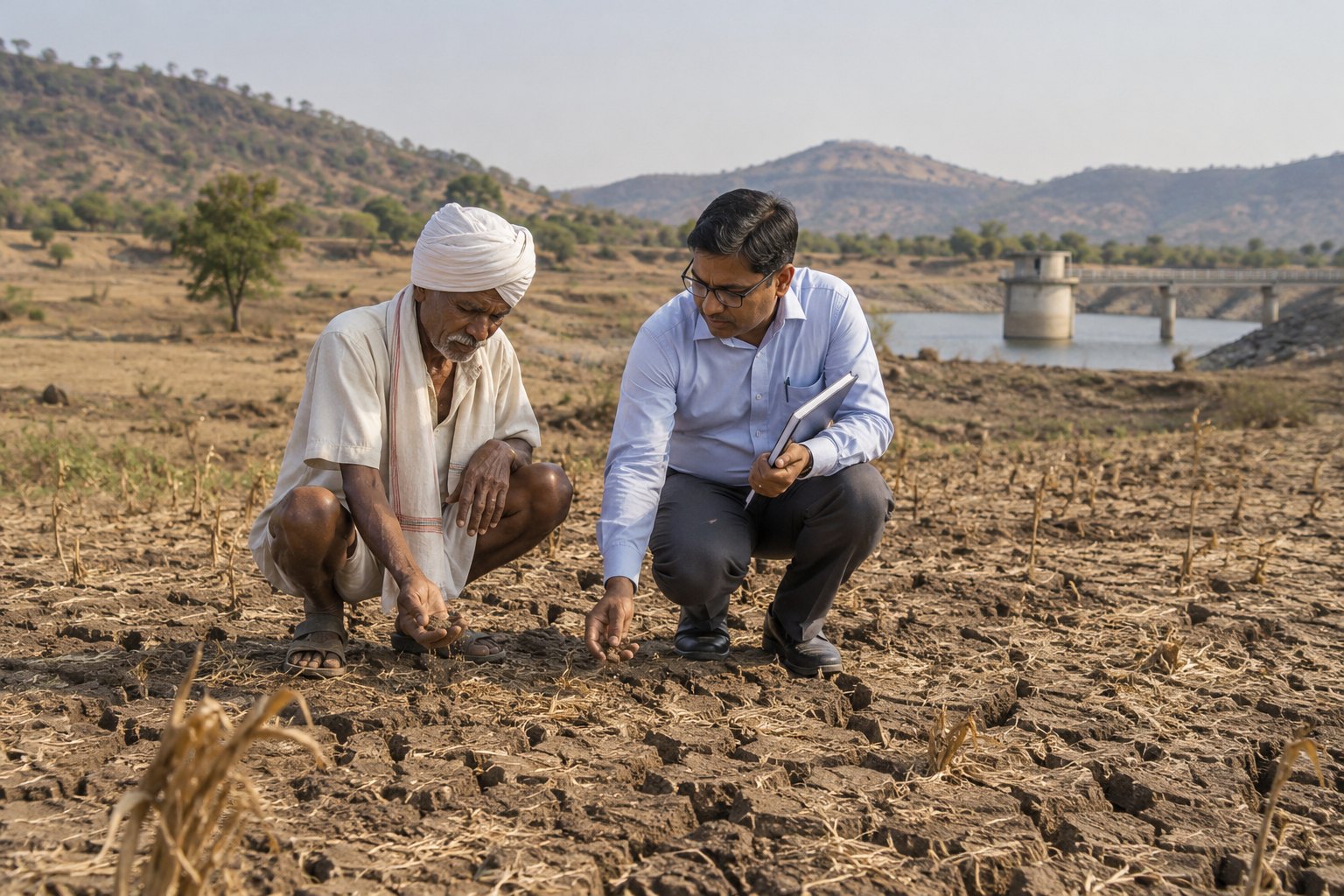
A State government declares drought by notification under the Manual for Drought Management, 2016, after a rainfall trigger, an impact trigger and field verification. Relief comes from the State Disaster Response Fund; a severe drought can also draw on the National Disaster Response Fund. A central team assessing Maharashtra's drought met the Chief Minister on 11 October 2026.
Syllabus: GS2 · Federalism & Local Government; GS3 · Agriculture & Irrigation; GS3 · Disaster Management
In short
A drought officially exists only when a State notifies it under the Manual for Drought Management, 2016; relief flows from the SDRF, with NDRF help for severe drought.
The Manual has made declaration more objective; relief will reach farmers in time only if block-level data improve and central decisions keep their deadlines.
Why it matters
A farmer whose soybean or cotton has failed gets no drought relief until the taluka or mandal is notified, so the date of the declaration decides when help arrives. After that, input subsidy is payable where crop loss is 33% or more, and the Manual tells States to pay it through Direct Benefit Transfer within a month of receiving central money and to publish the list of beneficiaries. The money is relief, not compensation for the loss, the Ministry of Home Affairs told the Rajya Sabha in March 2026. The larger issue is federal: the State carries the primary responsibility for relief, but a severe drought needs a central team's assessment before NDRF money is released.
Prelims pointers
- Disaster Management Act, 2005: Section 46 constitutes the National Disaster Response Fund; Section 48 requires each State to constitute a State Disaster Response Fund.
- SDRF: the State's first source of relief for notified disasters, drought among them. The Centre contributes 75% for most States and 90% for north-eastern and Himalayan States.
- NDRF: funded by the Centre; it supplements the SDRF for a disaster of a severe nature, after an Inter-Ministerial Central Team's assessment.
- IMD rainfall categories: normal is +19% to -19% of the Long Period Average; deficient is -20% to -59%; large deficient is -60% to -99%.
- Dry spell: three to four consecutive weeks after the due date of monsoon onset, each with less than 50% of normal rainfall.
- Standardized Precipitation Index (SPI): rainfall expressed as a standardised departure from its long-term distribution; a negative value means below-median rain. It needs at least 30 years of data.
- For drought, the agriculture department constitutes the IMCT under the Manual; for disasters generally, the Ministry of Home Affairs deploys IMCTs.
- The 15th Finance Commission recommended a two-stage assessment; the Centre runs it as the IMCT for immediate impact, then a Post-Disaster Needs Assessment (PDNA) for long-term recovery.
Practise a UPSC-style question
With reference to the declaration of drought in India, consider the following statements:
1. The Manual for Drought Management, 2016 was issued by the Ministry of Home Affairs.
2. A drought is declared by the State Government through a notification that specifies the area covered and the severity.
Which of the statements given above is/are correct?
- (a) 1 only
- (b) 2 only
- (c) Both 1 and 2
- (d) Neither 1 nor 2
Show the answer
Answer: (b) 2 only
1 is incorrect: the Manual was issued by the Department of Agriculture, Cooperation and Farmers Welfare of the Union agriculture ministry, not the Ministry of Home Affairs. 2 is correct: the State Government notifies drought, naming the administrative units and grading it moderate or severe.
More Explainers
- State Legislative Councils: Articles 168-172 and the graduates' and teachers' seats Polity
- Whales and dolphins in Indian waters: legal protection, IUCN status and strandings Environment
- The Aligarh Movement, AMU and the Article 30 minority test Polity
- Environmental clearance by States: SEIAA, SEAC and the EIA Notification, 2006 Environment
- Software vulnerabilities: CVE, CVSS, coordinated disclosure and CERT-In's role Sci-Tech
- Drug trafficking law in India: NDPS Act, PIT-NDPS, NCB and NCORD National
- Choosing the UN Secretary-General: Article 97, UNSC veto and straw polls World & IR
- UN Convention against Torture, and why India has not ratified it Polity
- NavIC: why India's navigation constellation cannot give a standalone position Sci-Tech
- International Energy Agency: membership, 90-day oil stocks and India's status World & IR
- PM Surya Ghar: Muft Bijli Yojana and the rooftop solar subsidy Economy
- HFSS foods: FSSAI's draft limits and front-of-pack warning labels National