
DAY-NULM and DJAY-S: India's urban livelihoods mission
Why in news: At least five States wrote to the Centre between July and September 2026 seeking funds to sustain urban self-help groups.
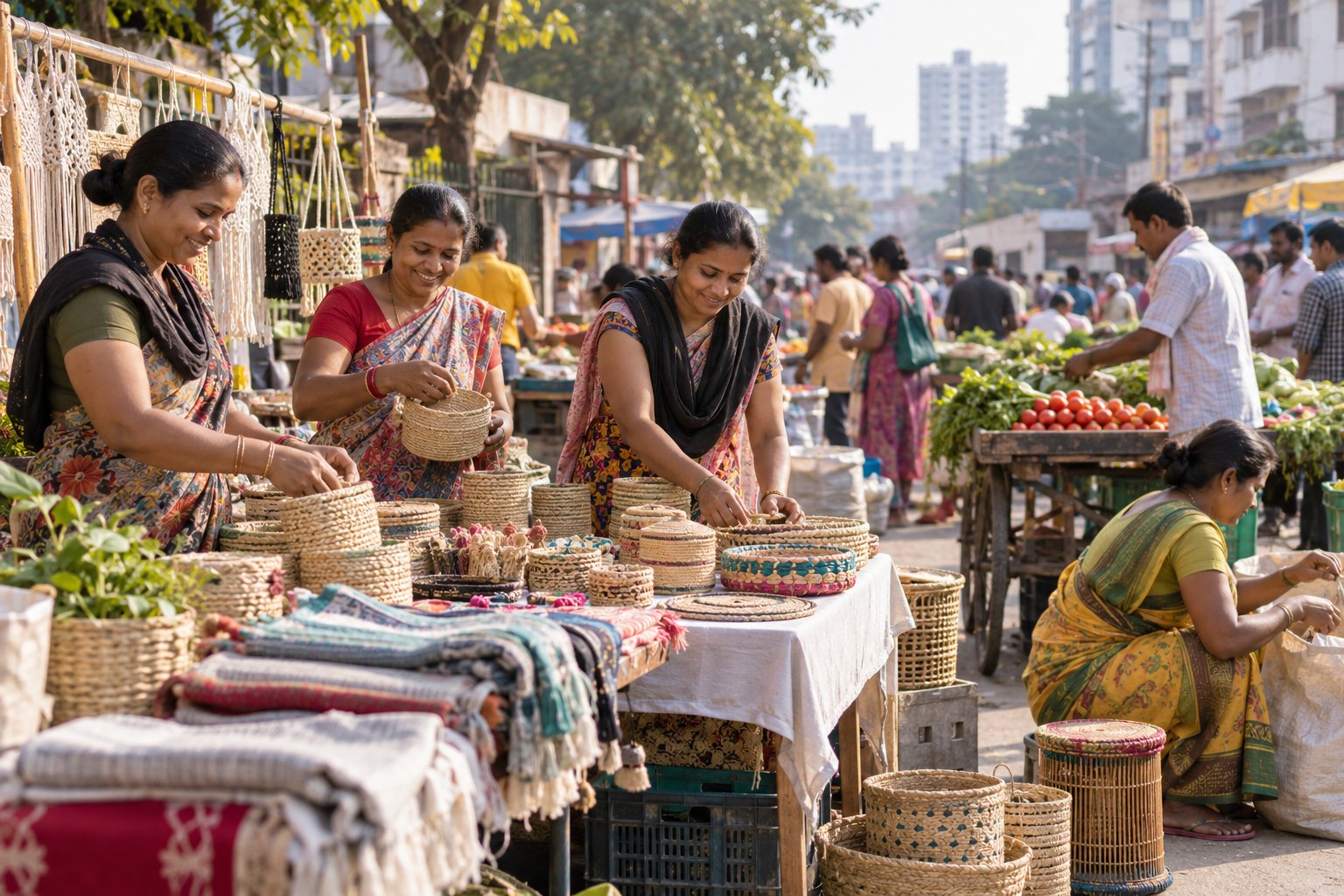
The Deendayal Antyodaya Yojana-National Urban Livelihoods Mission (DAY-NULM), a Ministry of Housing and Urban Affairs scheme, mobilised poor urban women into self-help groups and offered skills, subsidised credit, homeless shelters and street-vendor support until 30 September 2024. Its pilot successor, DJAY-S, targets six vulnerable occupational groups. States are now seeking Central funds to keep the groups running.
Syllabus: GS3 · Inclusive Growth; Prelims · Economy & Social Development; GS2 · NGOs, SHGs & Civil Society
Why this matters for UPSC
GS2 welfare schemes for vulnerable sections and the role of SHGs, and GS3 inclusive growth: Prelims can ask DAY-NULM's ministry, components and beneficiaries, or DJAY-S's six target groups; Mains, about funding a State subject through Central schemes.
In short
DAY-NULM was the Ministry of Housing and Urban Affairs' Centrally Sponsored Scheme to cut urban poverty by organising poor women into self-help groups and linking them to skills and credit.
DJAY-S should be built on DAY-NULM's women's federations, not beside them, with old dues cleared first so the urban poor keep trusting government-backed credit.
Why it matters
For a poor woman in a city, the self-help group was often her first door to a bank: savings in a group account, a group loan, then a loan of her own at a lower rate. When Central money stops, the subsidy on loans already taken goes unpaid, the workers who keep group books and bank links lose their salaries, and federations built over a decade can weaken. The successor's turn to gig, care, domestic and other workers matters as well: it moves urban anti-poverty policy from the household to the job, where unsafe work and irregular pay arise. The larger issue is how a State subject is financed when States depend on Central schemes.
Prelims pointers
- DAY-NULM funding: 60:40 between Centre and most States, 90:10 for the North Eastern and Himalayan States, and fully Central for Union Territories.
- A revolving fund of Rs 10,000 went to an SHG with over 70% urban poor members, and Rs 50,000 to a registered Area Level Federation.
- SEP project cost ceilings were Rs 2 lakh for an individual enterprise and Rs 10 lakh for a group enterprise, with no collateral beyond the enterprise.
- Women's SHGs repaying on time got a further 3% interest subvention, bringing their effective rate down to 4%.
- SUH norm: permanent shelter for at least 100 persons per one lakh urban population, with priority to million-plus cities of Census 2011.
- Under SUSV, cities prepare a City Street Vending Plan under the Street Vendors (Protection of Livelihood and Regulation of Street Vending) Act, 2014.
- EST&P and SEP set aside at least 30% of beneficiaries for women, 15% of targets for minorities and 3% for the differently-abled.
- PM SVANidhi, a separate Central Sector Scheme of the same Ministry since June 2020, gives street vendors collateral-free working capital loans.
Practise a UPSC-style question
With reference to the Deendayal Antyodaya Yojana-National Urban Livelihoods Mission (DAY-NULM), consider the following statements:
1. It was implemented by the Ministry of Housing and Urban Affairs in the statutory towns of the country.
2. Its Self-Employment Programme was run as a Central Sector Scheme, fully funded by the Centre.
3. Its Scheme of Shelter for Urban Homeless aimed at permanent, all-weather shelters with essential services.
Which of the statements given above is/are correct?
- (a) 1 and 2 only
- (b) 2 and 3 only
- (c) 1 and 3 only
- (d) 1, 2 and 3
Show the answer
Answer: (c) 1 and 3 only
Answer: (c) 1 and 3 only. DAY-NULM was a Centrally Sponsored Scheme, so no part of it was a Central Sector Scheme.
Statement 1: correct. The Ministry of Housing and Urban Affairs implemented DAY-NULM in the statutory towns to reduce poverty and vulnerability of urban poor households.
Statement 2: incorrect. DAY-NULM, its Self-Employment Programme included, was a Centrally Sponsored Scheme, with costs shared 60:40 between the Centre and most States.
Statement 3: correct. The Scheme of Shelter for Urban Homeless sought permanent, all-weather, round-the-clock shelters with water, sanitation and other essential services.
Eliminate: Be sure of statement 2 first: a Centrally Sponsored Scheme shares its costs with the States, so it is incorrect. Out: (a), (b), (d).
Trap: Swapped attribution. PM SVANidhi, the same Ministry's Central Sector Scheme for street vendors, tempts a student to give its funding form to DAY-NULM's Self-Employment Programme.
Remember: DAY-NULM: Centrally Sponsored, MoHUA. PM SVANidhi: Central Sector, MoHUA.
More Explainers
- State Legislative Councils: Articles 168-172 and the graduates' and teachers' seats Polity
- Whales and dolphins in Indian waters: legal protection, IUCN status and strandings Environment
- The Aligarh Movement, AMU and the Article 30 minority test Polity
- Environmental clearance by States: SEIAA, SEAC and the EIA Notification, 2006 Environment
- Software vulnerabilities: CVE, CVSS, coordinated disclosure and CERT-In's role Sci-Tech
- Drug trafficking law in India: NDPS Act, PIT-NDPS, NCB and NCORD National
- Choosing the UN Secretary-General: Article 97, UNSC veto and straw polls World & IR
- UN Convention against Torture, and why India has not ratified it Polity
- NavIC: why India's navigation constellation cannot give a standalone position Sci-Tech
- International Energy Agency: membership, 90-day oil stocks and India's status World & IR
- PM Surya Ghar: Muft Bijli Yojana and the rooftop solar subsidy Economy
- HFSS foods: FSSAI's draft limits and front-of-pack warning labels National