
DAY-NRLM: how rural women's self-help groups are organised, financed, marketed
Why in news: A PIB backgrounder of 21 October 2026 set out the National SARAS Mela at Vijayawada, 13-31 October, the first held outside Delhi-NCR.
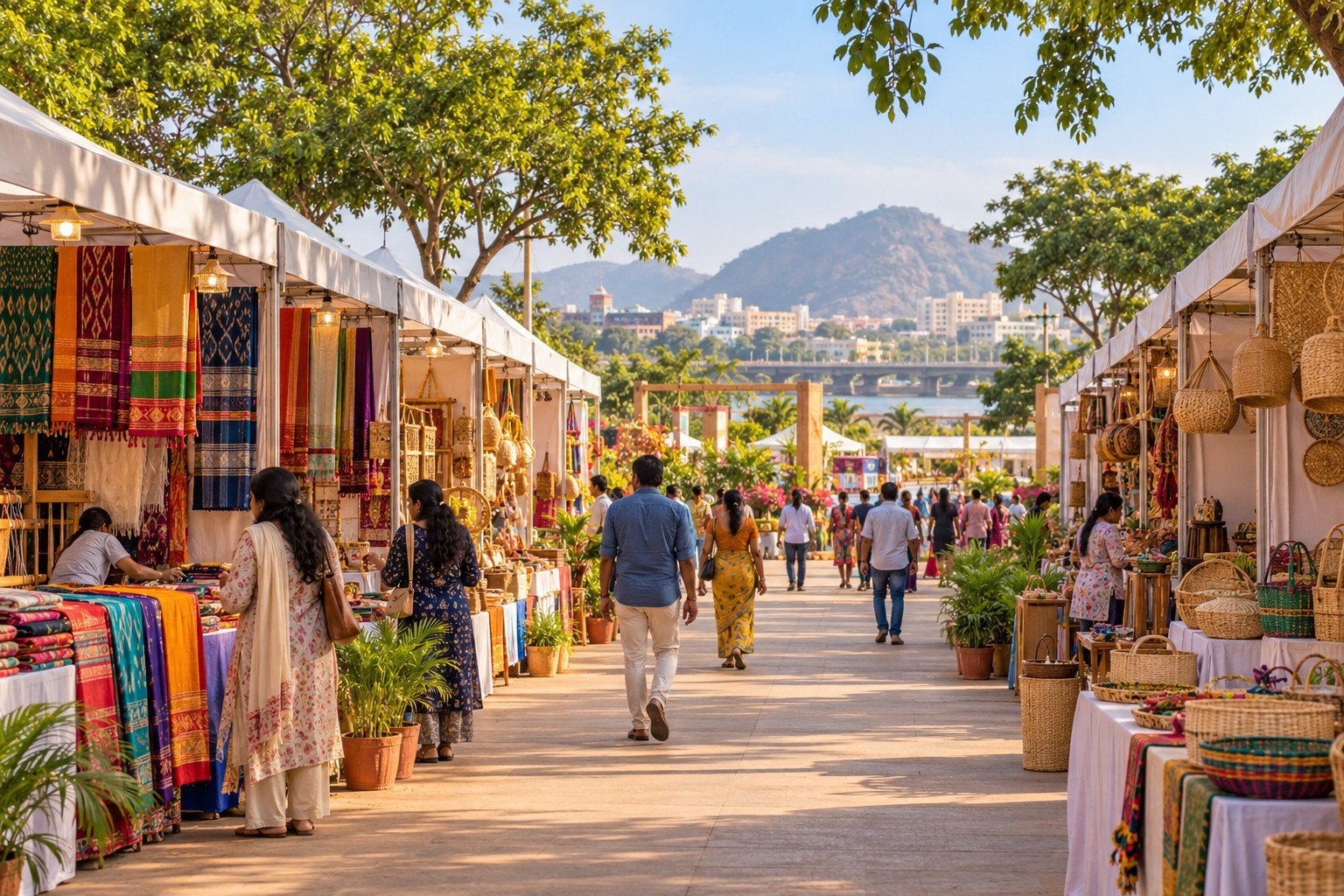
The Deendayal Antyodaya Yojana-National Rural Livelihoods Mission (DAY-NRLM) is the Ministry of Rural Development's centrally sponsored scheme that organises poor rural women into self-help groups, federates them, links them to bank credit and helps them sell. It is in the news as Vijayawada hosts the first National SARAS Mela outside Delhi-NCR, from 13 to 31 October 2026.
Syllabus: GS3 · Inclusive Growth; GS1 · Women, Population & Urbanisation; GS2 · NGOs, SHGs & Civil Society
Why this matters for UPSC
GS2 asks about welfare schemes and the role of SHGs, and GS3 about inclusive growth. Prelims can ask DAY-NRLM's ministry, its federations, the Revolving Fund and Community Investment Fund, SVEP and the Lakhpati Didi definition.
In short
DAY-NRLM, the Ministry of Rural Development's centrally sponsored mission, fights rural poverty by turning poor women into federated self-help groups that save, borrow and sell together.
DAY-NRLM has built the institutions and the credit; its test now is turning women's livelihoods into enterprises with steady, year-round markets.
Why it matters
A poor rural woman who joins a self-help group gets a safe place to save small sums and to borrow from her group. Once the group shows it repays, a bank lends to it without collateral, and that money can buy a cow, a sewing machine or stock for a village shop. The harder step is selling: a weaver in a village rarely meets buyers in a city. Fairs and online stores bring those buyers to her, and steady sales are what turn a loan into a lasting income. The larger question is whether credit-led livelihoods can grow into real enterprises that keep households out of poverty for good.
Prelims pointers
- Lakhpati Didi: an SHG member whose household earns at least Rs 1 lakh a year, sustained over at least four agricultural seasons or business cycles.
- Start-up Village Entrepreneurship Programme (SVEP): DAY-NRLM sub-scheme lending to rural entrepreneurs from a Community Enterprise Fund, with business support from CRP-EP cadres.
- National Rural Economic Transformation Project (NRETP): externally aided project under DAY-NRLM, approved by the Union Cabinet in 2019 with a World Bank (IBRD) loan.
- 'Saras', 'Saras Aajeevika' and 'Aajeevika' are brands registered by the Ministry of Rural Development; 25 States run their own SHG brands, such as UMED of Maharashtra.
- Aajeevika Grameen Express Yojana (AGEY): lets SHG members or community-based organisations own and operate vehicles for rural transport in remote villages.
- LokOS: DAY-NRLM's digital platform; community cadres record household income in the Digital Aajeevika Register, verified at block level, to certify Lakhpati Didis.
- Self-Help Entrepreneur Mart (SHE-Mart): announced in the Union Budget 2026-27 as community-owned retail spaces for SHG women, aiming to benefit 1 crore women.
Practise a UPSC-style question
With reference to the Deendayal Antyodaya Yojana-National Rural Livelihoods Mission (DAY-NRLM), consider the following statements:
1. It was created by restructuring the Swarnajayanti Grameen Swarojgar Yojana and renamed DAY-NRLM in 2019.
2. It is a centrally sponsored scheme funded jointly by the Centre and the States.
3. Its self-help groups federate into Village Organisations, which in turn form Cluster Level Federations.
Which of the statements given above is/are correct?
- (a) 1 and 2 only
- (b) 2 and 3 only
- (c) 1 and 3 only
- (d) 1, 2 and 3
Show the answer
Answer: (b) 2 and 3 only
Answer: (b) 2 and 3 only. The Mission's funding and federation structure are right; the renaming year is not.
Statement 1: incorrect. NRLM came from restructuring SGSY, but it was renamed DAY-NRLM in 2016, not 2019, per PIB.
Statement 2: correct. PIB describes DAY-NRLM as a centrally sponsored scheme jointly funded by the central and State governments.
Statement 3: correct. SHGs are federated into Village Organisations (VOs) and these into Cluster Level Federations (CLFs).
Eliminate: statement 3 is the Mission's best-known design, so it is correct. Out: (a).
Eliminate: statement 1 has the wrong renaming year. Out: (c), (d).
Trap: Near-miss figure. The SGSY link is true, so a student may accept the whole statement without checking the year 2016.
Remember: NRLM 2010 from SGSY; renamed DAY-NRLM in 2016; SHG to VO to CLF.
More Explainers
- State Legislative Councils: Articles 168-172 and the graduates' and teachers' seats Polity
- Whales and dolphins in Indian waters: legal protection, IUCN status and strandings Environment
- The Aligarh Movement, AMU and the Article 30 minority test Polity
- Environmental clearance by States: SEIAA, SEAC and the EIA Notification, 2006 Environment
- Software vulnerabilities: CVE, CVSS, coordinated disclosure and CERT-In's role Sci-Tech
- Drug trafficking law in India: NDPS Act, PIT-NDPS, NCB and NCORD National
- Choosing the UN Secretary-General: Article 97, UNSC veto and straw polls World & IR
- UN Convention against Torture, and why India has not ratified it Polity
- NavIC: why India's navigation constellation cannot give a standalone position Sci-Tech
- International Energy Agency: membership, 90-day oil stocks and India's status World & IR
- PM Surya Ghar: Muft Bijli Yojana and the rooftop solar subsidy Economy
- HFSS foods: FSSAI's draft limits and front-of-pack warning labels National