
Critical minerals, rare earths and the National Critical Mineral Mission
Why in news: On 16 October 2026 the World Bank announced a goal to quintuple its critical-minerals business in five years: USD 19 billion over FY2026-30, per Reuters.
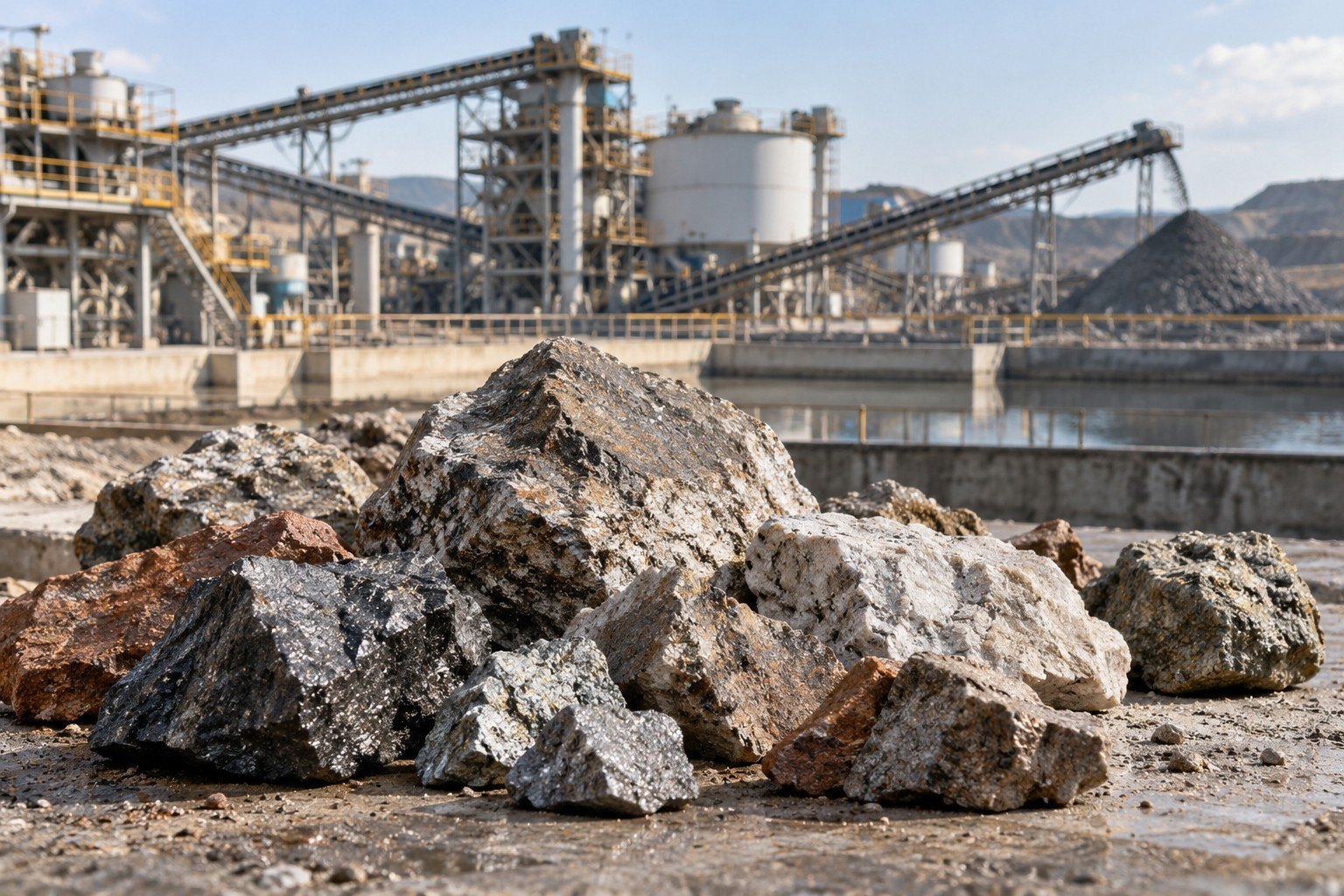
Critical minerals are minerals of high economic importance whose supply is at risk; the Ministry of Mines listed 30 for India in June 2023, rare earth elements among them. The MMDR Amendment Act, 2023 lets the Centre auction them. On 16 October 2026 World Bank President Ajay Banga set a goal to quintuple the Bank's critical-minerals business within five years.
Syllabus: GS3 · Liberalisation & Industry; GS3 · Infrastructure; GS1 · Resources & Industry Location
Why this matters for UPSC
Critical minerals sit in GS3 (resources, industrial policy, energy security) and GS2 (international groupings). Prelims asks Part D of the MMDR Act, KABIL's promoters, monazite and the Minerals Security Partnership; Mains asks about import dependence on rare earth permanent magnets.
In short
Critical minerals are minerals of high economic importance and high supply risk; the Ministry of Mines' 2023 list of 30 anchors India's policy for clean energy and defence.
India now has the list, the law and the mission; its mineral security will turn on building processing and magnet capacity without diluting environmental safeguards.
Why it matters
A two-wheeler maker, a wind-turbine factory and a smartphone assembler all need small amounts of lithium, cobalt or rare earth magnets, and India buys most of them abroad. When one supplier country slows exports, Indian factories can stall, prices rise and jobs suffer. Mining more at home cuts that risk, but only if the ore is also processed here, which needs plants, skills and years of investment. It can also bring mining into new forests and coastal areas, so the people living there need a say and a share. The larger question is whether India can meet its 2070 net-zero goal on its own supply chain or will swap dependence on imported oil for dependence on imported minerals.
Prelims pointers
- MMDR Act, 1957, First Schedule: Part B lists atomic minerals, mined only through PSUs; Part D lists critical and strategic minerals auctioned by the Centre.
- Part D's rare earths are those not containing uranium and thorium; thorium-bearing monazite falls to the Department of Atomic Energy's AMD and IREL.
- Exploration licence: covers 29 minerals in the Seventh Schedule; the bidder quoting the lowest share of the future mining lessee's auction premium wins.
- KABIL's promoters: National Aluminium Company (NALCO), Hindustan Copper Limited and Mineral Exploration and Consultancy Limited (MECL), all CPSEs under the Ministry of Mines.
- IREL (India) Limited: formerly Indian Rare Earths Limited, under DAE since 1963; Rare Earth Extraction Plant in Odisha, refining unit at Aluva, Kerala.
- Atomic Minerals Directorate for Exploration and Research (AMD): a constituent unit of the Department of Atomic Energy that maps rare earth and atomic mineral resources.
- Minerals Security Partnership members include the United States, Australia, Canada, Japan, Republic of Korea, the United Kingdom and the European Commission; India joined as the 14th.
- India's list counts REE as 17 elements: the 15 lanthanides, from lanthanum to lutetium, plus scandium and yttrium.
Practise a UPSC-style question
With reference to the Mines and Minerals (Development and Regulation) Amendment Act, 2023, consider the following statements:
1. It empowers the Central Government to auction mining leases and composite licences for the critical minerals listed in Part D of the First Schedule.
2. The auction premium from such blocks accrues to the Central Government.
3. It removed lithium, beryllium and zirconium bearing minerals from the list of atomic minerals.
Which of the statements given above is/are correct?
- (a) 1 and 2 only
- (b) 2 and 3 only
- (c) 1 and 3 only
- (d) 1, 2 and 3
Show the answer
Answer: (c) 1 and 3 only
Answer: (c) 1 and 3 only. The Centre runs Part D auctions, but the State keeps the money.
Statement 1: correct. The 2023 amendment lets the Central Government exclusively auction mining leases and composite licences for Part D critical minerals.
Statement 2: incorrect. The State Government grants the lease and continues to receive the auction premium and other statutory payments.
Statement 3: correct. Six minerals left Part B's atomic list: those of lithium, beryllium, titanium, niobium, tantalum and zirconium.
Eliminate: statement 2 is the surest, because the revenue stays with the States. Out: (a), (b), (d).
Trap: Swapped attribution. The Centre conducts the auction, so the question pins the revenue on the Centre too.
Remember: Centre auctions Part D minerals; the State grants the lease and keeps the premium.
More Explainers
- State Legislative Councils: Articles 168-172 and the graduates' and teachers' seats Polity
- Whales and dolphins in Indian waters: legal protection, IUCN status and strandings Environment
- The Aligarh Movement, AMU and the Article 30 minority test Polity
- Environmental clearance by States: SEIAA, SEAC and the EIA Notification, 2006 Environment
- Software vulnerabilities: CVE, CVSS, coordinated disclosure and CERT-In's role Sci-Tech
- Drug trafficking law in India: NDPS Act, PIT-NDPS, NCB and NCORD National
- Choosing the UN Secretary-General: Article 97, UNSC veto and straw polls World & IR
- UN Convention against Torture, and why India has not ratified it Polity
- NavIC: why India's navigation constellation cannot give a standalone position Sci-Tech
- International Energy Agency: membership, 90-day oil stocks and India's status World & IR
- PM Surya Ghar: Muft Bijli Yojana and the rooftop solar subsidy Economy
- HFSS foods: FSSAI's draft limits and front-of-pack warning labels National