
Consumer Price Index and the RBI's flexible inflation target
Why in news: Official data released on 12 October 2026 put September CPI inflation at 5.5%, the highest since October 2024, with food and beverages at 7.4%.
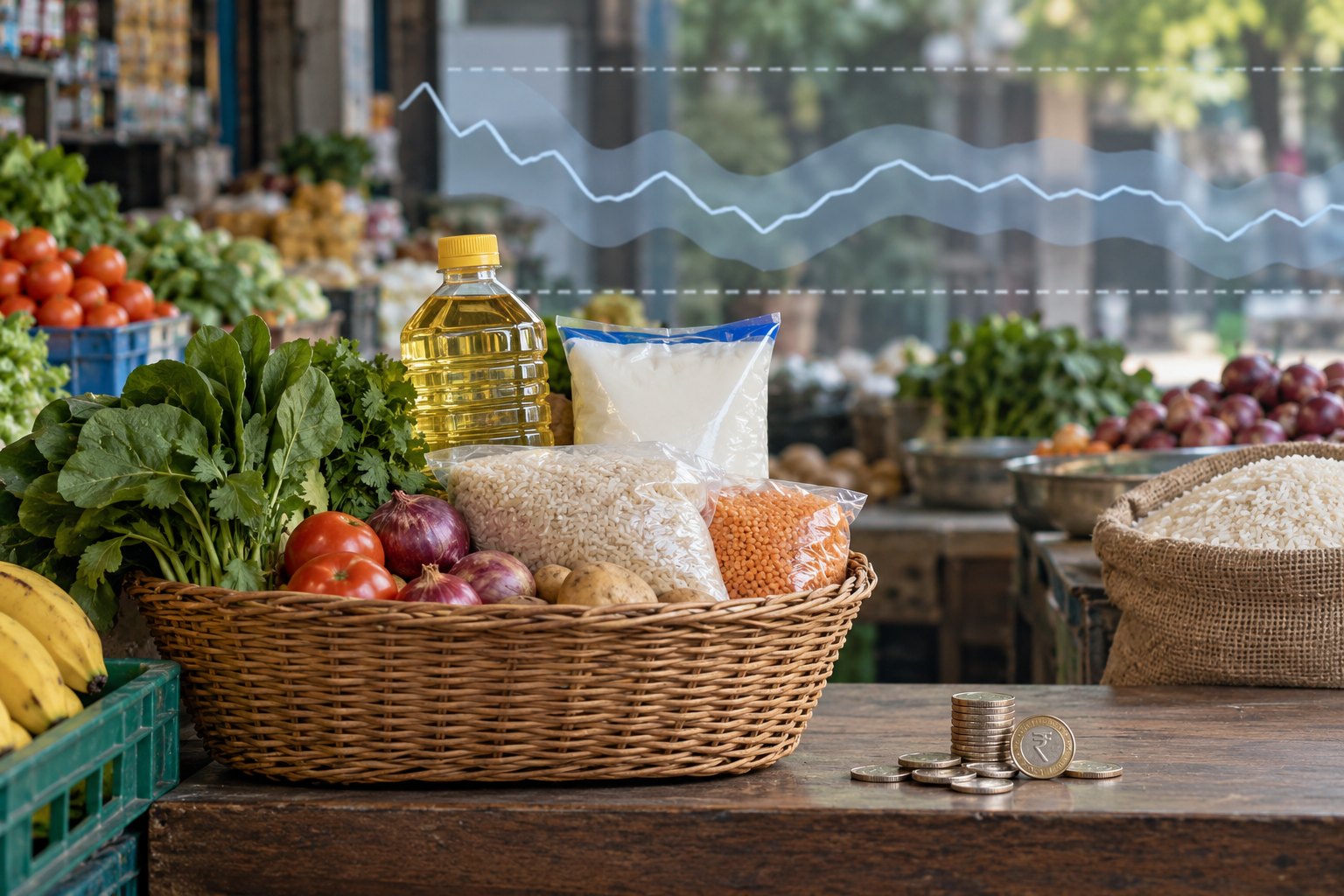
The Consumer Price Index (CPI), compiled by the National Statistics Office under the Ministry of Statistics and Programme Implementation, measures retail price change for rural, urban and combined India, on base 2024=100 since February 2026. The RBI targets 4% CPI inflation within a 2-6% band. Official data released on 12 October 2026 put September inflation at 5.5%.
Syllabus: GS3 · Indian Economy & Growth; Prelims · Economy & Social Development
Why this matters for UPSC
GS3, Indian economy: inflation and monetary policy. Prelims asks who compiles the Consumer Price Index, what the 2024 base changed and what Section 45ZA provides; Mains asks how well flexible inflation targeting and the Monetary Policy Committee work.
In short
The Consumer Price Index, compiled by MoSPI's National Statistics Office, measures retail price change; under Section 45ZA of the RBI Act, 1934, it anchors a 4% inflation target.
The 2024 base makes the CPI a truer yardstick; the target's credibility now rests on telling supply-driven food spikes from demand pressure before raising rates.
Why it matters
A family's spending on groceries, rent, fuel, fees and phone bills is what the CPI tracks, and its reading feeds into what that family pays to borrow. When CPI inflation climbs toward 6%, the Monetary Policy Committee is more likely to raise the repo rate, which pushes up loan and EMI costs and cools demand; the committee raised rates in early October 2026. The 2024 base matters because the old basket gave food too much weight and missed newer spending such as streaming and rural rent, so a price rise is now measured against what households really buy. If inflation stays above 6% for three straight quarters, the RBI must tell the Centre why, what it will do and by when.
Prelims pointers
- Section 45ZA, RBI Act, 1934: the Central Government, in consultation with the RBI, fixes the CPI inflation target once in five years and notifies it in the Official Gazette.
- Failure to meet the target: average inflation above 6% or below 2% for any three consecutive quarters; the RBI then reports reasons, remedial action and a time-frame.
- Section 45ZB: the Central Government constitutes the six-member MPC; the RBI Governor chairs it with a casting vote; quorum is four; it meets at least four times a year.
- The MPC fixes the policy repo rate; the operating target of monetary policy is the weighted average call rate (WACR).
- The target index is CPI (Combined); the 4% (2-6%) target followed the 2014 recommendation of the Urjit Patel committee on the monetary policy framework.
- New in CPI 2024: rural house rent, OTT streaming services, e-commerce prices in 12 towns of over 25 lakh people, and Computer Assisted Personal Interviewing.
- COICOP 2018 is the United Nations Statistics Division's classification of individual consumption by purpose.
Practise a UPSC-style question
With reference to the Consumer Price Index with base 2024=100, consider the following statements:
1. The share of food and beverages in its basket is higher than in the CPI 2012 series.
2. Its item basket and weights are drawn from the Household Consumption Expenditure Survey 2023-24.
3. It classifies items into 12 divisions under the COICOP 2018 framework of the United Nations Statistics Division.
Which of the statements given above is/are correct?
- (a) 1 and 2 only
- (b) 2 and 3 only
- (c) 1 and 3 only
- (d) 1, 2 and 3
Show the answer
Answer: (b) 2 and 3 only
1 is incorrect: the food and beverages weight fell from 45.86% in the 2012 series to 36.75%, though it remains the largest division. 2 is correct: MoSPI took the basket and weights from HCES 2023-24. 3 is correct: COICOP 2018, developed by the UN Statistics Division, replaced the six groups of the old series with 12 divisions.
More Explainers
- State Legislative Councils: Articles 168-172 and the graduates' and teachers' seats Polity
- Whales and dolphins in Indian waters: legal protection, IUCN status and strandings Environment
- The Aligarh Movement, AMU and the Article 30 minority test Polity
- Environmental clearance by States: SEIAA, SEAC and the EIA Notification, 2006 Environment
- Software vulnerabilities: CVE, CVSS, coordinated disclosure and CERT-In's role Sci-Tech
- Drug trafficking law in India: NDPS Act, PIT-NDPS, NCB and NCORD National
- Choosing the UN Secretary-General: Article 97, UNSC veto and straw polls World & IR
- UN Convention against Torture, and why India has not ratified it Polity
- NavIC: why India's navigation constellation cannot give a standalone position Sci-Tech
- International Energy Agency: membership, 90-day oil stocks and India's status World & IR
- PM Surya Ghar: Muft Bijli Yojana and the rooftop solar subsidy Economy
- HFSS foods: FSSAI's draft limits and front-of-pack warning labels National