
Connectivity infrastructure in Jammu and Kashmir: rail, roads and air
Why in news: PIB's explainer of 17 October 2026, Connecting Kashmir: Building the Infrastructure for Growth, reviewed the region's rail, road, air and cargo links.
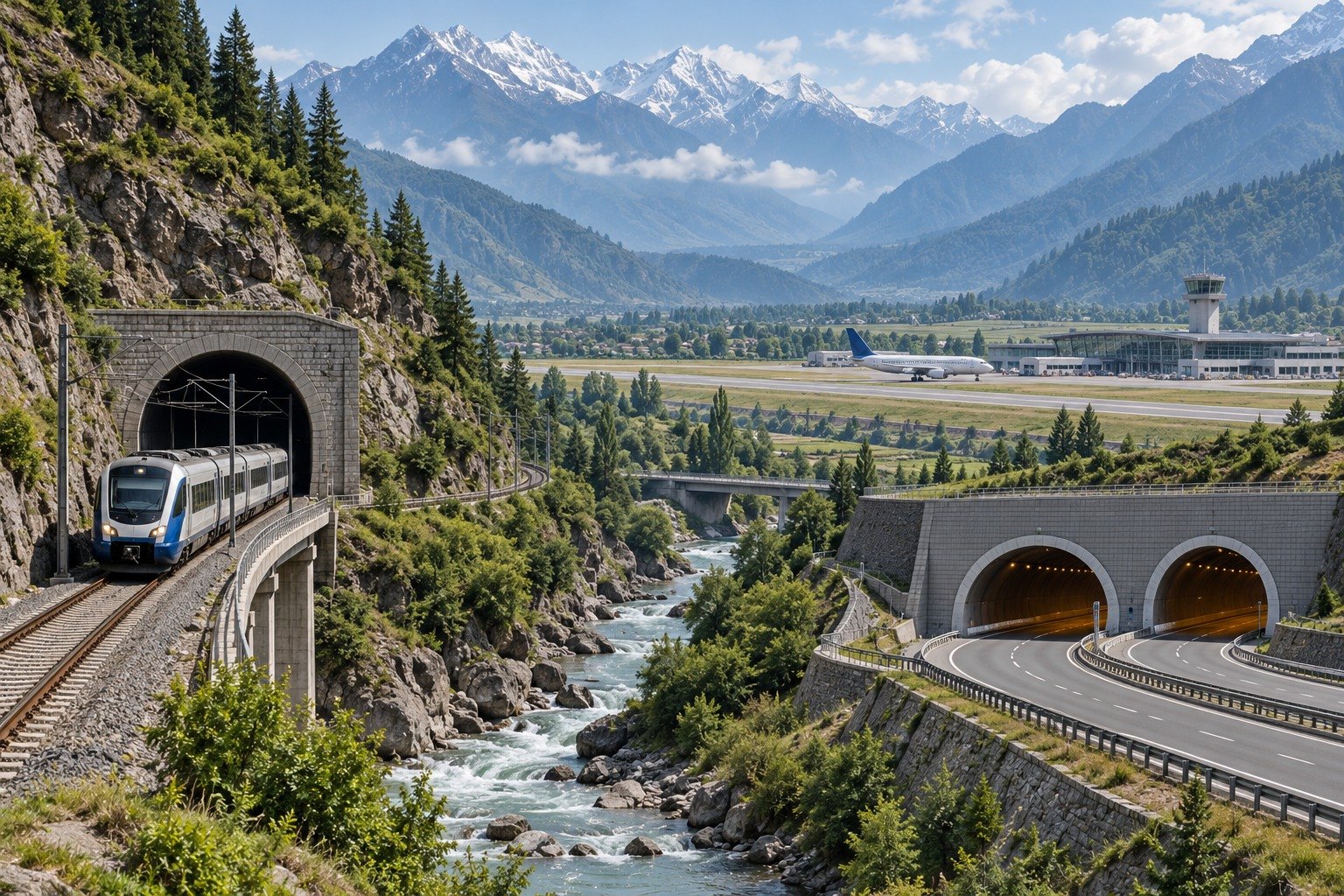
Jammu and Kashmir's connectivity rests on the 272-km Udhampur-Srinagar-Baramulla Rail Link, the Sonamarg (Z-Morh) road tunnel with the Zojila Tunnel being built towards Ladakh, Srinagar's expanding airport and UDAN airports planned at Udhampur and Kishtwar. Freight terminals carry the region's produce outward. A PIB explainer of 17 October 2026 reviewed how these links now work as one network.
Syllabus: Prelims · Geography; GS3 · Infrastructure; GS3 · Border Security & Organised Crime
Why this matters for UPSC
GS3 infrastructure (railways, roads, airports) and border-area security: Prelims can ask about the Chenab and Anji Khad bridges, Tunnel T50, the Zojila Tunnel and UDAN; Mains, about building in the Himalayas and connectivity as national integration.
In short
Connectivity in Jammu and Kashmir means all-weather rail, road and air links across Himalayan terrain that once cut the Kashmir Valley off each winter.
Connectivity in Jammu and Kashmir now works as one network; its value will rest on finishing strategic links and building for Himalayan hazards.
Why it matters
An apple grower in the Valley, a pilgrim heading to Katra and a soldier posted in Ladakh all depend on roads that snow, avalanches and landslides often closed. A train that runs through winter, and tunnels that avoid the worst passes, mean produce reaches distant markets before it spoils, tourists can come in every season, and supplies reach border areas on time. The larger issue is national integration: a region that is physically cut off stays economically marginal, while dependable links draw it into the country's markets, jobs and services.
Prelims pointers
- Chenab Rail Bridge, Reasi district: 1,315 m long, a 467 m arch span, 359 m above the riverbed; PIB calls it the world's highest railway arch bridge.
- Anji Khad bridge, Reasi district: India's first cable-stayed railway bridge per PIB, over the Anji, a tributary of the Chenab, with a 193 m inverted-Y pylon.
- Tunnel T50: 12.77 km between Khari and Sumber, India's longest transportation tunnel per PIB; escape tunnel linked every 375 m.
- Dr Syama Prasad Mookerjee Tunnel (9 km, opened 2017) links Udhampur and Ramban; PIB calls it India's longest operating highway tunnel.
- Sonamarg (Z-Morh) tunnel: 6.4 km at 2,634 m above sea level, giving Srinagar-Sonamarg all-weather access en route to Leh.
- UDAN, launched on 21 October 2016 under the National Civil Aviation Policy 2016: airlines bid for routes, the lowest-subsidy bid wins, and Viability Gap Funding covers capped fares.
- PMGSY-IV (FY 2024-25 to 2028-29) connects habitations of 250+ people in hill States and UTs; its roads are aligned on the PM Gati Shakti portal.
- PM Gati Shakti National Master Plan (October 2021) is a GIS-based platform spanning 44 Central Ministries and 36 States and UTs.
Practise a UPSC-style question
With reference to railway bridges on the Udhampur-Srinagar-Baramulla Rail Link, consider the following statements:
1. The Chenab Rail Bridge in Reasi district is described by the government as the world's highest railway arch bridge.
2. The Anji Khad bridge, India's first cable-stayed railway bridge, spans a gorge of a tributary of the Jhelum.
Which of the statements given above is/are correct?
- (a) 1 only
- (b) 2 only
- (c) Both 1 and 2
- (d) Neither 1 nor 2
Show the answer
Answer: (a) 1 only
Answer: (a) 1 only. The Chenab bridge claim is right, but the Anji is a tributary of the Chenab, not the Jhelum.
Statement 1: correct. The Chenab bridge in Reasi rises 359 m above the riverbed with a 467 m arch span; PIB calls it the world's highest railway arch bridge.
Statement 2: incorrect. The Anji Khad bridge, India's first cable-stayed rail bridge per PIB, crosses the gorge of the Anji river, a tributary of the Chenab.
Eliminate: statement 2 names the wrong parent river, so it is incorrect. Out: (b), (c).
Eliminate: statement 1 matches PIB's description of the Chenab bridge. Out: (d).
Trap: Look-alike names. The statement swaps the Anji's parent river, the Chenab, for the Jhelum, a river name that reads naturally in a Jammu and Kashmir question.
Remember: Chenab = highest railway arch bridge; Anji Khad = first cable-stayed rail bridge, on a Chenab tributary.
More Explainers
- State Legislative Councils: Articles 168-172 and the graduates' and teachers' seats Polity
- Whales and dolphins in Indian waters: legal protection, IUCN status and strandings Environment
- The Aligarh Movement, AMU and the Article 30 minority test Polity
- Environmental clearance by States: SEIAA, SEAC and the EIA Notification, 2006 Environment
- Software vulnerabilities: CVE, CVSS, coordinated disclosure and CERT-In's role Sci-Tech
- Drug trafficking law in India: NDPS Act, PIT-NDPS, NCB and NCORD National
- Choosing the UN Secretary-General: Article 97, UNSC veto and straw polls World & IR
- UN Convention against Torture, and why India has not ratified it Polity
- NavIC: why India's navigation constellation cannot give a standalone position Sci-Tech
- International Energy Agency: membership, 90-day oil stocks and India's status World & IR
- PM Surya Ghar: Muft Bijli Yojana and the rooftop solar subsidy Economy
- HFSS foods: FSSAI's draft limits and front-of-pack warning labels National