
Coir, the Coir Board and the Coir Vikas Yojana
Why in news: On 14 October 2026 the Ministry of MSME issued a backgrounder on the coir sector, putting FY 2025-26 coir exports at Rs 6,614.40 crore.
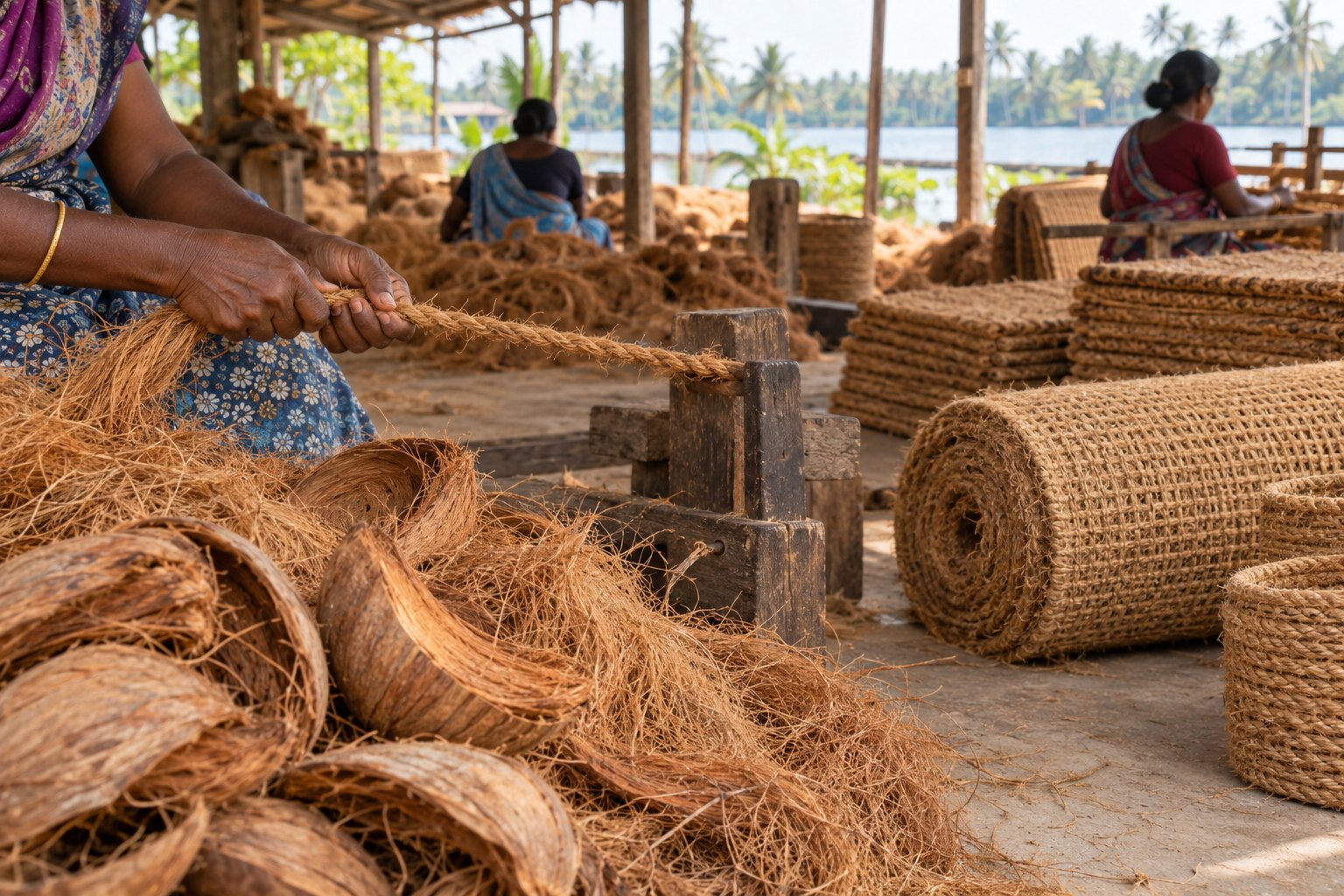
Coir, the fibre of coconut husk, ends up as rope, matting and road fabric. The Coir Board, a statutory body under the Ministry of MSME, steers the industry, and the Ministry's Coir Vikas Yojana funds its technology, training and markets. A ministry backgrounder of 14 October 2026 put FY 2025-26 exports at Rs 6,614.40 crore.
Syllabus: GS3 · Indian Economy & Growth; GS3 · Inclusive Growth; GS1 · Women, Population & Urbanisation
Why this matters for UPSC
GS3 Indian economy and GS1 women's work: Prelims can ask the Coir Board's statute, parent ministry and headquarters, the Coir Vikas Yojana's type and components, or coir geotextiles' uses; Mains, on reviving traditional rural industries.
In short
Coir is the natural fibre of the coconut's outer husk. The Coir Board, a statutory body under the Coir Industry Act, 1953, develops this rural industry, whose workforce is mostly women.
Coir's growth should rest on higher-value products such as geotextiles and pith while the rural women who spin the fibre gain skills and steady wages.
Why it matters
Coir work is done mostly by women in coastal villages who spin husk fibre into yarn or weave mats at home or in small units. When a coir unit gets a better spinning machine or a buyer abroad, those women earn steadier wages without leaving their village. Coir also turns a waste product into income: husks that would rot or be burnt become rope, fertiliser or road material. Coir geotextiles hold soil on slopes and under roads and are made of a natural fibre, so they offer a green alternative to synthetic materials in rural works. The larger issue is how India keeps a traditional, labour-heavy rural industry alive by moving it towards higher-value, greener products.
Prelims pointers
- Coir Board headquarters: Coir House, M.G. Road, Kochi, Kerala; its research institutes include the Central Coir Research Institute, Kalavoor, and the Central Institute of Coir Technology, Bengaluru.
- Coir Industry Act, 1953 functions of the Board: research, modernisation, quality improvement, human resource development, market promotion and welfare of coir workers.
- Coir Vikas Yojana components (Ministry of MSME): Science and Technology, Skill Upgradation and Mahila Coir Yojana, Export and Domestic Market Promotion, Welfare Measures.
- Indian Roads Congress has accredited coir geotextiles as a material for road construction.
- PMGSY new-technology guidelines (May 2013): States propose at least 15% of annual road length with new technologies, coir geotextiles among them.
- Eco Mark: coir products have gained this Government of India eco-label for environment-friendly products, per the Ministry of MSME.
Practise a UPSC-style question
With reference to the Coir Board, consider the following statements:
1. It is a statutory body set up under the Coir Industry Act, 1953.
2. It functions under the administrative control of the Ministry of Textiles.
3. Its headquarters is located at Kochi in Kerala.
Which of the statements given above is/are correct?
- (a) 1 and 2 only
- (b) 2 and 3 only
- (c) 1 and 3 only
- (d) 1, 2 and 3
Show the answer
Answer: (c) 1 and 3 only
Answer: (c) 1 and 3 only. The Board is statutory and sits in Kochi, but its parent ministry is MSME.
Statement 1: correct. The Coir Industry Act, 1953 created the Coir Board to develop the coir industry and its workers' welfare.
Statement 2: incorrect. The Coir Board works under the Ministry of Micro, Small and Medium Enterprises, not the Ministry of Textiles.
Statement 3: correct. Its headquarters is Coir House on M.G. Road, Kochi, Kerala.
Eliminate: Statement 2 is the surest: coir, like khadi, is an MSME subject. Out: (a), (b), (d).
Trap: Swapped attribution. Coir is a fibre, so the question pins the Board on the Ministry of Textiles, which handles jute and silk boards instead.
Remember: Coir Board: Coir Industry Act, 1953; Ministry of MSME; Kochi.
More Explainers
- State Legislative Councils: Articles 168-172 and the graduates' and teachers' seats Polity
- Whales and dolphins in Indian waters: legal protection, IUCN status and strandings Environment
- The Aligarh Movement, AMU and the Article 30 minority test Polity
- Environmental clearance by States: SEIAA, SEAC and the EIA Notification, 2006 Environment
- Software vulnerabilities: CVE, CVSS, coordinated disclosure and CERT-In's role Sci-Tech
- Drug trafficking law in India: NDPS Act, PIT-NDPS, NCB and NCORD National
- Choosing the UN Secretary-General: Article 97, UNSC veto and straw polls World & IR
- UN Convention against Torture, and why India has not ratified it Polity
- NavIC: why India's navigation constellation cannot give a standalone position Sci-Tech
- International Energy Agency: membership, 90-day oil stocks and India's status World & IR
- PM Surya Ghar: Muft Bijli Yojana and the rooftop solar subsidy Economy
- HFSS foods: FSSAI's draft limits and front-of-pack warning labels National