
Cochin Jews of Kerala: Malabari, Paradesi and the Anjuvannam copper plates
Why in news: On 12 October 2026, an arson attempt close to the Kadavumbhagam Synagogue in Kochi's Ernakulam Market turned attention to Kerala's dwindling Jewish community.
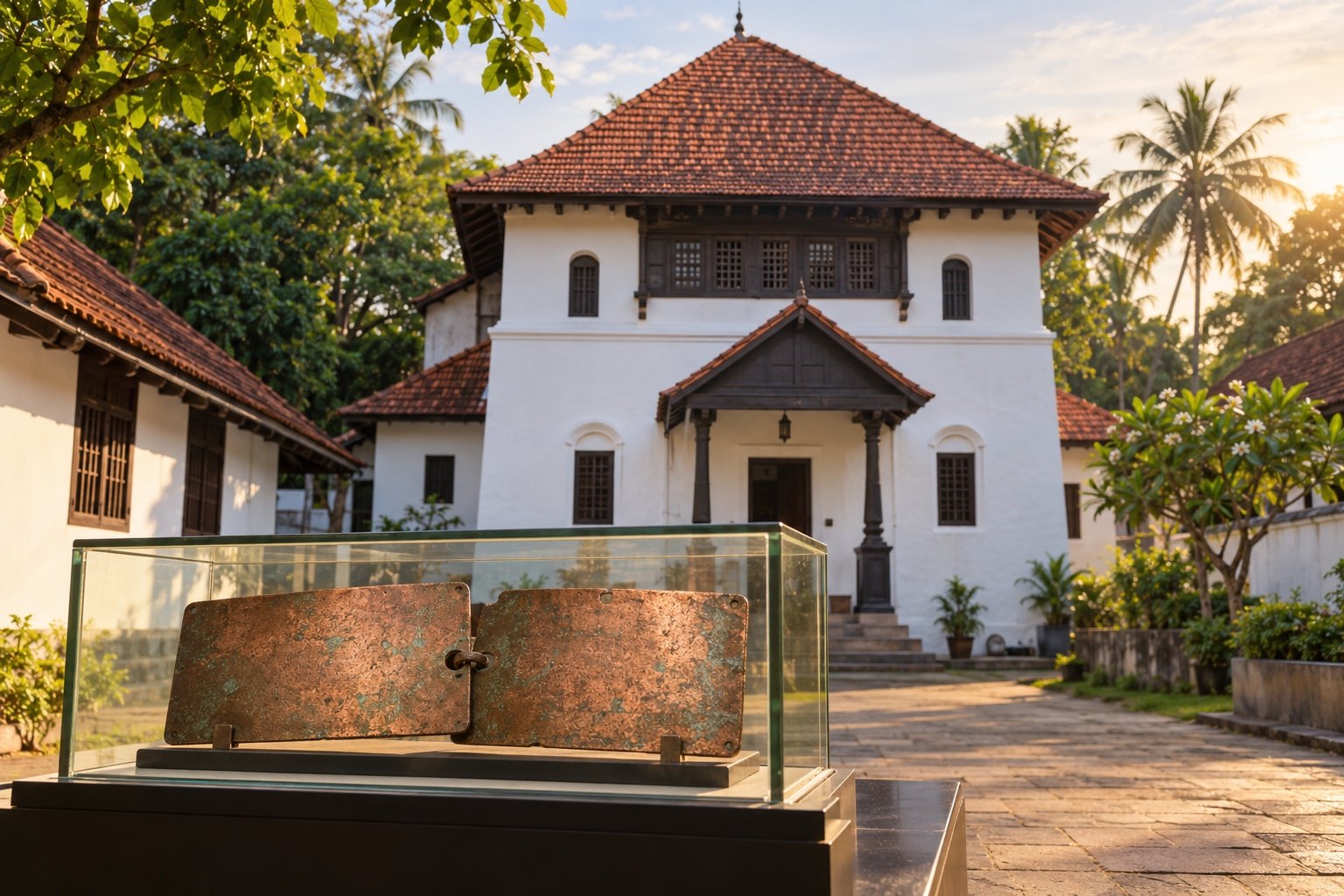
The Cochin Jews are Kerala's historic Jewish community: Malabari Jews, settled since early times, and Paradesi Jews, who came from Europe and West Asia in the 15th and 16th centuries. Copper plates of around 1000 CE granted their leader Joseph Rabban the Anjuvannam settlement. An attempted arson near Ernakulam's Kadavumbhagam Synagogue on 12 October 2026 has revived interest.
Syllabus: GS1 · Art & Culture; Prelims · History & Culture; GS1 · Indian Society & Diversity
Why this matters for UPSC
GS1 Indian culture: Prelims can ask about Anjuvannam, Joseph Rabban's copper plates, the Paradesi Synagogue and Muziris; GS1 society can ask how small religious minorities shaped India's diversity.
In short
The Cochin Jews are Kerala's historic Jewish community, Malabari and Paradesi, whose settlement rested on royal grants and who almost all left for Israel after 1948.
Cochin Jewry shows Kerala's plural trading past; with the community nearly gone, its plates, synagogues and songs need active protection and documentation.
Why it matters
A community that once had thousands of members in Kochi and its nearby towns now has only a few people, so its history survives mainly in buildings, objects and songs. When the last families go, nobody is left to keep up the synagogues or the prayers, and the buildings depend on the State, museums and visitors. The story also shows how traders from far away were welcomed by local kings, took on local language, dress and music, and still kept their faith. That makes it a clear case of how Indian society absorbed outsiders, and a warning that heritage of very small groups needs deliberate care.
Prelims pointers
- Paradesi ('foreigner') and Malabari Jews kept separate synagogues and, until at least the 20th century, did not intermarry.
- The Paradesi Synagogue, in Jew Town, Mattancherry, is described as the oldest active synagogue in the Commonwealth of Nations.
- Cranganore is the old name of Kodungallur, an ancient port town on the Periyar river and once the centre of Jewish prosperity.
- The Paravur and Chendamangalam synagogues lie in the Muziris heritage area and are preserved as museums.
- Portuguese rule on the Kerala coast ran 1503-1663, followed by Dutch rule (1663-1795) and then British rule.
- Under the National Commission for Minorities Act, 1992, five communities were first notified: Muslims, Christians, Sikhs, Buddhists and Parsis; Jains followed on 27 January 2014.
Practise a UPSC-style question
With reference to the Jewish copper plates of Kerala, consider the following statements:
1. The grant was issued to the Jewish leader by a Zamorin of Calicut.
2. The plates granted Joseph Rabban the settlement of Anjuvannam along with 72 privileges.
3. The copper plates are now kept at the Paradesi Synagogue in Mattancherry.
Which of the statements given above is/are correct?
- (a) 1 and 2 only
- (b) 2 and 3 only
- (c) 1 and 3 only
- (d) 1, 2 and 3
Show the answer
Answer: (b) 2 and 3 only
Answer: (b) 2 and 3 only. The grant came from the king of Cranganore, not Calicut.
Statement 1: incorrect. The plates, dated around 1000 CE, were issued by Bhaskara Ravi Varma, king of Cranganore (present-day Kodungallur).
Statement 2: correct. They conferred 72 royal privileges on Joseph Rabban and land around Anjuvannam, Kerala's first recorded Jewish settlement.
Statement 3: correct. Kerala Tourism lists the copper plate among the Paradesi Synagogue's most valued possessions.
Eliminate: Statement 1 is incorrect, since the grantor ruled Cranganore. Out: (a), (c), (d).
Trap: Swapped attribution. The question pins a real grant on the best-known Malabar ruler, the Zamorin of Calicut, instead of the king of Cranganore who issued it.
Remember: Bhaskara Ravi Varma of Cranganore to Joseph Rabban: Anjuvannam and 72 privileges.
More Explainers
- State Legislative Councils: Articles 168-172 and the graduates' and teachers' seats Polity
- Whales and dolphins in Indian waters: legal protection, IUCN status and strandings Environment
- The Aligarh Movement, AMU and the Article 30 minority test Polity
- Environmental clearance by States: SEIAA, SEAC and the EIA Notification, 2006 Environment
- Software vulnerabilities: CVE, CVSS, coordinated disclosure and CERT-In's role Sci-Tech
- Drug trafficking law in India: NDPS Act, PIT-NDPS, NCB and NCORD National
- Choosing the UN Secretary-General: Article 97, UNSC veto and straw polls World & IR
- UN Convention against Torture, and why India has not ratified it Polity
- NavIC: why India's navigation constellation cannot give a standalone position Sci-Tech
- International Energy Agency: membership, 90-day oil stocks and India's status World & IR
- PM Surya Ghar: Muft Bijli Yojana and the rooftop solar subsidy Economy
- HFSS foods: FSSAI's draft limits and front-of-pack warning labels National