
Cell broadcast and civil defence: how India warns its public
Why in news: The Indian Express reported on 15 October 2026 that C-DOT is trialling a prototype sounding air raid sirens by cell broadcast, from Jaisalmer to Mumbai.
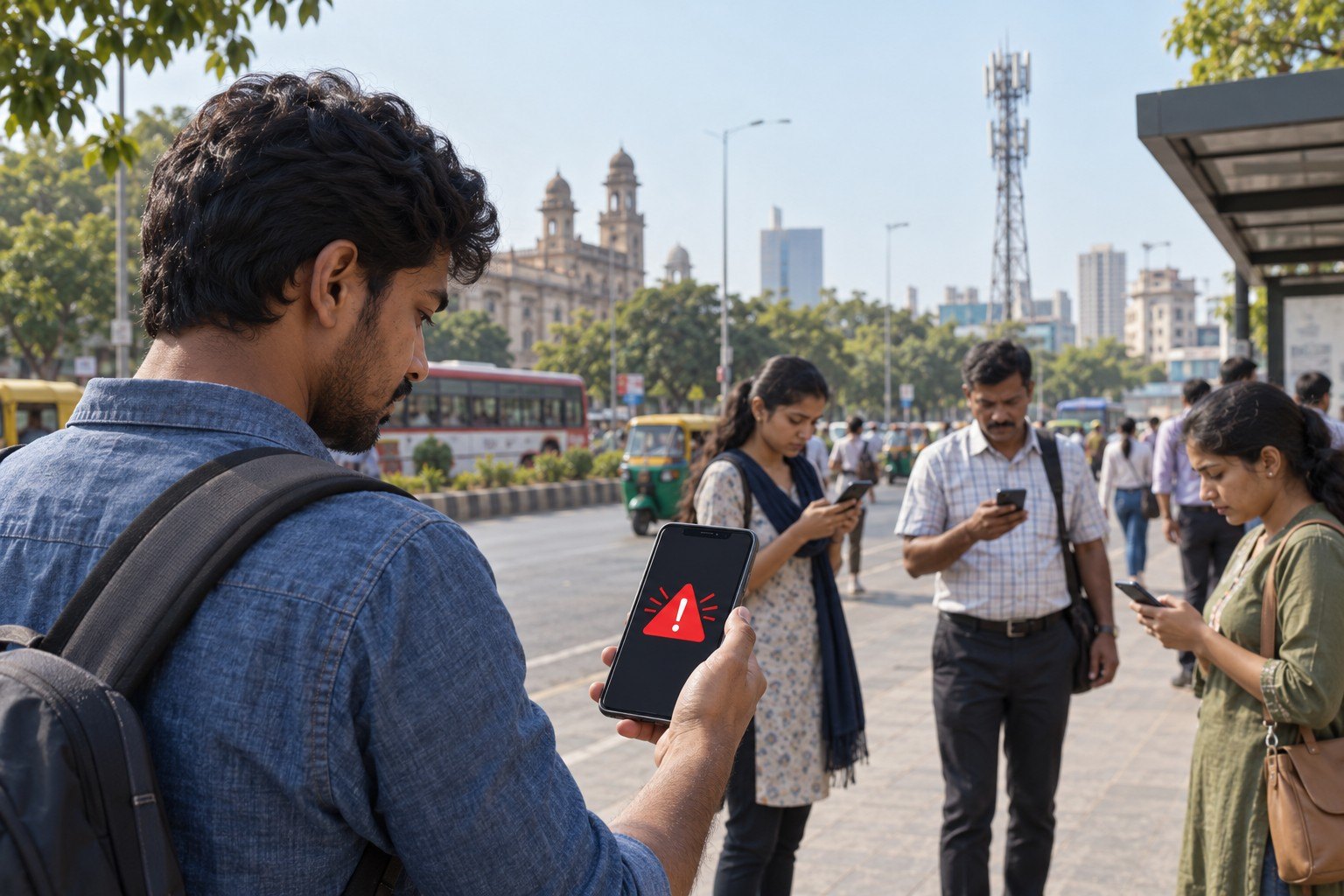
Cell broadcast sends one geo-targeted alert to every phone in an area within seconds, without phone numbers, apps or internet. Developed by C-DOT and linked to NDMA's CAP-based SACHET, it was launched nationwide on 2 May 2026. A C-DOT prototype using it to sound civil defence sirens was field-tested in Mumbai on 8 October 2026, a press report says.
Syllabus: GS2 · Federalism & Local Government; GS3 · Science & Technology; GS3 · Indian Achievements in S&T
Why this matters for UPSC
GS3 disaster management and indigenous technology: Prelims can ask how cell broadcast differs from SMS, who built SACHET and what the Civil Defence Act, 1968 lets the Centre and the States do; Mains, how early warnings reach the last mile.
In short
India warns its public through two layers: alerts pushed to phones by C-DOT's cell broadcast and NDMA's SACHET, and civil defence volunteers organised under the Civil Defence Act, 1968.
Cell broadcast gives India fast, targeted warnings; its value now depends on civil defence: standard sirens, trained volunteers and public trust built before any crisis.
Why it matters
A fisher on the Odisha coast or a pilgrim on the Char Dham route may have no data connection and a phone registered in another State. A cell broadcast alert still reaches that phone, pops up with a loud tone and cannot be switched off, so a cyclone or flash-flood warning arrives in seconds instead of waiting in a message queue. The same signal could one day start sirens for people who are not looking at a phone. The larger question is whether India's warning chain works in the last mile: technology can deliver a message, but only drills, trained volunteers and public trust turn a warning into safe action.
Prelims pointers
- Civil Defence Act, 1968 (Act 27 of 1968): extends to all India; in force from 10 July 1968; Act 3 of 2010 added disaster management to its definition.
- Division of powers: the Central Government makes civil defence rules (section 3) and Corps regulations (section 9); State Governments constitute the Corps (section 4).
- Section 15: the Act does not apply to the Armed Forces of the Union or to their own measures to protect their installations and stores.
- Act 8 of 2026 (in force 15 May 2026) turned section 11's fines into penalties, imposed by a State-appointed adjudicating officer such as the Controller of Civil Defence (section 11A).
- Civil defence is raised only where areas are judged vulnerable to enemy attack: 259 categorised towns in 36 States and UTs, per the Directorate's undated page.
- Training tiers: master trainers at the National Civil Defence College, Nagpur; team and leadership courses at State Civil Defence Training Institutes; volunteers locally.
- CAP standard: ITU-T Recommendation X.1303 (CAP 1.1); C-DOT's cell broadcast carries X.1303 interfaces to connect CAP-based alert platforms.
- NDMA: created under the Disaster Management Act, 2005 and headed by the Prime Minister; State Disaster Management Authorities are headed by Chief Ministers.
Practise a UPSC-style question
With reference to India's Cell Broadcast System for disaster alerts, consider the following statements:
1. It can deliver an alert to every mobile phone in a targeted area without using phone numbers or the internet.
2. It was developed indigenously by the Centre for Development of Telematics, which works under the Ministry of Electronics and Information Technology.
Which of the statements given above is/are correct?
- (a) 1 only
- (b) 2 only
- (c) Both 1 and 2
- (d) Neither 1 nor 2
Show the answer
Answer: (a) 1 only
Answer: (a) 1 only. The system needs no numbers or internet, but C-DOT belongs to the Department of Telecommunications.
Statement 1: correct. C-DOT says its cell broadcast needs no phone numbers, apps, internet or subscriber database; towers broadcast to every handset in the area.
Statement 2: incorrect. C-DOT is the research and development centre of the Department of Telecommunications, Ministry of Communications, not of MeitY.
Eliminate: Judge statement 2 first: C-DOT sits under the Department of Telecommunications, so statement 2 is incorrect. Out: (b), (c).
Eliminate: Judge statement 1: broadcast needs no phone numbers or internet, so statement 1 is correct. Out: (d).
Trap: Swapped attribution. C-DOT is placed under a technology ministry that sounds right, MeitY, instead of the Department of Telecommunications.
Remember: Cell broadcast is C-DOT's, and C-DOT is the Department of Telecommunications' R&D centre.
More Explainers
- State Legislative Councils: Articles 168-172 and the graduates' and teachers' seats Polity
- Whales and dolphins in Indian waters: legal protection, IUCN status and strandings Environment
- The Aligarh Movement, AMU and the Article 30 minority test Polity
- Environmental clearance by States: SEIAA, SEAC and the EIA Notification, 2006 Environment
- Software vulnerabilities: CVE, CVSS, coordinated disclosure and CERT-In's role Sci-Tech
- Drug trafficking law in India: NDPS Act, PIT-NDPS, NCB and NCORD National
- Choosing the UN Secretary-General: Article 97, UNSC veto and straw polls World & IR
- UN Convention against Torture, and why India has not ratified it Polity
- NavIC: why India's navigation constellation cannot give a standalone position Sci-Tech
- International Energy Agency: membership, 90-day oil stocks and India's status World & IR
- PM Surya Ghar: Muft Bijli Yojana and the rooftop solar subsidy Economy
- HFSS foods: FSSAI's draft limits and front-of-pack warning labels National