
BRICS: origin, expansion, rotating chair, NDB and CRA
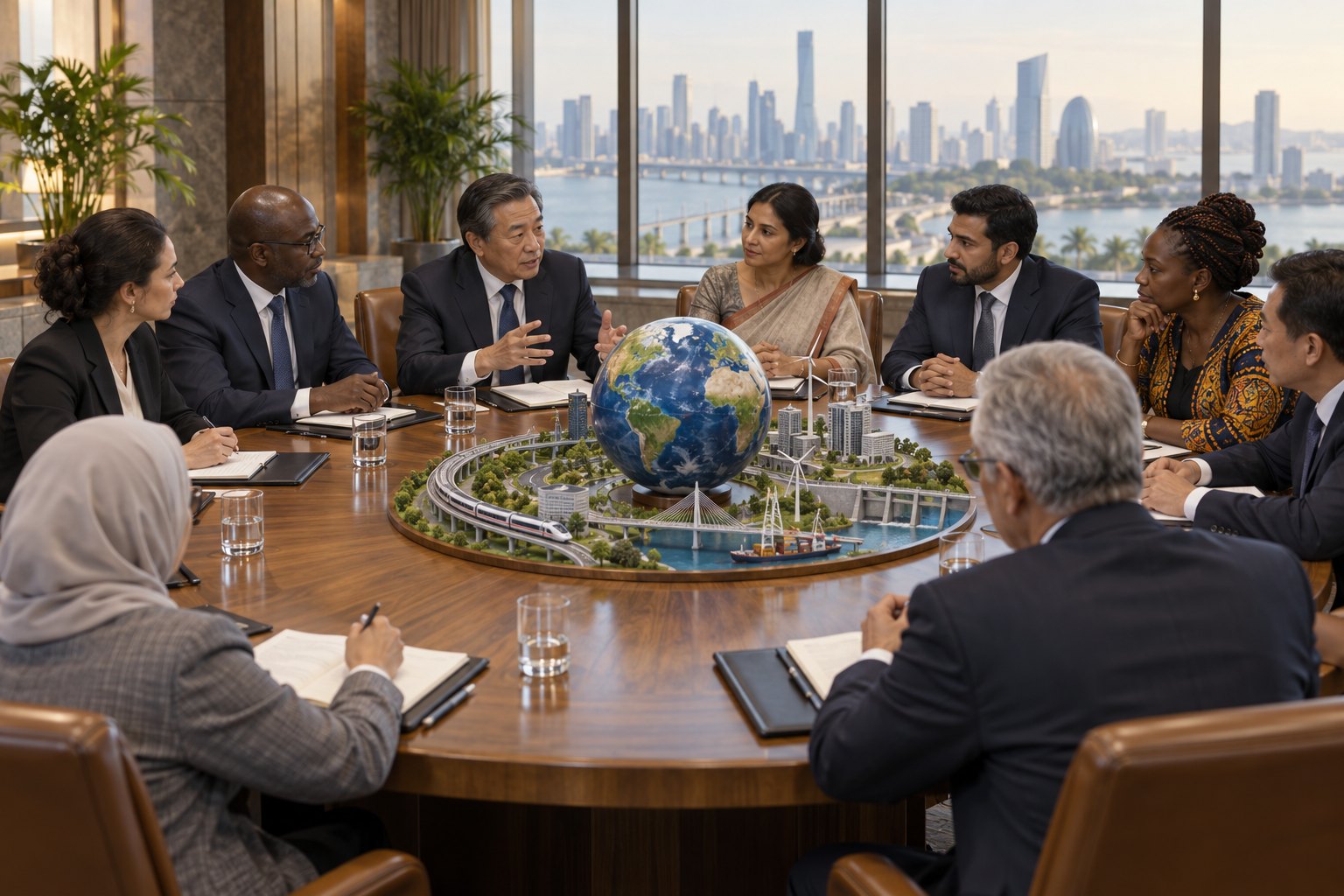
BRICS is a grouping of major emerging economies that began in 2006 as a forum of Brazil, Russia, India and China, took in South Africa in 2010-11 and expanded from 2024. It has no charter or secretariat, and its two financial bodies are the New Development Bank and the Contingent Reserve Arrangement. India holds its rotating chair in 2026.
Syllabus: Prelims · Current Affairs & IR; GS2 · Groupings & Agreements; GS2 · International Institutions
In short
BRICS is a charter-less grouping of major emerging economies that coordinates on global governance; widening to eleven members adds weight but strains consensus.
India should keep an expanded BRICS practical and issue-based: working bodies like the NDB and CRA matter more than headcount or anti-Western posture.
Why it matters
For a State that needs a metro line or a renewable-energy project, BRICS means another lender: the New Development Bank funds such projects, and its five founders hold equal shares, so emerging economies have the say they lack at the World Bank. For the Reserve Bank of India, the CRA is a backstop: if a sudden outflow of capital hits the rupee, India can swap rupees for up to USD 18 billion from its partners. The larger issue is global governance. BRICS is the main club through which big developing countries press for fairer votes in the IMF and World Bank and an open trading system. A wider membership adds weight, but consensus among eleven varied states is harder to reach.
Prelims pointers
- Expansion: invitations issued at the 2023 BRICS Summit in Johannesburg; Argentina declined; Indonesia joined in January 2025; partner-country category created at the Kazan Summit, 2024.
- Presidency: rotates each calendar year, by convention in the order B-R-I-C-S (Russia and Brazil swapped 2024 and 2025); the chair hosts the summit. No permanent secretariat; consensus decisions.
- New Development Bank: headquarters Shanghai; voting power follows subscribed shares, and the five founders subscribed equally; lends for infrastructure and sustainable development.
- Contingent Reserve Arrangement: liquidity and precautionary instruments; reserves stay with members until a request is met by central-bank swaps; under the 2014 treaty, 30% of access needs no IMF programme.
- Three pillars of BRICS cooperation: political and security; economic and financial; cultural and people-to-people.
- India-led outcomes: New Delhi 2012 proposed the development bank; Goa 2016 held a BIMSTEC Outreach Summit; 2021 adopted the BRICS Counter-Terrorism Action Plan.
Practise a UPSC-style question
With reference to the New Development Bank, consider the following statements:
1. The agreement establishing it was signed at the BRICS Summit held in Fortaleza, Brazil.
2. Its headquarters is located in Johannesburg, South Africa.
3. Its initial subscribed capital was shared equally among the five founding members.
Which of the statements given above is/are correct?
- (a) 1 and 2 only
- (b) 2 and 3 only
- (c) 1 and 3 only
- (d) 1, 2 and 3
Show the answer
Answer: (c) 1 and 3 only
1 is correct: the Agreement on the New Development Bank was signed at the Fortaleza Summit in 2014. 2 is incorrect: the bank is headquartered in Shanghai, China; Johannesburg hosts its Africa regional centre. 3 is correct: the USD 50 billion initial subscribed capital was divided equally among Brazil, Russia, India, China and South Africa, giving them equal votes.
In the news
More Explainers
- State Legislative Councils: Articles 168-172 and the graduates' and teachers' seats Polity
- Whales and dolphins in Indian waters: legal protection, IUCN status and strandings Environment
- The Aligarh Movement, AMU and the Article 30 minority test Polity
- Environmental clearance by States: SEIAA, SEAC and the EIA Notification, 2006 Environment
- Software vulnerabilities: CVE, CVSS, coordinated disclosure and CERT-In's role Sci-Tech
- Drug trafficking law in India: NDPS Act, PIT-NDPS, NCB and NCORD National
- Choosing the UN Secretary-General: Article 97, UNSC veto and straw polls World & IR
- UN Convention against Torture, and why India has not ratified it Polity
- NavIC: why India's navigation constellation cannot give a standalone position Sci-Tech
- International Energy Agency: membership, 90-day oil stocks and India's status World & IR
- PM Surya Ghar: Muft Bijli Yojana and the rooftop solar subsidy Economy
- HFSS foods: FSSAI's draft limits and front-of-pack warning labels National