
BHAVYA: India's scheme for plug-and-play industrial parks
Why in news: PIB published a backgrounder on BHAVYA's design and progress on 14 October 2026.
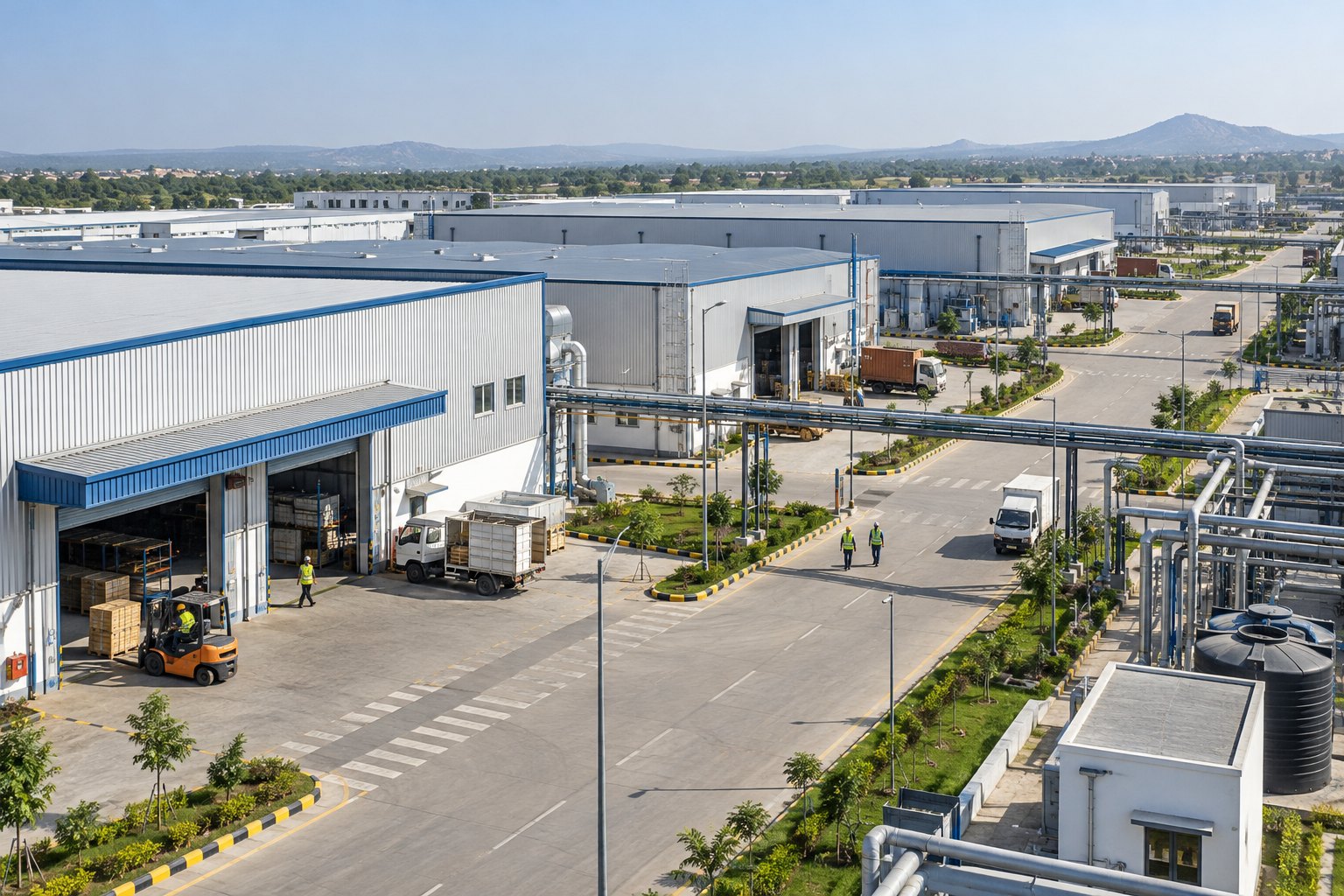
Bharat Audyogik Vikas Yojna (BHAVYA) is a Central Sector Scheme of the Ministry of Commerce and Industry to build 100 plug-and-play industrial parks with ₹33,660 crore over FY2026-27 to FY2031-32. States and private developers are partners, and parks are chosen by competition. A PIB backgrounder of 14 October 2026 set out its design.
Syllabus: GS3 · Indian Economy & Growth; GS3 · Liberalisation & Industry; GS3 · Infrastructure
Why this matters for UPSC
GS III, industrial policy, infrastructure and investment models: Prelims can ask BHAVYA's ministry, scheme type, funding and managing agency; Mains, whether ready-built parks can raise manufacturing's share of GDP.
In short
Bharat Audyogik Vikas Yojna (BHAVYA), a Central Sector Scheme of DPIIT under the Ministry of Commerce and Industry, funds ready-built industrial parks so factories can start production without delay.
BHAVYA should be judged by occupied plots and jobs, not built sheds, which needs States to deliver land and approvals quickly.
Why it matters
A small manufacturer who wants to open a factory can spend months chasing a land title, a power connection and a string of permits before a single machine runs. A BHAVYA park offers a ready shed, water, power and a testing lab on one site, so that firm can spend its money on machines and workers instead. For a State, winning a park is a way to compete for factories and jobs; for workers, housing and clinics inside the park matter as much as the wage. The larger question is whether India can turn its young workforce into factory jobs, and that depends on ready land and quick approvals as much as on tax breaks.
Prelims pointers
- Centrally Sponsored Schemes: framed mainly on State List subjects, cost-shared with States in ratios such as 75:25 or 90:10, and implemented by State Governments.
- SEZ Act, 2005: in force from 2006; an inter-ministerial Board of Approval clears SEZ proposals recommended by State Governments.
- Kandla, Gujarat: India's first Export Processing Zone, set up in 1965, per the SEZ India portal of the Department of Commerce.
- PM MITRA: Ministry of Textiles scheme for seven integrated textile parks, outlay ₹4,445 crore, running up to 2027-28.
- BHAVYA-Rasayan: Centre's grant up to ₹1,000 crore a park; each chemical park needs at least 2,000 acres and a State contribution of at least ₹500 crore.
- NICDP nodes: Dholera SIR (Gujarat), Shendra-Bidkin (Maharashtra), Vikram Udyogpuri (Madhya Pradesh), Integrated Industrial Township Greater Noida (Uttar Pradesh).
Practise a UPSC-style question
With reference to the Bharat Audyogik Vikas Yojna (BHAVYA), consider the following statements:
1. It is a Centrally Sponsored Scheme in which States bear a fixed share of the cost.
2. It is administered by the Department for Promotion of Industry and Internal Trade under the Ministry of Commerce and Industry.
3. The National Industrial Corridor Development Corporation is its Project Management Agency.
Which of the statements given above is/are correct?
- (a) 1 and 2 only
- (b) 2 and 3 only
- (c) 1 and 3 only
- (d) 1, 2 and 3
Show the answer
Answer: (b) 2 and 3 only
Answer: (b) 2 and 3 only. BHAVYA is a Central Sector Scheme run by DPIIT, with NICDC managing it.
Statement 1: incorrect. DPIIT's guidelines of May 2026 call BHAVYA a Central Sector Scheme, which the Union funds and runs; States give land and reforms.
Statement 2: correct. DPIIT, a department of the Ministry of Commerce and Industry, issued BHAVYA's operational guidelines.
Statement 3: correct. The guidelines name the National Industrial Corridor Development Corporation (NICDC) as Project Management Agency.
Eliminate: Statement 1 is wrong because BHAVYA is a Central Sector Scheme. Out: (a), (c), (d).
Trap: Look-alike names. Central Sector and Centrally Sponsored sound alike, and States' role in giving land tempts a student to call BHAVYA cost-shared.
Remember: BHAVYA = Central Sector Scheme, DPIIT, NICDC as Project Management Agency.
More Explainers
- State Legislative Councils: Articles 168-172 and the graduates' and teachers' seats Polity
- Whales and dolphins in Indian waters: legal protection, IUCN status and strandings Environment
- The Aligarh Movement, AMU and the Article 30 minority test Polity
- Environmental clearance by States: SEIAA, SEAC and the EIA Notification, 2006 Environment
- Software vulnerabilities: CVE, CVSS, coordinated disclosure and CERT-In's role Sci-Tech
- Drug trafficking law in India: NDPS Act, PIT-NDPS, NCB and NCORD National
- Choosing the UN Secretary-General: Article 97, UNSC veto and straw polls World & IR
- UN Convention against Torture, and why India has not ratified it Polity
- NavIC: why India's navigation constellation cannot give a standalone position Sci-Tech
- International Energy Agency: membership, 90-day oil stocks and India's status World & IR
- PM Surya Ghar: Muft Bijli Yojana and the rooftop solar subsidy Economy
- HFSS foods: FSSAI's draft limits and front-of-pack warning labels National