
Behaviour change in Swachh Bharat Mission: SBCC, Swachhagrahis and ODF protocols
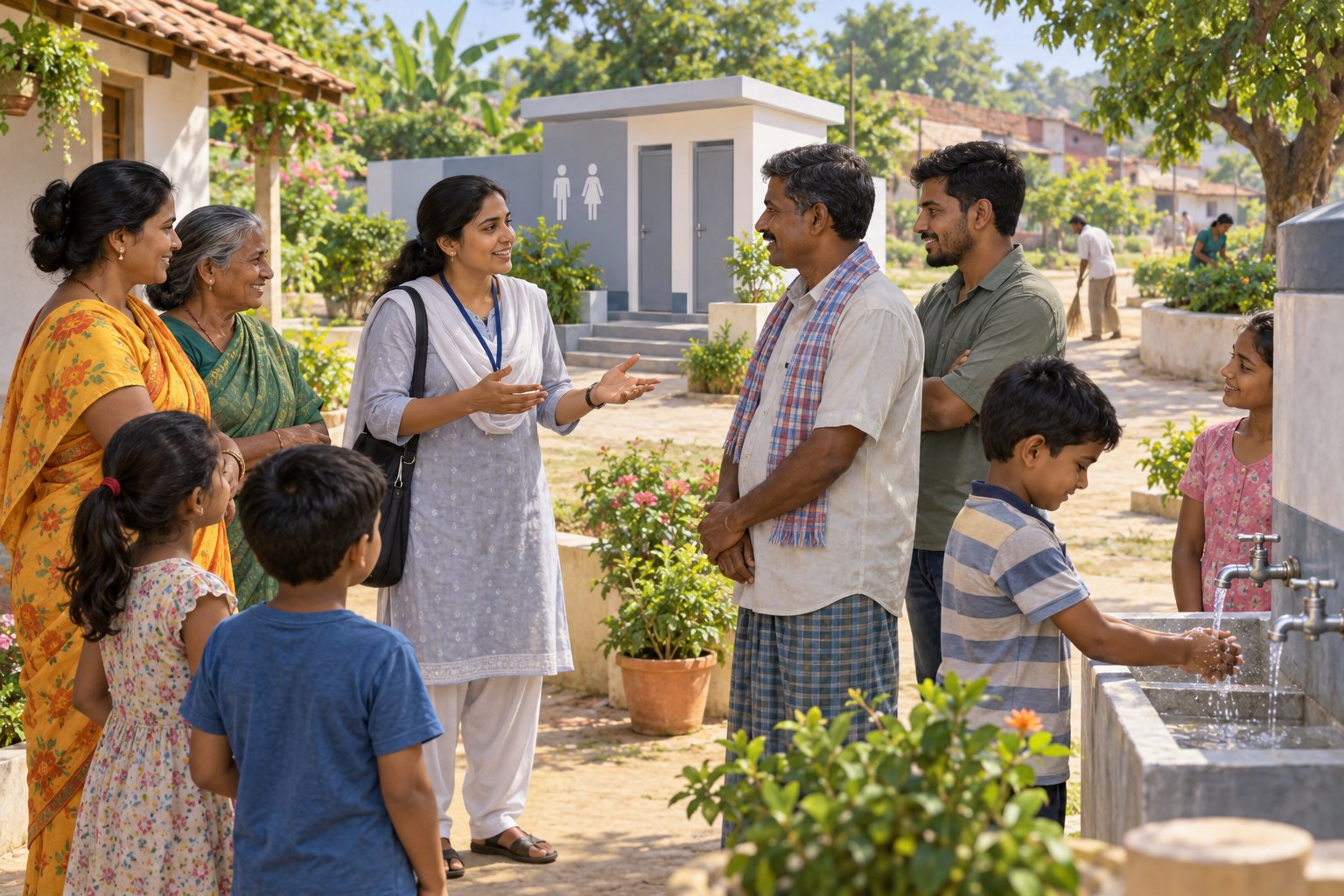
Social and Behaviour Change Communication (SBCC) is how the Swachh Bharat Mission makes toilet use and clean habits last: home visits by Swachhagrahis, village vigilance committees, mass media, and certification such as ODF, ODF+ and ODF++. The Mission, launched on 2 October 2014, turned twelve on 2 October 2026, when the government published a note on this approach.
Syllabus: Prelims · Economy & Social Development; GS2 · Government Policies; GS2 · Health, Education & Human Resources
In short
Social and Behaviour Change Communication (SBCC) is how the Swachh Bharat Mission, launched in 2014, makes toilet use last: dialogue, community pressure and media that shift norms.
Toilets stay in use only when verified ODF status, women's leadership and local ownership keep sanitation a community norm, not a campaign.
Why it matters
For a woman in a village, a toilet at home means she no longer has to wait for darkness or walk to the fields. A study done with the Ministry of Jal Shakti reported that 93% of women no longer feared being hurt while defecating and 91% saved up to an hour. But a toilet helps only if it is used, maintained and its pit emptied safely; where habits do not change, villages slip back into open defecation and disease spreads through water and soil. Behaviour change is what holds the gains, and the same tools now aim at waste segregation in cities.
Prelims pointers
- Rural sanitation programmes in order: Central Rural Sanitation Programme (1986), Total Sanitation Campaign (1999), Nirmal Bharat Abhiyan (2012), Swachh Bharat Mission (2014).
- SBM-Urban protocols: ODF (toilets for all), ODF+ (functional, maintained community and public toilets), ODF++ (safe faecal sludge management), Water+ (black and grey water treated, part reused).
- Star Rating Protocol for Garbage Free Cities: a single rating of urban solid waste management, covering door-to-door collection, source segregation, scientific processing and legacy dumpsite remediation.
- Swachh Survekshan: annual urban cleanliness survey of the Ministry of Housing and Urban Affairs, first held in 2016; the government calls it the world's largest urban sanitation survey.
- Swachhagrahis: grassroots sanitation motivators under SBM-Grameen. Nigrani Samitis: village committees that watch for open defecation.
- Twin-pit toilet: two pits used in turn; while one is in use, the other rests and its contents decompose into safe manure that can be emptied by hand.
- Black water is toilet wastewater carrying faeces and urine; grey water comes from kitchens, bathing and laundry.
- Champaran Satyagraha (1917, Bihar): Gandhi's first satyagraha in India, on behalf of indigo cultivators; SBM's Chalo Champaran campaign drew on it.
Practise a UPSC-style question
With reference to the Swachh Bharat Mission, consider the following statements:
1. Its logo depicts the spectacles of Mahatma Gandhi.
2. Its rural component, SBM-Grameen, is implemented by the Ministry of Housing and Urban Affairs.
Which of the statements given above is/are correct?
- (a) 1 only
- (b) 2 only
- (c) Both 1 and 2
- (d) Neither 1 nor 2
Show the answer
Answer: (a) 1 only
1 is correct: the logo shows Gandhi's spectacles, tying the Mission to his ideal of cleanliness. 2 is incorrect: SBM-Grameen is run by the Department of Drinking Water and Sanitation in the Ministry of Jal Shakti; the Ministry of Housing and Urban Affairs runs SBM-Urban.
More Explainers
- State Legislative Councils: Articles 168-172 and the graduates' and teachers' seats Polity
- Whales and dolphins in Indian waters: legal protection, IUCN status and strandings Environment
- The Aligarh Movement, AMU and the Article 30 minority test Polity
- Environmental clearance by States: SEIAA, SEAC and the EIA Notification, 2006 Environment
- Software vulnerabilities: CVE, CVSS, coordinated disclosure and CERT-In's role Sci-Tech
- Drug trafficking law in India: NDPS Act, PIT-NDPS, NCB and NCORD National
- Choosing the UN Secretary-General: Article 97, UNSC veto and straw polls World & IR
- UN Convention against Torture, and why India has not ratified it Polity
- NavIC: why India's navigation constellation cannot give a standalone position Sci-Tech
- International Energy Agency: membership, 90-day oil stocks and India's status World & IR
- PM Surya Ghar: Muft Bijli Yojana and the rooftop solar subsidy Economy
- HFSS foods: FSSAI's draft limits and front-of-pack warning labels National