
Arctic shipping routes: the Northern Sea Route and the Northwest Passage
Why in news: South Korea's PanStar Acro returned to Busan on 11 October 2026 after a 50-day round-trip trial voyage to Europe through the Northern Sea Route.
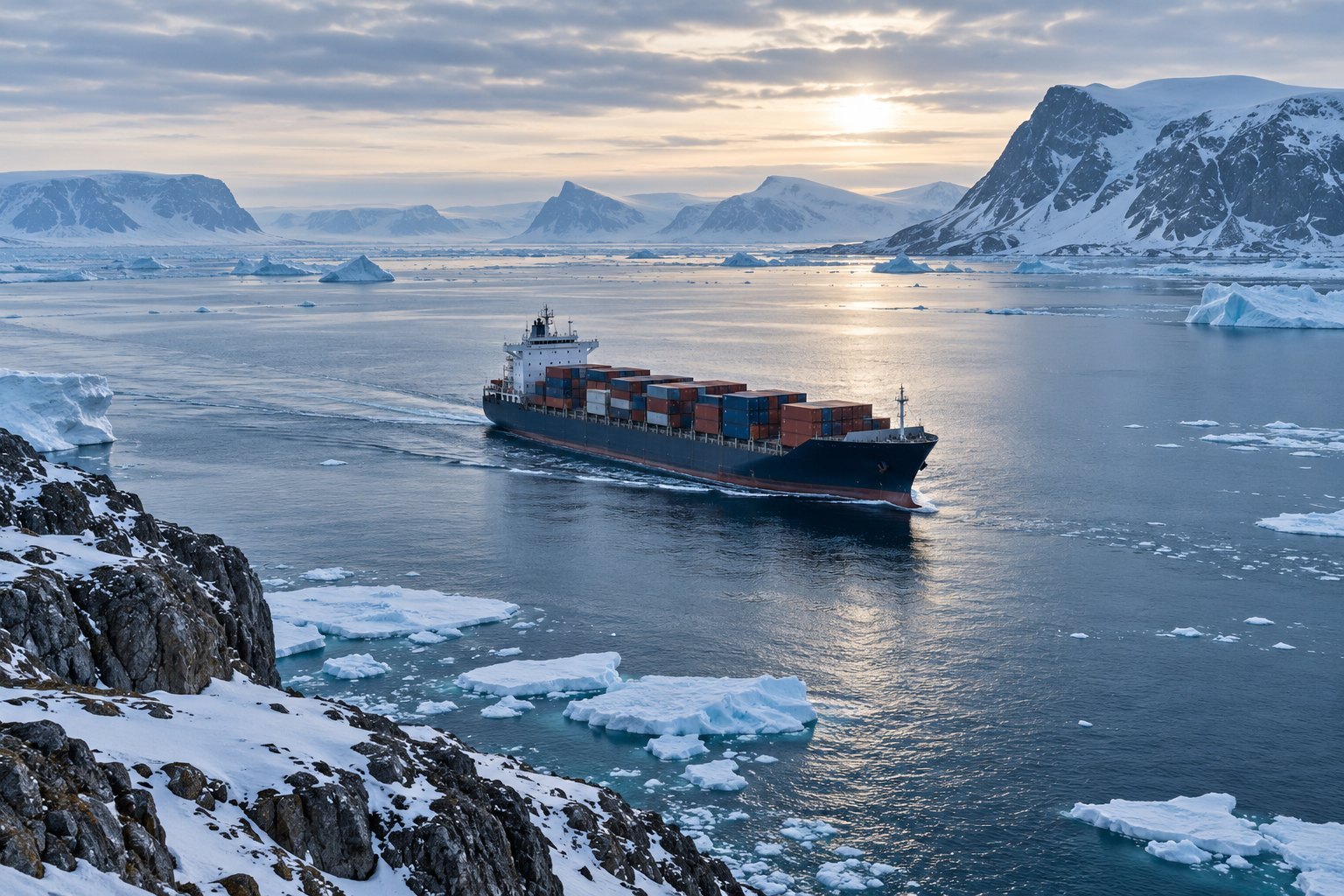
Arctic shipping routes are summer sea lanes across the Arctic Ocean: the Northern Sea Route along Russia's Arctic coast, the Northwest Passage through the Canadian Arctic Archipelago and a future route over the North Pole. South Korea's container ship PanStar Acro returned to Busan on 11 October 2026 from a round-trip trial through the Northern Sea Route.
Syllabus: Prelims · Geography; GS3 · Infrastructure; GS1 · Geophysical Phenomena
Why this matters for UPSC
GS1 world geography and GS2 international relations ask about Arctic routes. Prelims can ask which seas the Northern Sea Route crosses, the IMO Polar Code or Arctic Council observers; Mains, the Arctic's significance for India's connectivity.
In short
Arctic shipping routes are seasonal sea lanes across the ice-covered Arctic Ocean between the Atlantic and the Pacific, chiefly the Northern Sea Route and the Northwest Passage.
Arctic routes can supplement the Suez route, not replace it; India should build polar shipping skills while insisting on Polar Code safety and environmental safeguards.
Why it matters
For an exporter in Busan, Shanghai or Chennai, a shorter sea lane means goods reach European buyers days earlier. When conflict in the Middle East disrupts the Suez route, as in 2026, an Arctic option gives traders a second road. But the route runs along Russia's coast, so a shipping line using it may fall foul of Western sanctions, and it needs ice-class ships, costly insurance and sometimes an icebreaker. A spill in remote, freezing water is far harder to clean than one near a busy port, which is why several large container lines have pledged to stay away. For India, the question is whether Arctic links serve its trade without tying it to sanctions risk.
Prelims pointers
- Polar Code training: masters, chief mates and officers in charge of a navigational watch need polar training, mandatory under the STCW Convention from 1 July 2018.
- Bering Strait: about 85 km wide and 30-50 m deep, the only sea link between the Arctic Ocean and the Pacific.
- Northwest Passage: first complete transit by Roald Amundsen, 1903-06; the Canadian Arctic Archipelago it crosses has more than 36,000 islands.
- Polar Code adoption: safety part by IMO's Maritime Safety Committee in November 2014, environmental part by its Marine Environment Protection Committee in May 2015.
- Polar Ship Certificate categories: A for at least medium first-year ice, B for at least thin first-year ice, C for open water or lighter ice.
- Arctic Council: set up by the Ottawa Declaration, signed on 19 September 1996; six organisations of Arctic Indigenous Peoples are its Permanent Participants.
- Eastern Maritime Corridor: Chennai-Vladivostok sea route; coking coal, oil, LNG and fertilisers are its potential cargo, as the two sides named them in 2023.
Practise a UPSC-style question
Consider the following pairs:
(Sea or bay : Arctic shipping route that passes through it)
1. Laptev Sea : Northern Sea Route
2. Beaufort Sea : Northwest Passage
3. East Siberian Sea : Northern Sea Route
4. Baffin Bay : Northern Sea Route
How many of the above pairs are correctly matched?
- (a) Only one
- (b) Only two
- (c) Only three
- (d) All four
Show the answer
Answer: (c) Only three
Answer: (c) Only three. Baffin Bay lies on the Northwest Passage side of the Arctic, not on the Northern Sea Route.
Pair 1: correctly matched. The Laptev Sea fronts the Eurasian landmass, along Russia's Arctic coast, where the Northern Sea Route runs.
Pair 2: correctly matched. The Beaufort Sea is the western edge of the Canadian maritime Arctic, which the Northwest Passage crosses.
Pair 3: correctly matched. The East Siberian Sea also fronts Eurasia, between the Laptev and Chukchi seas on the Northern Sea Route.
Pair 4: not correctly matched. Baffin Bay is the eastern edge of the Canadian maritime Arctic, on the Northwest Passage.
Eliminate: pair 4 is wrong because Baffin Bay lies on the North American side. Out: (d).
Eliminate: pairs 1, 2 and 3 follow the routes' seas, so three are right. Out: (a), (b).
Trap: Swapped attribution. A real Arctic water body is pinned on the wrong route, the Eurasian one instead of the North American one.
Remember: NSR: Kara, Laptev, East Siberian, Chukchi. NWP: Baffin Bay to Beaufort Sea.
More Explainers
- State Legislative Councils: Articles 168-172 and the graduates' and teachers' seats Polity
- Whales and dolphins in Indian waters: legal protection, IUCN status and strandings Environment
- The Aligarh Movement, AMU and the Article 30 minority test Polity
- Environmental clearance by States: SEIAA, SEAC and the EIA Notification, 2006 Environment
- Software vulnerabilities: CVE, CVSS, coordinated disclosure and CERT-In's role Sci-Tech
- Drug trafficking law in India: NDPS Act, PIT-NDPS, NCB and NCORD National
- Choosing the UN Secretary-General: Article 97, UNSC veto and straw polls World & IR
- UN Convention against Torture, and why India has not ratified it Polity
- NavIC: why India's navigation constellation cannot give a standalone position Sci-Tech
- International Energy Agency: membership, 90-day oil stocks and India's status World & IR
- PM Surya Ghar: Muft Bijli Yojana and the rooftop solar subsidy Economy
- HFSS foods: FSSAI's draft limits and front-of-pack warning labels National