
Animal Birth Control Rules, 2023: managing street dogs and rabies
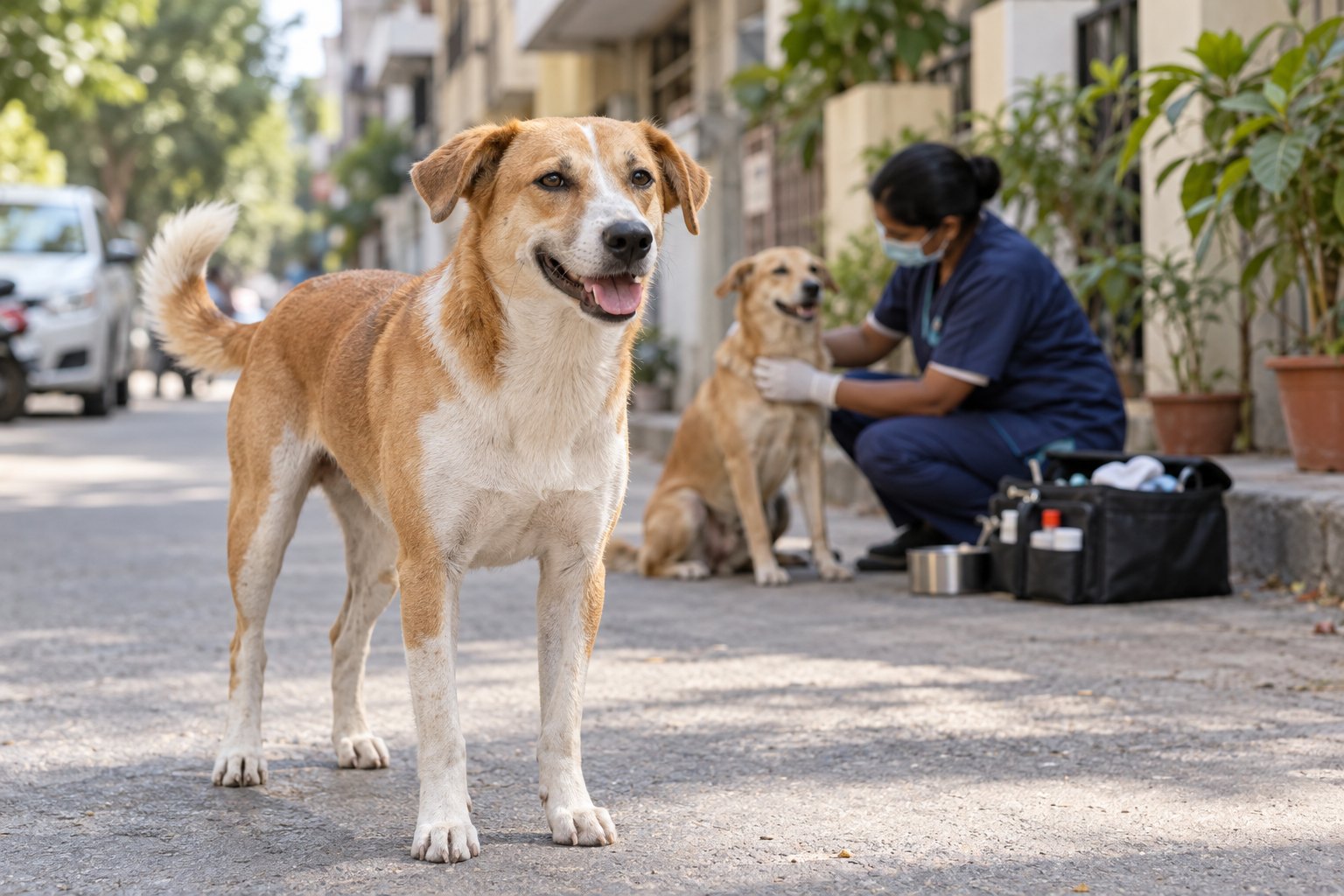
The Animal Birth Control Rules, 2023, framed under the Prevention of Cruelty to Animals Act, 1960, make local bodies sterilise street dogs, vaccinate them against rabies and return them to their area instead of relocating them. Organisations recognised by the Animal Welfare Board of India do the work.
Syllabus: GS2 · Federalism & Local Government; Prelims · Polity & Governance; GS2 · Government Policies
Why this matters for UPSC
GS2 health and local governance: Prelims can ask the ABC Rules' parent Act, who implements them, the Animal Welfare Board of India and the rabies programme's ministry; Mains, about municipal capacity and the One Health approach.
In short
The Animal Birth Control Rules, 2023, under the Prevention of Cruelty to Animals Act, 1960, manage street dogs by sterilisation and vaccination, balancing animal welfare with public safety.
The Rules are sound in design; their test is municipal delivery, with funds, recognised agencies and dog counts matched to bite and rabies data.
Why it matters
A child bitten on the way to school, a housing society arguing over who feeds the neighbourhood dogs, and a municipal officer with a sterilisation budget all fall under these Rules. States reported 37,17,336 dog-bite cases and 54 suspected human rabies deaths in 2024, per the National Centre for Disease Control. Rabies has no cure once symptoms begin, yet a vaccine prevents it. Sterilising dogs slows the growth of their numbers, and vaccinating them stops the virus at its source, so a town that runs the programme well protects people and animals at once. The larger issue is One Health: human disease control and animal welfare depend on the same municipal work.
Prelims pointers
- Prevention of Cruelty to Animals Act, 1960: the parent Act of the ABC Rules, 2023; the same Act set up the Animal Welfare Board of India.
- Animal Welfare Board of India: statutory advisory body under the PCA Act, 1960, set up in 1962; now under the Ministry of Fisheries, Animal Husbandry and Dairying.
- Article 243W and the Twelfth Schedule: 'cattle pounds; prevention of cruelty to animals' is a municipal function.
- 'Prevention of cruelty to animals' is an entry in the Concurrent List of the Seventh Schedule, so Parliament and States may both legislate.
- National Rabies Control Programme: run by the Ministry of Health and Family Welfare, funded under the National Health Mission; NCDC collects dog-bite and rabies data.
- NAPRE: national plan to eliminate dog-mediated rabies by 2030 through One Health; States draft State Action Plans (SAPRE).
- ASCAD, a component of the Livestock Health and Disease Control Programme, funds anti-rabies vaccines for animals, including stray dogs.
- Rabies: a viral zoonotic disease, almost always fatal once symptoms appear but preventable by vaccination.
Practise a UPSC-style question
With reference to the Animal Birth Control Rules, 2023, consider the following statements:
1. They were framed by the Central Government under the Wildlife (Protection) Act, 1972.
2. They superseded the earlier Animal Birth Control (Dog) Rules, 2001 on street dogs.
3. Under them, local bodies carry out the sterilisation and immunisation of street dogs.
Which of the statements given above is/are correct?
- (a) 1 and 2 only
- (b) 2 and 3 only
- (c) 1 and 3 only
- (d) 1, 2 and 3
Show the answer
Answer: (b) 2 and 3 only
1 is incorrect: the Rules were framed under the Prevention of Cruelty to Animals Act, 1960, not the Wildlife (Protection) Act, 1972. 2 is correct: they replaced the Animal Birth Control (Dog) Rules, 2001. 3 is correct: municipalities, Municipal Corporations and Panchayats run the ABC programme.
More Explainers
- State Legislative Councils: Articles 168-172 and the graduates' and teachers' seats Polity
- Whales and dolphins in Indian waters: legal protection, IUCN status and strandings Environment
- The Aligarh Movement, AMU and the Article 30 minority test Polity
- Environmental clearance by States: SEIAA, SEAC and the EIA Notification, 2006 Environment
- Software vulnerabilities: CVE, CVSS, coordinated disclosure and CERT-In's role Sci-Tech
- Drug trafficking law in India: NDPS Act, PIT-NDPS, NCB and NCORD National
- Choosing the UN Secretary-General: Article 97, UNSC veto and straw polls World & IR
- UN Convention against Torture, and why India has not ratified it Polity
- NavIC: why India's navigation constellation cannot give a standalone position Sci-Tech
- International Energy Agency: membership, 90-day oil stocks and India's status World & IR
- PM Surya Ghar: Muft Bijli Yojana and the rooftop solar subsidy Economy
- HFSS foods: FSSAI's draft limits and front-of-pack warning labels National