
Agrivoltaics (AgriPV): farming and solar power on the same land
Why in news: On 19 October 2026 the MNRE Secretary said the ministry plans a central sector scheme for AgriPV, its design still undecided.
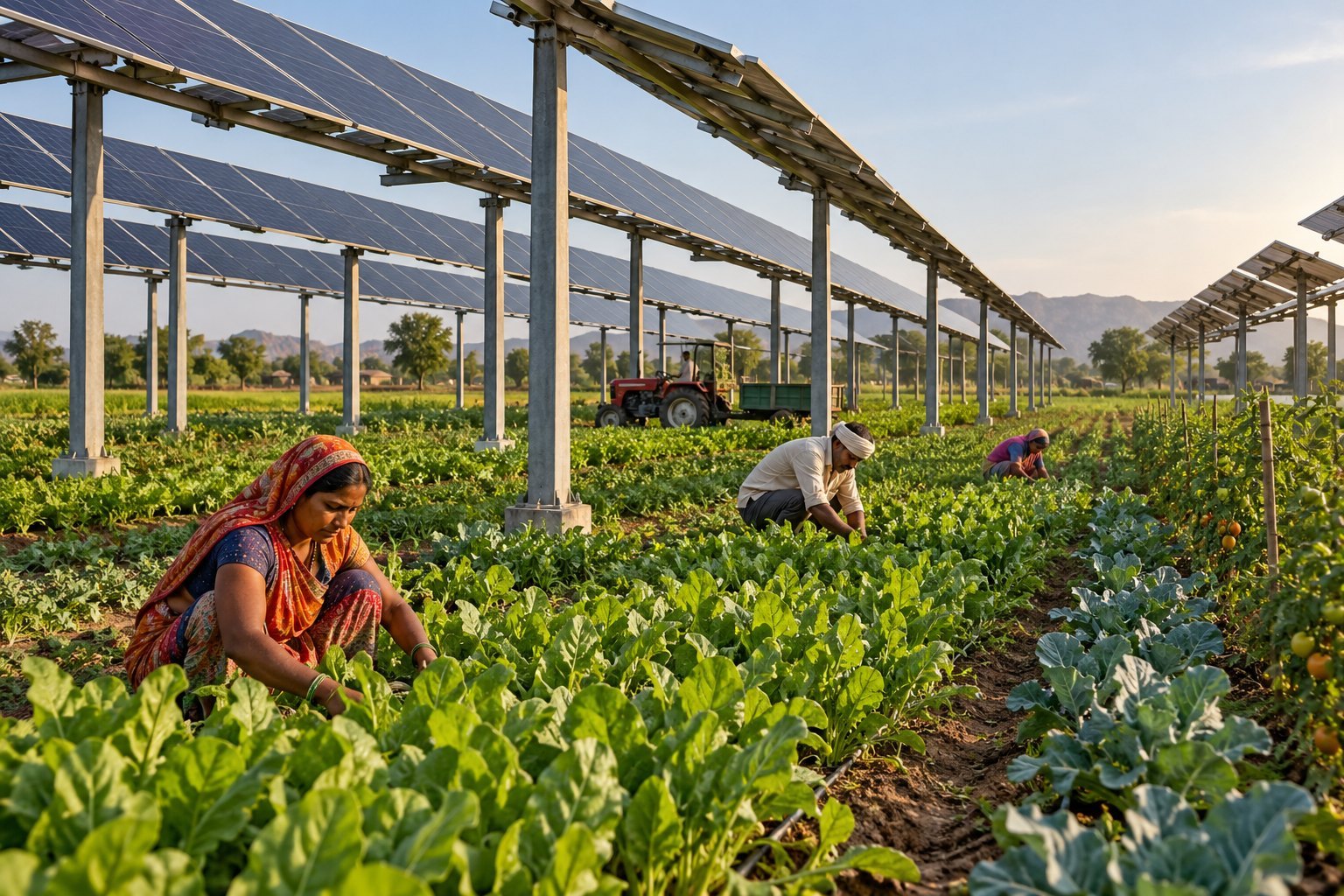
Agrivoltaics, or AgriPV, mounts solar panels on structures about four metres high so that farming continues beneath them, letting one plot yield both crops and electricity. The Ministry of New and Renewable Energy plans a central sector scheme to cover AgriPV's 25-30% higher cost, its Secretary said on 19 October 2026.
Syllabus: GS3 · Agriculture & Irrigation; Prelims · Environment & Ecology; GS3 · Infrastructure
Why this matters for UPSC
GS3 (infrastructure: energy; agriculture and farm incomes): Prelims can ask how agrivoltaics works and what PM-KUSUM's three components provide; Mains, how India can expand renewable energy without competing with farmland.
In short
Agrivoltaics (AgriPV) is the co-location of solar panels and crops on the same land, so that one plot yields both food and electricity.
AgriPV can reconcile food and energy security on scarce land, but only if States price its power fairly and crop science guides its design.
Why it matters
India has many people and little land, and both food and solar power need it. A large solar park can take fields out of farming; agrivoltaics lets a farmer keep growing crops while panels above earn money from electricity. That second income does not depend on rain or on market prices, so a bad season hurts less. The catch is cost: the raised structures make the power dearer, so unless States pay a fair price for it, farmers will not adopt it. How the planned support scheme is designed will decide whether this stays a few pilots or spreads to ordinary farms.
Prelims pointers
- PM-KUSUM Component-B: standalone solar pumps up to 7.5 HP in off-grid areas; central aid 30% (50% in the North East and hill States and island UTs).
- PM-KUSUM Component-C: a farmer may solarise a grid-connected pump with solar capacity up to twice the pump's capacity in kW and sell surplus power to discoms.
- PM-KUSUM Component-A: discoms buy the power at a feed-in tariff set by the State Electricity Regulatory Commission and earn a performance-based incentive for five years.
- Feeder-level solarisation: solar plants for a whole agricultural feeder, through CAPEX or RESCO mode, for a 25-year project period.
- ICAR-CAZRI, Jodhpur: arid north-western India receives about 6.11 kWh per square metre a day of solar radiation, against 5.6 for the rest of the country.
- Indian Agricultural Research Institute (IARI): MNRE's partner in AgriPV pilots mapping crops suited to different agro-climatic zones.
Practise a UPSC-style question
With reference to the Pradhan Mantri Kisan Urja Suraksha evam Utthaan Mahabhiyan (PM-KUSUM), consider the following statements:
1. Its Component-B supports standalone solar agriculture pumps in off-grid areas where grid supply is not available.
2. Under its Component-A, distribution companies buy farmers' solar power at a feed-in tariff fixed by the Central Electricity Regulatory Commission.
Which of the statements given above is/are correct?
- (a) 1 only
- (b) 2 only
- (c) Both 1 and 2
- (d) Neither 1 nor 2
Show the answer
Answer: (a) 1 only
Answer: (a) 1 only. Component-B is for off-grid pumps; the feed-in tariff under Component-A is set by the State regulator.
Statement 1: correct. MNRE's scheme page says Component-B helps individual farmers install standalone solar pumps of up to 7.5 HP where grid supply is not available.
Statement 2: incorrect. Under Component-A, discoms buy the power at a feed-in tariff determined by the respective State Electricity Regulatory Commission.
Eliminate: Judge statement 2 first: tariffs for power bought within a State are set by its SERC, so statement 2 is incorrect. Out: (b), (c).
Eliminate: Statement 1 matches Component-B's off-grid pumps, so it is correct. Out: (d).
Trap: Swapped attribution. The central regulator replaces the State commission that actually fixes the tariff.
Remember: PM-KUSUM: A plants on farm land, B off-grid pumps, C solarise grid pumps; tariff by SERC.
More Explainers
- State Legislative Councils: Articles 168-172 and the graduates' and teachers' seats Polity
- Whales and dolphins in Indian waters: legal protection, IUCN status and strandings Environment
- The Aligarh Movement, AMU and the Article 30 minority test Polity
- Environmental clearance by States: SEIAA, SEAC and the EIA Notification, 2006 Environment
- Software vulnerabilities: CVE, CVSS, coordinated disclosure and CERT-In's role Sci-Tech
- Drug trafficking law in India: NDPS Act, PIT-NDPS, NCB and NCORD National
- Choosing the UN Secretary-General: Article 97, UNSC veto and straw polls World & IR
- UN Convention against Torture, and why India has not ratified it Polity
- NavIC: why India's navigation constellation cannot give a standalone position Sci-Tech
- International Energy Agency: membership, 90-day oil stocks and India's status World & IR
- PM Surya Ghar: Muft Bijli Yojana and the rooftop solar subsidy Economy
- HFSS foods: FSSAI's draft limits and front-of-pack warning labels National