
Supreme Court orders checks on alleged fake Form 7 deletions in Mustafabad
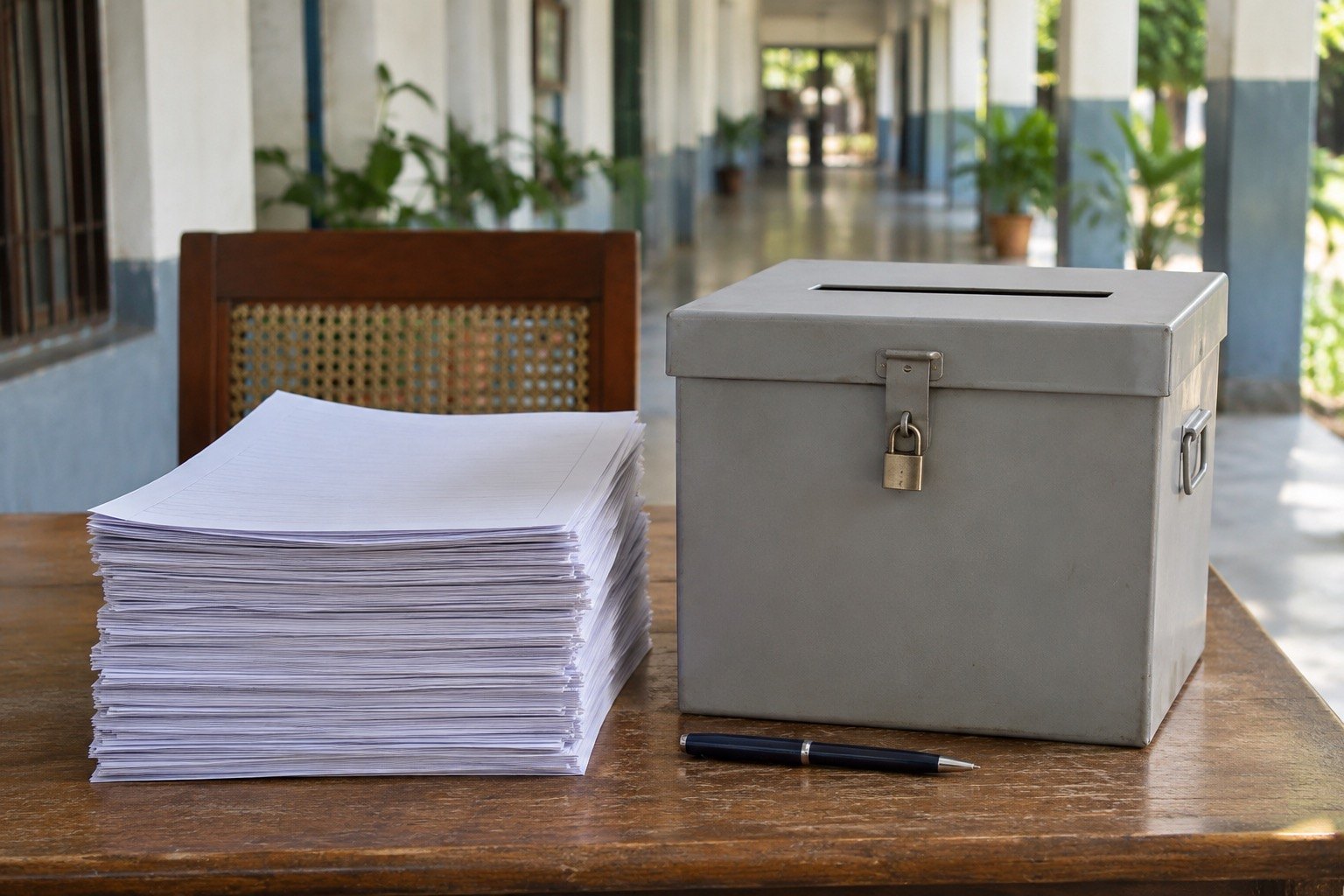
The Supreme Court on 19 November 2026 ordered the authorities to check allegations of forged Form 7 applications in Delhi's Mustafabad Assembly constituency. The forms allegedly sought to strike genuine voters off the electoral roll. They were filed during the Special Intensive Revision (SIR) of the rolls. The Court also directed all remedial measures.
Syllabus: Prelims · Polity & Governance; GS2 · Representation of the People Act; GS2 · Constitutional Bodies
Why this matters for UPSC
GS2 polity: the Representation of the People Act, 1950 and the Election Commission's control over electoral rolls. Prelims can ask Forms 6, 7 and 8 and Article 324; Mains, safeguards against wrongful deletion.
Why it matters
A voter struck off the roll on a forged objection loses the vote without having done anything wrong, and often learns of it only at the polling booth. The law tries to stop this in three ways: a real person on the same roll must stand behind the objection, the officer must check the facts, and the voter must be heard first. When objections are lodged in the names of people who never made them, the first check fails and the burden falls on the officer's verification. In an intensive revision, when large numbers of applications arrive together, a weak check can remove many genuine voters at once. The court's direction puts the duty to verify the complaints, and to set right any wrong deletion, back on the authorities.
Prelims pointers
- Article 324 of the Constitution vests superintendence, direction and control of preparing electoral rolls for Parliament and State Legislature elections in the Election Commission of India.
- Article 243K vests the same control over rolls for Panchayat elections in a State Election Commission, headed by a State Election Commissioner whom the Governor appoints.
- Article 325 provides one general electoral roll for every territorial constituency; no one is excluded on grounds only of religion, race, caste or sex.
- Under Article 326, elections to the Lok Sabha and State Assemblies are on adult suffrage: a citizen aged at least 18 and not disqualified may register.
- Under the 1960 Rules, Form 6 is a new elector's claim, Form 7 an objection or deletion request, Form 8 a correction or shifting request by the elector concerned.
- An ERO is an officer of a government or local authority designated by the ECI in consultation with the State government.
- An appeal against an ERO's order on correcting or deleting an entry lies to the district magistrate or an equivalent officer, and then to the Chief Electoral Officer.
Practise a UPSC-style question
With reference to the deletion of names from electoral rolls under the Representation of the People Act, 1950, consider the following statements:
1. The Electoral Registration Officer may delete an entry only after proper verification of facts.
2. Before deleting a name because the elector has stopped being ordinarily resident, the officer must give that elector a reasonable opportunity of being heard.
3. The Electoral Registration Officer for an Assembly constituency is designated by the State Election Commission of that State.
Which of the statements given above is/are correct?
- (a) 1 and 2 only
- (b) 2 and 3 only
- (c) 1 and 3 only
- (d) 1, 2 and 3
Show the answer
Answer: (a) 1 and 2 only
Answer: (a) 1 and 2 only. The Act requires verification and a hearing, and the ECI designates the officer.
Statement 1: correct. The Representation of the People Act, 1950 allows deletion only after proper verification of facts by the Electoral Registration Officer.
Statement 2: correct. The Act's proviso requires a reasonable opportunity of being heard before deleting a name on residence or entitlement grounds.
Statement 3: incorrect. The Election Commission of India designates the officer in consultation with the State government; a State Election Commission handles Panchayat and municipal rolls.
Eliminate: statement 3 swaps the ECI for a State Election Commission, so it is wrong. Out: (b), (c), (d).
Trap: Look-alike names. The State Election Commission sounds like the right body for a State's Assembly roll, but it controls only local body elections.
Remember: Assembly and Lok Sabha rolls are the ECI's; Panchayat rolls are the State Election Commission's.
More from the 21 November 2026 edition
- India's indigenous H5N1 avian influenza vaccine for chickens dedicated to nation Sci-Tech
- Supreme Court dismisses Karnataka appeal, leaving bike-taxi permit ruling standing Polity
- Project Cheetah: Botswana-born female's four wild cubs lift count to 62 Environment
- Supreme Court dismisses Tamil Nadu's Cauvery shortfall plea against Karnataka Polity
- EAC recommends Terms of Reference for mines near Great Indian Bustard area Environment
- Health Ministry releases national guidelines on wastewater surveillance for pathogens Sci-Tech
- ICJ finds Myanmar committed genocide against the Rohingya: first such ruling World & IR
- Press Council's 2026 norms ask Government to avoid NSA, UAPA against journalists Polity
- Supreme Court holds Gram Sabha consent mandatory for Scheduled Area acquisition Polity