
EAC recommends Terms of Reference for mines near Great Indian Bustard area
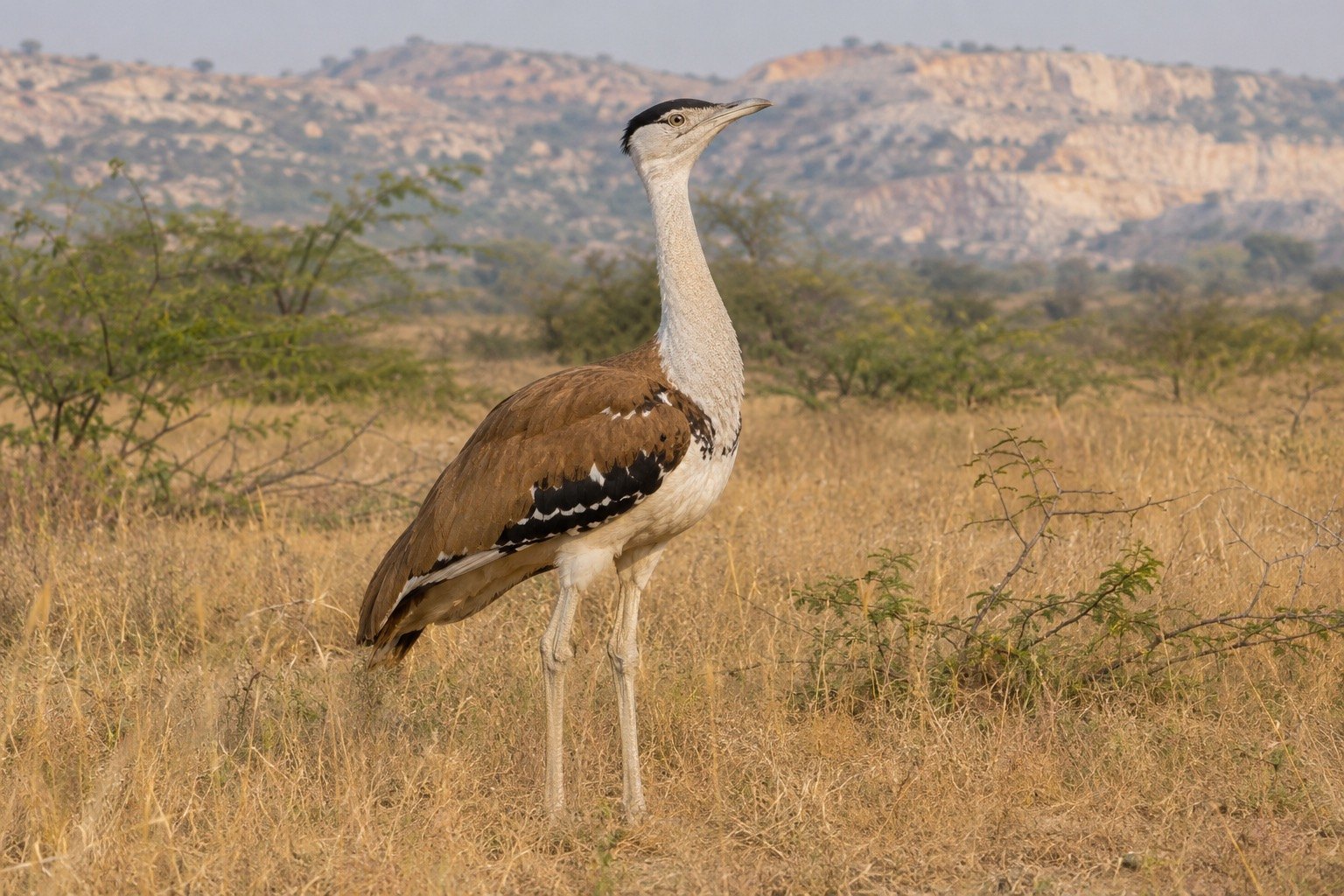
The Environment Ministry's Expert Appraisal Committee (EAC) on non-coal mining recommended Terms of Reference (ToR) for two limestone mines in Jaisalmer, Rajasthan, on 2-4 November 2026. The Joga-IV and Joga-II blocks lie 3.8 km and 5.7 km from the Great Indian Bustard priority area. It told both proponents to avoid a 3.5 km route through that area.
Syllabus: Prelims · Current Affairs & IR; Prelims · Environment & Ecology; GS3 · Environment & Conservation
Why this matters for UPSC
GS3 environment: environmental impact assessment and conservation of the Great Indian Bustard. Prelims can ask the EIA stages and the bird's status; Mains, mining versus habitat protection.
Why it matters
A villager near the Joga blocks gets a formal say only later, at the public consultation the EIA process requires before any clearance. For the bustard, the route trucks take may matter as much as where the pit is dug. The bird nests and lays its egg on open ground, where dust, noise and new roads disturb it. That is why the committee wrote transport conditions at the first step. For the companies, the decision is permission to study, not to mine. The case belongs to a larger contest in western Rajasthan, where demand for cement, power lines and renewable energy presses on the last grasslands of a critically endangered bird.
Prelims pointers
- Under the EIA Notification, 2006, an application for prior clearance is made in Form 1 before any construction or land preparation at the site.
- Screening applies to Category B projects: B1 projects need an EIA report, while B2 projects do not.
- The EAC or SEAC must convey Terms of Reference within 60 days of the application; if it fails, the applicant's proposed ToR are deemed final for the EIA study.
- An Expert Appraisal Committee only recommends; the regulatory authority, the Union Environment Ministry for Category A or the SEIAA for Category B, grants or rejects prior environmental clearance.
- The IUCN Red List has classed the Great Indian Bustard as Critically Endangered since 2011; it was Endangered from 1994 to 2008.
- The Great Indian Bustard is listed in Schedule I of the Wild Life (Protection) Act, 1972, which gives the highest protection from hunting.
- The bustard usually lays a single egg on open ground; overhead transmission lines, habitat loss, hunting and predators are among its recorded threats.
- Conservation breeding centres for the bustard run at Sam and Ramdeora in Jaisalmer, with the Wildlife Institute of India.
Practise a UPSC-style question
With reference to the Environmental Impact Assessment (EIA) Notification, 2006, consider the following statements:
1. The screening stage applies to Category B projects and not to Category A projects.
2. Terms of Reference are fixed at scoping for Category A projects, while Category B1 projects are not scoped at all.
3. If Terms of Reference are not conveyed within sixty days, the applicant's proposed Terms of Reference are deemed final.
Which of the statements given above is/are correct?
- (a) 1 and 2 only
- (b) 2 and 3 only
- (c) 1 and 3 only
- (d) 1, 2 and 3
Show the answer
Answer: (c) 1 and 3 only
Answer: (c) 1 and 3 only. Screening is for Category B, and late ToR default to the applicant's draft.
Statement 1: correct. The notification lists screening as a stage for Category B projects, which it sorts into B1 and B2.
Statement 2: incorrect. The State Expert Appraisal Committee also scopes Category B1 projects and sets their Terms of Reference.
Statement 3: correct. Terms of Reference not conveyed within sixty days of Form 1 are taken as the applicant's own proposed ToR.
Eliminate: Statement 2 is wrong, since SEACs scope B1 projects. Out: (a), (b), (d).
Trap: Wrong scope. Statement 2 narrows scoping to Category A, though B1 projects are scoped by State committees.
Remember: Screening is for Category B; scoping covers Category A and B1; late ToR default to the applicant's draft.
More from the 21 November 2026 edition
- India's indigenous H5N1 avian influenza vaccine for chickens dedicated to nation Sci-Tech
- Supreme Court dismisses Karnataka appeal, leaving bike-taxi permit ruling standing Polity
- Project Cheetah: Botswana-born female's four wild cubs lift count to 62 Environment
- Supreme Court dismisses Tamil Nadu's Cauvery shortfall plea against Karnataka Polity
- Health Ministry releases national guidelines on wastewater surveillance for pathogens Sci-Tech
- ICJ finds Myanmar committed genocide against the Rohingya: first such ruling World & IR
- Press Council's 2026 norms ask Government to avoid NSA, UAPA against journalists Polity
- Supreme Court holds Gram Sabha consent mandatory for Scheduled Area acquisition Polity
- Supreme Court orders checks on alleged fake Form 7 deletions in Mustafabad Polity