
Supreme Court directs MeitY to curb misuse of live-streamed court hearings
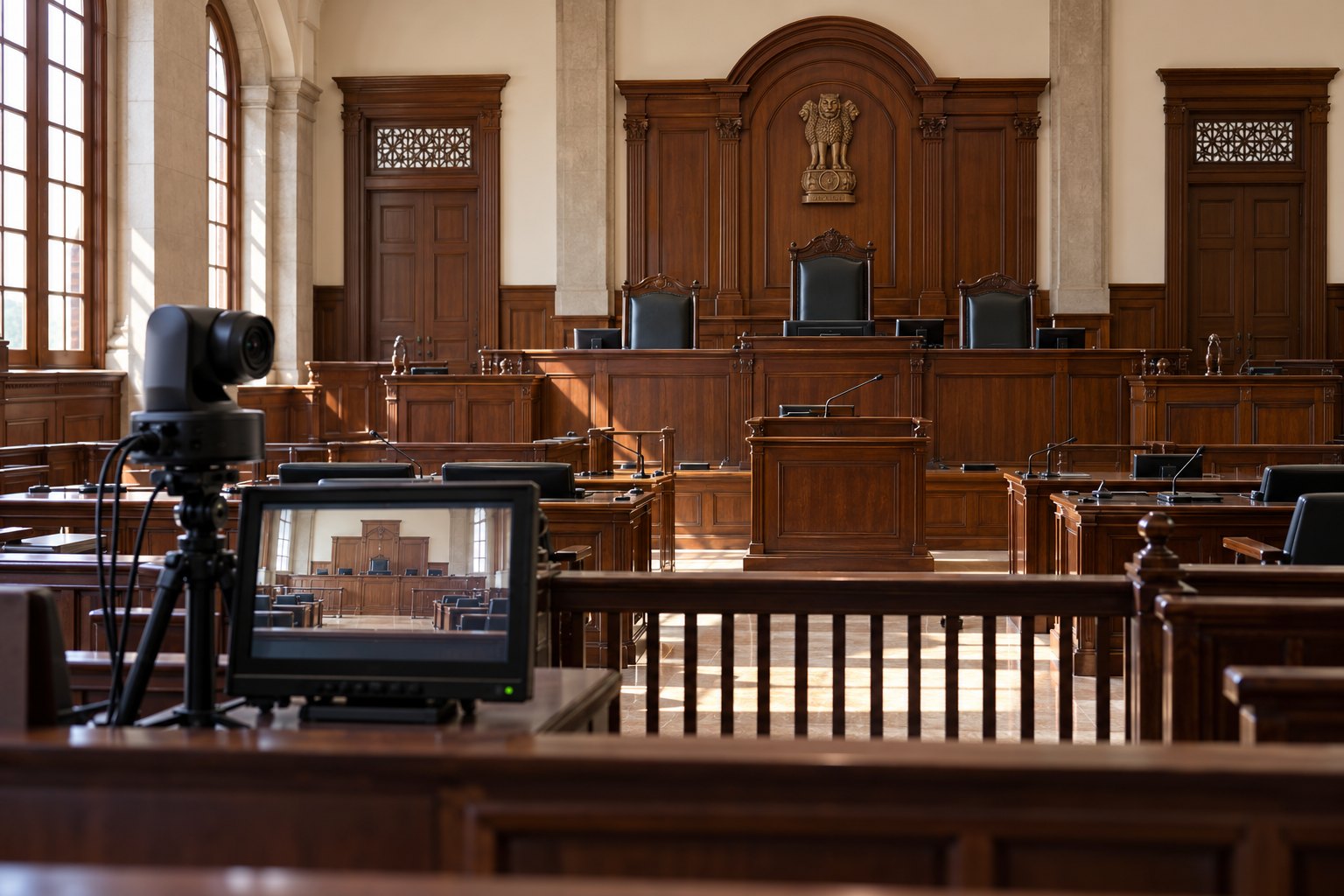
On 30 October 2026 the Supreme Court told MeitY, the Union ministry for electronics and IT, to enforce its interim bar on unauthorised use of live-streamed court proceedings. The policy the Centre is drafting must provide for action against violators. Justice Joymalya Bagchi said in court that authorities under the intermediary rules must act at once on breaches.
Syllabus: Prelims · Polity & Governance; GS2 · Executive & Judiciary; GS2 · Governance & e-Governance
Why this matters for UPSC
GS2 judiciary and governance, GS3 digital platforms. Prelims can ask about the IT Rules, 2021 and safe harbour; Mains, open justice versus misuse of court footage.
Why it matters
A litigant whose words in a hearing are clipped, recaptioned and posted for views can suffer long after the case is over. People who see such a clip also learn a false version of what the judges did. Streaming was meant to let ordinary citizens watch justice at work, so misuse undercuts the reason for opening courts at all. If edited footage keeps spreading for profit, judges may hesitate to stream more hearings. Making the Ministry and the platforms act on breaches keeps the feed open while stopping its abuse. Reporters can still cover hearings, but a creator who wants to reuse footage will first need the court's permission.
Prelims pointers
- The Information Technology (Intermediary Guidelines and Digital Media Ethics Code) Rules, 2021 were framed under the Information Technology Act, 2000, replacing the Intermediary Guidelines Rules of 2011.
- Part II of the 2021 Rules, on intermediaries, is run by MeitY; Part III, the digital media code of ethics, by the Ministry of Information and Broadcasting.
- Under the 2021 Rules, a Grievance Officer acknowledges a user's complaint within 24 hours and resolves it within 15 days.
- The 2021 Rules split platforms into social media intermediaries and significant social media intermediaries by a user threshold the Government notifies; the larger ones carry additional duties.
- Intermediaries must remove content showing a person's private areas or morphed images within 24 hours of a complaint, which another person may file on the victim's behalf.
Practise a UPSC-style question
With reference to the Information Technology (Intermediary Guidelines and Digital Media Ethics Code) Rules, 2021, consider the following statements:
1. Part III of the Rules, the code of ethics for digital media, is administered by the Ministry of Electronics and Information Technology.
2. The Rules were framed under the Information Technology Act, 2000 and replaced the intermediary guidelines of 2011.
Which of the statements given above is/are correct?
- (a) 1 only
- (b) 2 only
- (c) Both 1 and 2
- (d) Neither 1 nor 2
Show the answer
Answer: (b) 2 only
Answer: (b) 2 only. The parent law is right; the ministry for Part III is wrong.
Statement 1: incorrect. Part III, the code of ethics and safeguards for digital media, is administered by the Ministry of Information and Broadcasting; MeitY runs Part II.
Statement 2: correct. The 2021 Rules were made under the Information Technology Act, 2000, superseding the Intermediary Guidelines Rules of 2011.
Eliminate: Statement 2 is the parent-law fact and is surely true. Out: (a), (d).
Eliminate: Statement 1 gives Part III to the wrong ministry. Out: (c).
Trap: Swapped attribution. Two ministries share the 2021 Rules, so the question pins the digital media part on MeitY, which handles only the intermediary part.
Remember: Platforms: MeitY (Part II). Digital news and OTT ethics: Information and Broadcasting (Part III).
More from the 1 November 2026 edition
- BIMSTEC's seven members hold inaugural maritime security exercise World & IR
- Landslide in Odisha's Ganjam after Cyclone Arnab rain; NDRF joins search National
- CBD COP17 closes in Yerevan; Cali Fund design unresolved, Ecuador next host Environment
- Felling for Karjat pumped storage project paused after tribal villages protest Environment
- Bihar tender seeks cottages and helipad inside Bhimbandh Wildlife Sanctuary Environment
- Chola-era bronzes of Nataraja and Sivakami found in Nagapattinam excavation National
- CAQM orders curbs on construction and 50% office attendance in Delhi-NCR Environment
- World Bank's India poverty brief applies 2021 PPP lines to surveys Economy
- Supreme Court: a soured consensual relationship cannot be recast as rape Polity
- CCS clears eight next-generation corvettes for Navy at GRSE, Goa Shipyard Defence
- ISRO's GSLV-F18 places NavIC satellite NVS-03 in its intended orbit Sci-Tech
- UN Commission of Inquiry finds genocidal acts in Gaza continued after ceasefire World & IR