
CAQM orders curbs on construction and 50% office attendance in Delhi-NCR
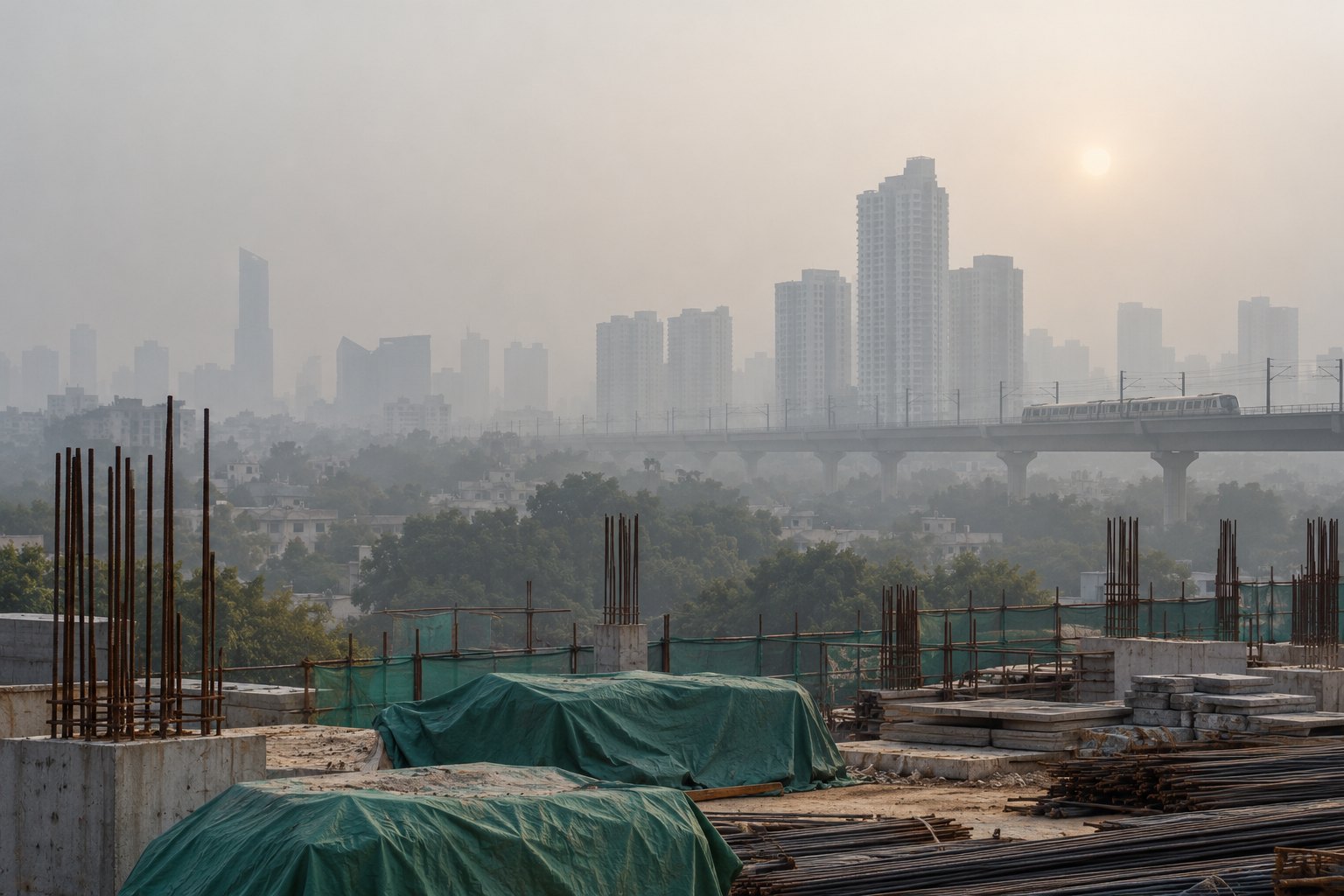
The Commission for Air Quality Management (CAQM) on 30 October 2026 ordered curbs on dust-generating demolition and outdoor construction across the National Capital Region from 5 to 20 November. State Government and private offices in Delhi and five nearby districts must keep physical attendance at 50% or less. Railways, Metro, airports and hospitals are exempt.
Syllabus: Prelims · Environment & Ecology; GS2 · Statutory & Regulatory Bodies; GS3 · Environment & Conservation
Why this matters for UPSC
GS3 environment: air pollution control in the NCR and the CAQM's powers. Prelims can ask GRAP's stages and AQI bands; Mains, pre-emptive curbs and regional air governance.
Why it matters
A mason in Ghaziabad or a site worker in Gurugram loses outdoor work for the period, because dust-raising jobs stop across the region. An office worker in Delhi or Faridabad may be told to work from home, so fewer cars and buses crowd the roads. Hospitals, metro lines and airport projects carry on. The order tries to cut dust and traffic smoke before the fortnight that has brought the worst air in recent years, instead of waiting for the air to turn severe. Whether it works will show in how often the region slips into the severe band this November, and in whether daily-wage workers who lose income get any help.
Prelims pointers
- GRAP for the NCR has four stages by Delhi's AQI: I 'Poor' 201-300, II 'Very Poor' 301-400, III 'Severe' 401-450, IV 'Severe+' above 450.
- GRAP stages are invoked in advance on IMD and IITM forecasts, and each higher stage's actions add to those of the lower stages.
- GRAP Stage III leaves the 50% office-strength decision to NCR State Governments and GNCTD, and the Central Government may decide on work from home for its own offices.
- GRAP Stage IV extends the Stage III construction ban to linear public projects such as highways, flyovers, power transmission and pipelines.
- Low wind speeds and a shallow atmospheric boundary layer reduce vertical mixing and limit the dispersion of pollutants near the ground.
Practise a UPSC-style question
With reference to the Graded Response Action Plan (GRAP) for the National Capital Region, consider the following statements:
1. Stage II 'Very Poor' applies when the AQI of Delhi is between 301 and 400.
2. Stage IV 'Severe+' applies when the AQI of Delhi is above 400.
3. Actions under a higher stage are taken in addition to those under the lower stages.
Which of the statements given above is/are correct?
- (a) 1 and 2 only
- (b) 2 and 3 only
- (c) 1 and 3 only
- (d) 1, 2 and 3
Show the answer
Answer: (c) 1 and 3 only
Answer: (c) 1 and 3 only. Stage IV begins above an AQI of 450, so statement 2 fails.
Statement 1: correct. The GRAP revised on 29 September 2026 places Stage II 'Very Poor' at a Delhi AQI of 301 to 400.
Statement 2: incorrect. Stage IV 'Severe+' applies above an AQI of 450; the band of 401 to 450 is Stage III 'Severe'.
Statement 3: correct. GRAP is cumulative: Stage III actions come in addition to those under Stages I and II, and so on.
Eliminate: Statement 2 is wrong, since Stage IV starts above 450. Out: (a), (b), (d).
Trap: Near-miss figure. The AQI scale's severe band starts at 401, so a student may put Stage IV there; GRAP splits severe air at 450.
Remember: GRAP stages by Delhi AQI: 201-300, 301-400, 401-450, above 450.
More from the 1 November 2026 edition
- BIMSTEC's seven members hold inaugural maritime security exercise World & IR
- Landslide in Odisha's Ganjam after Cyclone Arnab rain; NDRF joins search National
- CBD COP17 closes in Yerevan; Cali Fund design unresolved, Ecuador next host Environment
- Felling for Karjat pumped storage project paused after tribal villages protest Environment
- Bihar tender seeks cottages and helipad inside Bhimbandh Wildlife Sanctuary Environment
- Chola-era bronzes of Nataraja and Sivakami found in Nagapattinam excavation National
- Supreme Court directs MeitY to curb misuse of live-streamed court hearings Polity
- World Bank's India poverty brief applies 2021 PPP lines to surveys Economy
- Supreme Court: a soured consensual relationship cannot be recast as rape Polity
- CCS clears eight next-generation corvettes for Navy at GRSE, Goa Shipyard Defence
- ISRO's GSLV-F18 places NavIC satellite NVS-03 in its intended orbit Sci-Tech
- UN Commission of Inquiry finds genocidal acts in Gaza continued after ceasefire World & IR