
Bihar tender seeks cottages and helipad inside Bhimbandh Wildlife Sanctuary
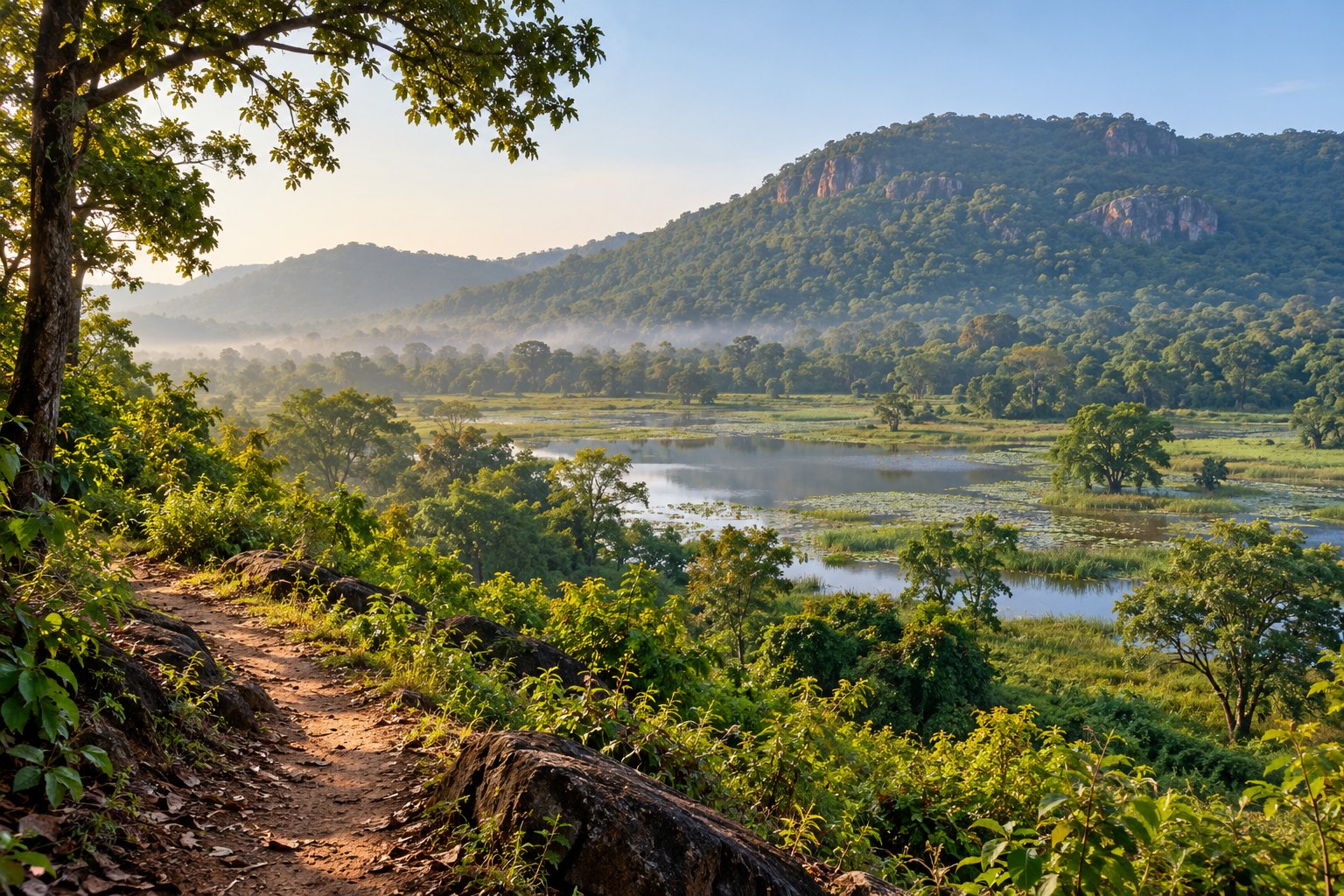
Bihar's forest-run eco-tourism society has invited bids to build 104 cottages, 12 tree-houses, a helipad and a spa on 12.9 acres inside Bhimbandh Wildlife Sanctuary. The tender, dated 16 October 2026, offers a private developer a 60-year concession for about Rs 62.87 crore of investment. Commercial lodges in a sanctuary need the National Board for Wildlife's prior approval.
Syllabus: Prelims · Environment & Ecology; GS3 · Environment & Conservation; GS2 · Governance & e-Governance
Why this matters for UPSC
GS3 environment: protected areas under the Wild Life (Protection) Act, 1972 and the National Board for Wildlife. Prelims can ask who approves commercial lodges in a sanctuary; Mains, eco-tourism against conservation.
Why it matters
A family booking a cottage at Bhimbandh would sleep inside a protected forest, not at its edge. That changes what the forest must absorb: helicopter landings, wedding crowds, vehicles, wastewater and lights, in hills where leopards, sloth bears and wolves still live. Once concrete stands, it is rarely removed, even if approval is later refused. The plan also puts the Forest Department in two roles at once. It is meant to guard the sanctuary, yet its own society is offering a private developer a 60-year concession inside it. That is the larger question across India: whether tourism inside protected areas pays for conservation or slowly turns wild land into a resort.
Prelims pointers
- A State Government declares a sanctuary by notification under the Wild Life (Protection) Act, 1972, for an area of ecological, faunal, floral or geomorphological significance.
- The Wild Life (Protection) Amendment Act, 2022 replaced "commercial tourist lodges" with "tourist lodges, including Government lodges, for commercial purposes", bringing state-run lodges under the approval rule.
- Sanctuary versus national park: both are declared by the State, but a national park bars all livestock grazing and its boundaries change only on the National Board's recommendation.
- A protected area under the 1972 Act means a national park, a sanctuary, a conservation reserve or a community reserve; a community reserve sits on private or community land.
- Parliament passed the 1972 Act under Article 252 after 11 State legislatures passed resolutions, as wildlife protection then lay in the State List.
Practise a UPSC-style question
With reference to the Wild Life (Protection) Act, 1972, consider the following statements:
1. Commercial tourist lodges inside a sanctuary need the prior approval of the National Tiger Conservation Authority.
2. The Chief Wild Life Warden is the authority who controls, manages and protects sanctuaries.
Which of the statements given above is/are correct?
- (a) 1 only
- (b) 2 only
- (c) Both 1 and 2
- (d) Neither 1 nor 2
Show the answer
Answer: (b) 2 only
Answer: (b) 2 only. The approval body is the National Board for Wildlife, not the tiger authority.
Statement 1: incorrect. Under the Wild Life (Protection) Act, 1972, tourist lodges for commercial purposes, hotels, zoos and safari parks inside a sanctuary need the National Board for Wildlife's prior approval.
Statement 2: correct. The Act makes the Chief Wild Life Warden the authority that controls, manages and protects all sanctuaries under approved management plans.
Eliminate: statement 1 names the wrong body, so it is incorrect, and statement 2 is correct. Out: (a), (c), (d).
Trap: Swapped attribution. The National Tiger Conservation Authority deals with tiger reserves; the approval for lodges in a sanctuary sits with the National Board for Wildlife.
Remember: lodges, hotels, zoos and safari parks in a sanctuary need the National Board's prior approval.
More from the 1 November 2026 edition
- BIMSTEC's seven members hold inaugural maritime security exercise World & IR
- Landslide in Odisha's Ganjam after Cyclone Arnab rain; NDRF joins search National
- CBD COP17 closes in Yerevan; Cali Fund design unresolved, Ecuador next host Environment
- Felling for Karjat pumped storage project paused after tribal villages protest Environment
- Chola-era bronzes of Nataraja and Sivakami found in Nagapattinam excavation National
- CAQM orders curbs on construction and 50% office attendance in Delhi-NCR Environment
- Supreme Court directs MeitY to curb misuse of live-streamed court hearings Polity
- World Bank's India poverty brief applies 2021 PPP lines to surveys Economy
- Supreme Court: a soured consensual relationship cannot be recast as rape Polity
- CCS clears eight next-generation corvettes for Navy at GRSE, Goa Shipyard Defence
- ISRO's GSLV-F18 places NavIC satellite NVS-03 in its intended orbit Sci-Tech
- UN Commission of Inquiry finds genocidal acts in Gaza continued after ceasefire World & IR