
Landslide in Odisha's Ganjam after Cyclone Arnab rain; NDRF joins search
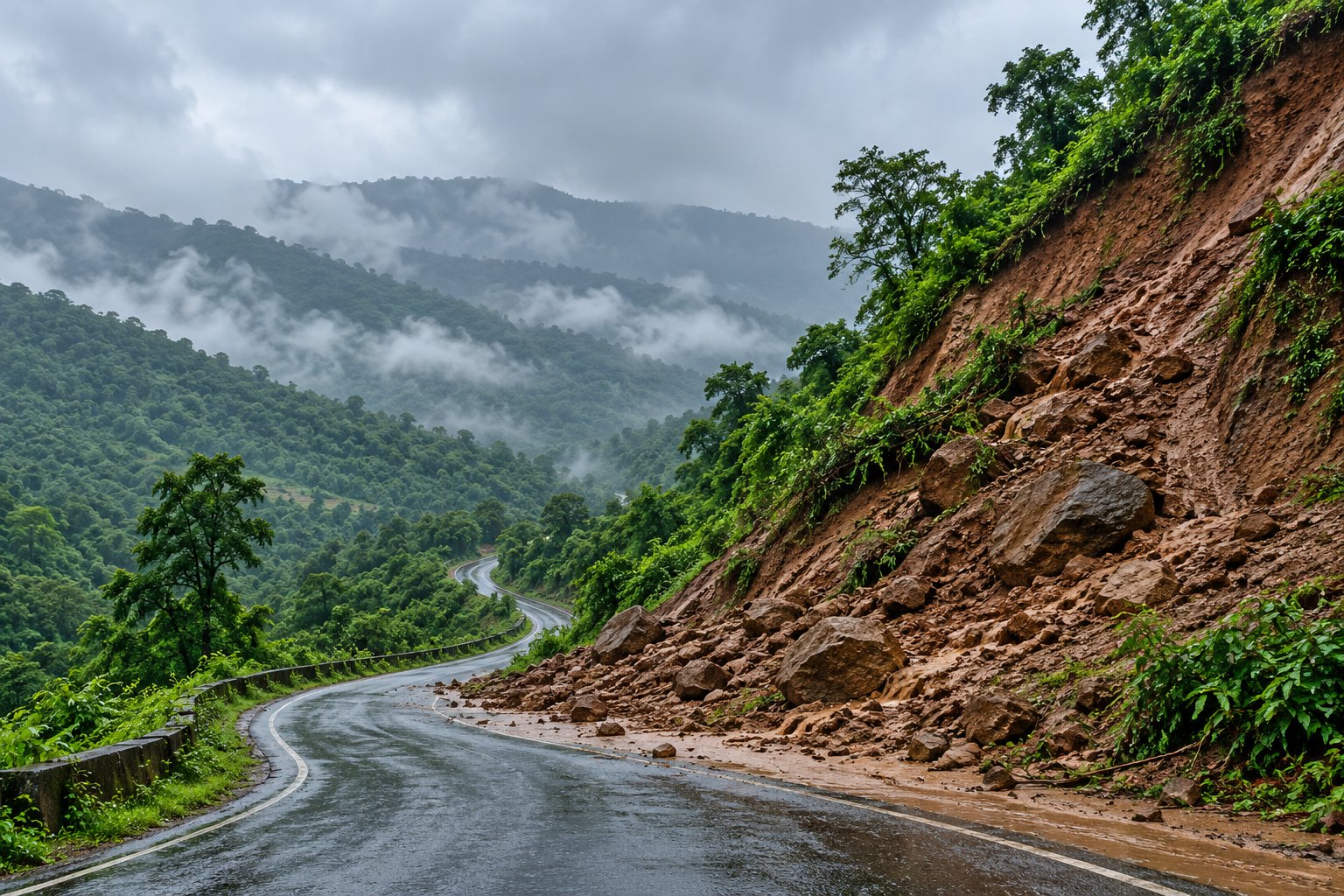
A landslide struck Gidipabali, a hilltop hamlet in Odisha's Ganjam district on the Ganjam-Kandhamal border, on 30 October 2026, after torrential rain from Cyclone Arnab. Twelve people remain missing and one was rescued alive, Odisha's special relief commissioner said. More than 170 personnel of the NDRF, ODRAF, fire services and Odisha Police are searching.
Syllabus: GS2 · Statutory & Regulatory Bodies; GS1 · Geophysical Phenomena; GS3 · Disaster Management
Why this matters for UPSC
GS3 disaster management: landslides, the NDMA and the NDRF under the Disaster Management Act, 2005. Prelims can ask who controls the NDRF; Mains, district-level landslide preparedness.
Why it matters
A family living on a hilltop in Ganjam faces a choice each time heavy rain arrives: stay with home and fields, or move to a shelter on an official's word. At Gidipabali, the half that moved survived the slide, while 12 of those who stayed are still missing. The case shows that saving lives in a landslide depends less on rescue after the event than on knowing in advance which slopes are unsafe and persuading people to leave in time. It also shows that cyclone rain can endanger hill villages well inland, far from the coast where cyclone warnings usually focus attention.
Prelims pointers
- The NDMA's chairperson is the Prime Minister; its mandate under the Disaster Management Act, 2005 is to lay down disaster management policies, plans and guidelines.
- NDMA's June 2009 national guideline covers landslides and snow avalanches together; the Ministry of Mines and the Geological Survey of India are its nodal ministry and agency.
- The NDMA sets disaster policy; the NDRF, under its general control, is the force for specialist response, commanded by a Director General the Centre appoints.
- Every State Government sets up a District Disaster Management Authority for each district, which follows the guidelines of the national and State authorities.
- NDMA's strategy lists major past landslides: Malpa 1998 and Varunavat Parvat 2003 (Uttarakhand), Malin 2014 (Pune, Maharashtra), Mirik 2015 (West Bengal), Kohima 1993 (Nagaland).
- NDMA ranks landslides high among hydrogeological hazards, affecting the Himalayan and other hilly regions of India.
Practise a UPSC-style question
With reference to the National Disaster Response Force (NDRF), consider the following statements:
1. It is constituted under the Disaster Management Act, 2005 for specialist response to a disaster or a threatening disaster situation.
2. Its general superintendence, direction and control vest in the National Disaster Management Authority.
Which of the statements given above is/are correct?
- (a) 1 only
- (b) 2 only
- (c) Both 1 and 2
- (d) Neither 1 nor 2
Show the answer
Answer: (c) Both 1 and 2
Answer: (c) Both 1 and 2. The Act creates the force and places its general control with the NDMA.
Statement 1: correct. The Disaster Management Act, 2005 constitutes the NDRF for specialist response to a threatening disaster situation or disaster.
Statement 2: correct. The same Act vests the general superintendence, direction and control of the force in the National Disaster Management Authority.
Eliminate: Statement 1 is the force's founding purpose and is true. Out: (b), (d).
Eliminate: Statement 2 is also true, as the NDMA holds general control. Out: (a).
Trap: Swapped attribution. Many students credit control of the NDRF to the Ministry of Home Affairs and so reject statement 2; the Act gives general control to the NDMA.
Remember: NDMA controls the NDRF; a Director General appointed by the Centre commands it.
More from the 1 November 2026 edition
- BIMSTEC's seven members hold inaugural maritime security exercise World & IR
- CBD COP17 closes in Yerevan; Cali Fund design unresolved, Ecuador next host Environment
- Felling for Karjat pumped storage project paused after tribal villages protest Environment
- Bihar tender seeks cottages and helipad inside Bhimbandh Wildlife Sanctuary Environment
- Chola-era bronzes of Nataraja and Sivakami found in Nagapattinam excavation National
- CAQM orders curbs on construction and 50% office attendance in Delhi-NCR Environment
- Supreme Court directs MeitY to curb misuse of live-streamed court hearings Polity
- World Bank's India poverty brief applies 2021 PPP lines to surveys Economy
- Supreme Court: a soured consensual relationship cannot be recast as rape Polity
- CCS clears eight next-generation corvettes for Navy at GRSE, Goa Shipyard Defence
- ISRO's GSLV-F18 places NavIC satellite NVS-03 in its intended orbit Sci-Tech
- UN Commission of Inquiry finds genocidal acts in Gaza continued after ceasefire World & IR