
ISRO's GSLV-F18 places NavIC satellite NVS-03 in its intended orbit
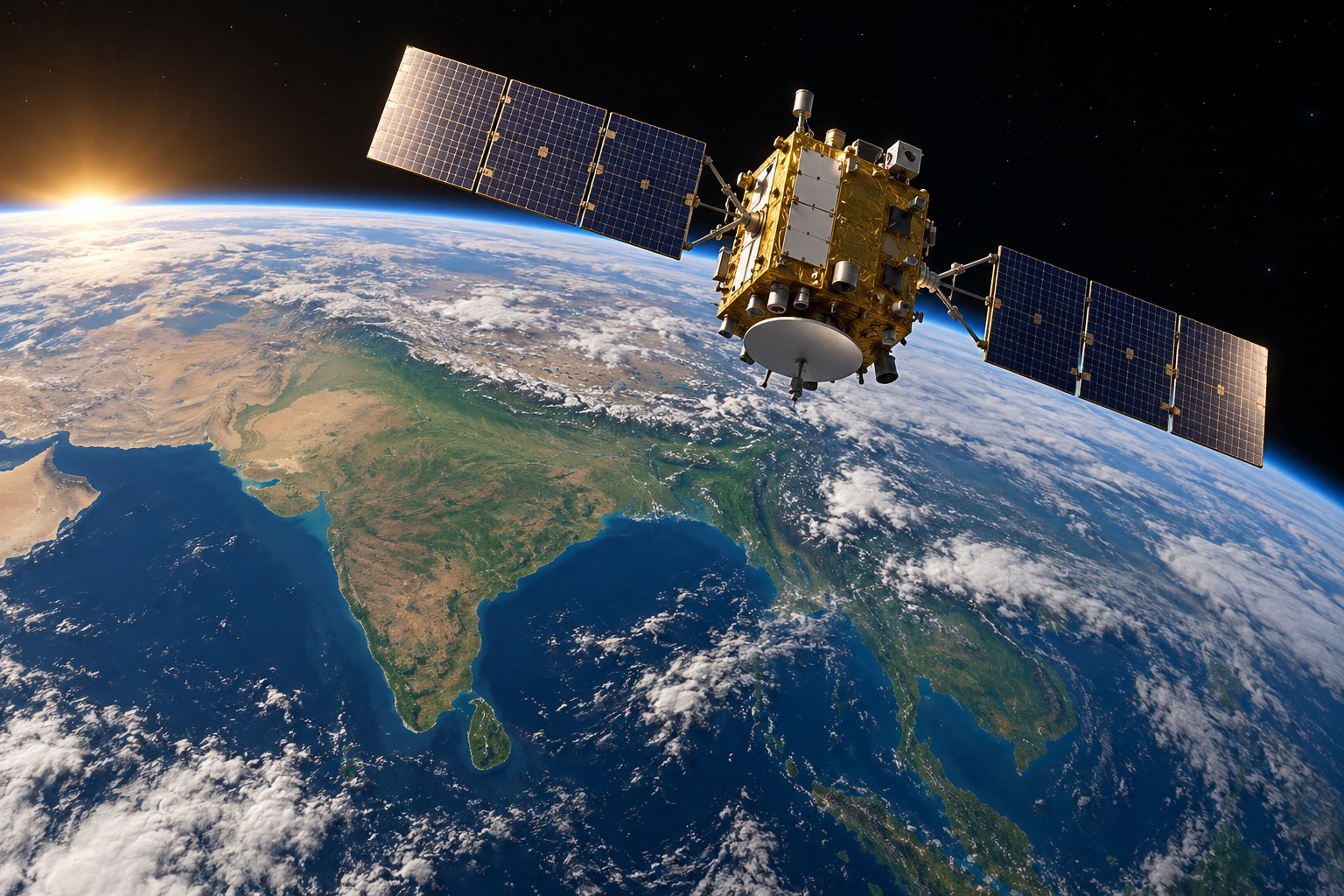
The Indian Space Research Organisation (ISRO) launched the 2,250-kg navigation satellite NVS-03 on GSLV-F18 from Sriharikota on 30 October 2026. ISRO said the mission was completed and the satellite reached its intended orbit. The satellite is meant to help revive NavIC, India's own regional navigation system.
Syllabus: Prelims · Current Affairs & IR; GS3 · Indian Achievements in S&T; GS3 · IT, Space, Biotech & IPR
Why this matters for UPSC
GS3 science and technology: India's space programme and NavIC, its regional navigation system. Prelims can ask NavIC's coverage, services and the GSLV; Mains, self-reliance in satellite navigation.
Why it matters
A trawler crew at sea, a fleet operator tracking trucks or a relief team in a cyclone zone can fix position from NavIC as well as from foreign systems. With so few satellites working, NavIC cannot promise that fix without gaps, so civilian and strategic users fall back on systems that other countries control and can restrict. Each working NVS satellite brings back some of that independence. A home-made clock matters because failing clocks are what hollowed out the first generation, and an Indian-built clock is one less part to import. The larger issue is whether India can replace satellites as fast as they age.
Prelims pointers
- NavIC's primary service area is India and about 1,500 km around it; an extended service area reaches 30 degrees South to 50 degrees North.
- NavIC's designed constellation has seven satellites: three in geostationary orbit and four in geosynchronous orbit inclined at 29 degrees to the equator.
- NavIC's Standard Positioning Service is open to all users; its Restricted Service is encrypted and given only to authorised users.
- Look-alike: NavIC is an independent regional navigation system; GAGAN (GPS Aided GEO Augmented Navigation) is ISRO and the Airports Authority of India's system that corrects GPS for aviation.
- Global navigation systems: GPS is the United States', GLONASS Russia's and BeiDou China's; NavIC serves a region, not the whole globe.
- The GSLV has three stages: a solid core with four liquid strap-ons, a liquid second stage and a cryogenic third stage burning liquid hydrogen and liquid oxygen.
- NavIC's system time is a weighted average of several atomic clocks; the design aims at position accuracy of about 20 m or better.
Practise a UPSC-style question
With reference to NavIC (Navigation with Indian Constellation), consider the following statements:
1. Its primary service area covers India and a region extending about 1,500 km beyond its boundary.
2. Its Standard Positioning Service is encrypted and offered only to authorised users.
3. Its designed constellation has three satellites in geostationary orbit and four in inclined geosynchronous orbit.
Which of the statements given above is/are correct?
- (a) 1 and 2 only
- (b) 2 and 3 only
- (c) 1 and 3 only
- (d) 1, 2 and 3
Show the answer
Answer: (c) 1 and 3 only
Answer: (c) 1 and 3 only. The open and the encrypted services are swapped in statement 2.
Statement 1: correct. ISRO describes NavIC's primary service area as India and the region extending about 1,500 km from its boundary.
Statement 2: incorrect. The Standard Positioning Service is open to all users; the Restricted Service is the encrypted one for authorised users.
Statement 3: correct. ISRO's Space Applications Centre gives the design as seven satellites: three geostationary and four geosynchronous inclined at 29 degrees.
Eliminate: statement 2 is wrong, since the open service is not encrypted. Out: (a), (b), (d).
Trap: Swapped attribution. The encryption that belongs to the Restricted Service is pinned on the Standard Positioning Service.
Remember: NavIC has two services, open SPS for all and encrypted RS for authorised users.
More from the 1 November 2026 edition
- BIMSTEC's seven members hold inaugural maritime security exercise World & IR
- Landslide in Odisha's Ganjam after Cyclone Arnab rain; NDRF joins search National
- CBD COP17 closes in Yerevan; Cali Fund design unresolved, Ecuador next host Environment
- Felling for Karjat pumped storage project paused after tribal villages protest Environment
- Bihar tender seeks cottages and helipad inside Bhimbandh Wildlife Sanctuary Environment
- Chola-era bronzes of Nataraja and Sivakami found in Nagapattinam excavation National
- CAQM orders curbs on construction and 50% office attendance in Delhi-NCR Environment
- Supreme Court directs MeitY to curb misuse of live-streamed court hearings Polity
- World Bank's India poverty brief applies 2021 PPP lines to surveys Economy
- Supreme Court: a soured consensual relationship cannot be recast as rape Polity
- CCS clears eight next-generation corvettes for Navy at GRSE, Goa Shipyard Defence
- UN Commission of Inquiry finds genocidal acts in Gaza continued after ceasefire World & IR