
ASI begins fresh excavation at Kashipur (Govisana), Uttarakhand
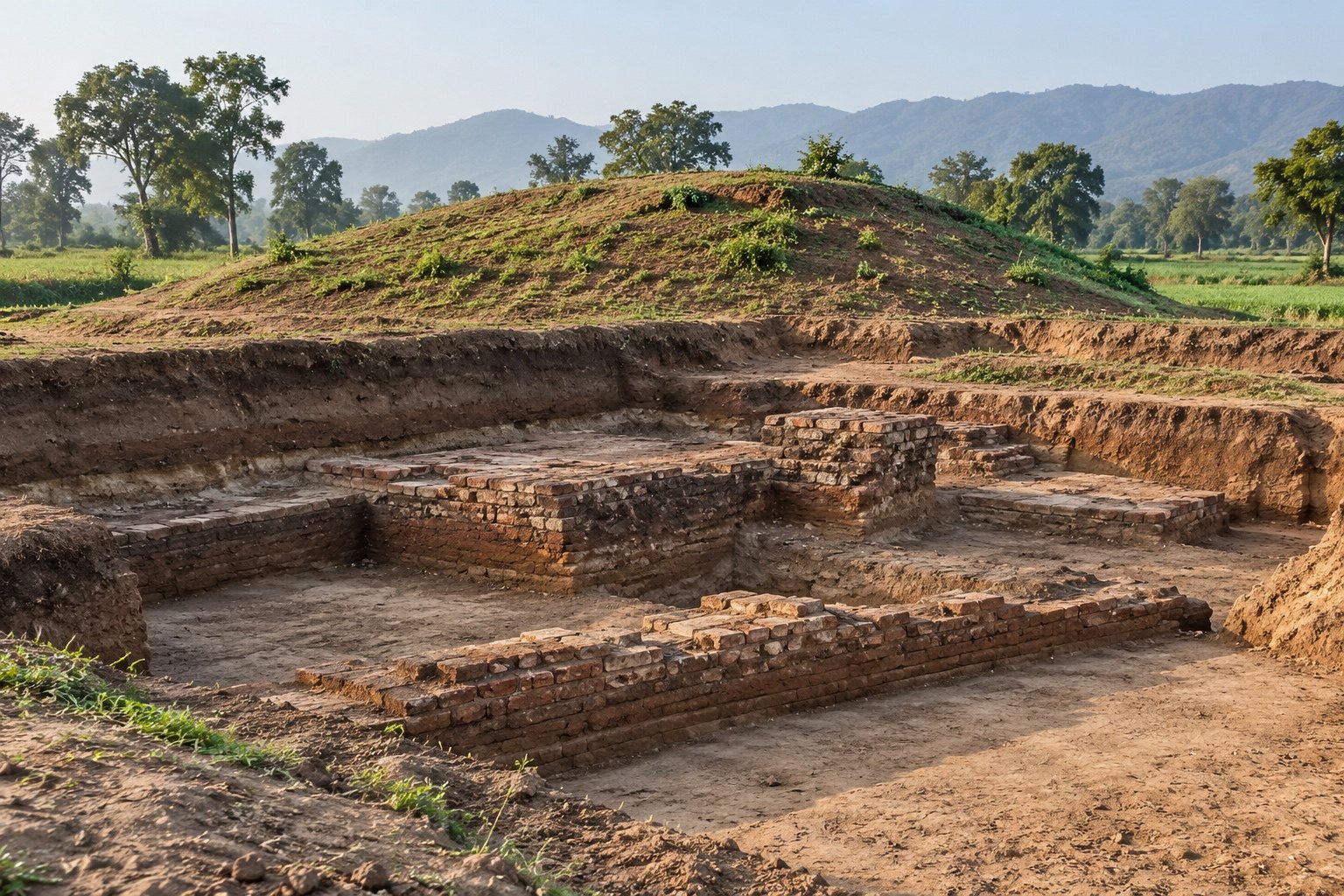
The Archaeological Survey of India (ASI) this week began a fresh excavation at the Kashipur mound in Udham Singh Nagar, Uttarakhand, which Alexander Cunningham identified with Govisana in Xuanzang's account. The Dehradun Circle expects to dig until March, seeking scientific evidence for earlier finds and the site's full cultural sequence.
Syllabus: GS1 · Art & Culture; Prelims · History & Culture
Why this matters for UPSC
GS1 art and culture: Prelims can ask Xuanzang's Govisana, Cunningham's identification, the Panchayatana plan, Painted Grey Ware sites and the heritage laws from 1810 to 1972; GS1 Mains, how archaeology tests tradition.
Why it matters
A mound in Uttarakhand holds many centuries of Indian life in layers: pots, coins, bangles and a temple rebuilt over centuries. Until now it was dug only to trace one building, so nobody knows the full order of who lived there and when. Careful digging and scientific dating can turn a local legend and a Chinese pilgrim's note into checked history, and tell scholars how early towns of north India grew. For residents, a protected and studied site can bring visitors and jobs, but it also means rules on digging and building in the protected area.
Prelims pointers
- Ancient Monuments and Archaeological Sites and Remains Act, 1958 (No. 24 of 1958): enacted 28 August 1958; in force with its Rules from 15 October 1959.
- The 1958 Act repealed the Ancient and Historical Monuments and Archaeological Sites and Remains (Declaration of National Importance) Act, 1951.
- Antiquities and Art Treasures Act, 1972: regulates the antiquities export trade and curbs smuggling; in force from 5 April 1976; repealed the 1947 export control Act.
- Bengal Regulation XIX of 1810 was India's first antiquarian law; the Ancient Monuments Preservation Act, 1904 was never repealed.
- In 1886 Director General James Burgess secured orders barring any excavation without the Archaeological Survey's prior consent.
- Alexander Cunningham became the first Archaeological Surveyor in December 1861 and took charge as Director General in February 1871.
- Painted Grey Ware in the Uttarakhand hills: a single PGW phase at Thapli (Tehri, on the Alaknanda) and PGW from the earliest level at Purola (Uttarkashi).
Practise a UPSC-style question
With reference to Kashipur in Uttarakhand, consider the following statements:
1. Alexander Cunningham identified Kashipur with Govisana, a kingdom described by Xuanzang.
2. Xuanzang, who described Govisana, travelled from China to India in the seventh century AD.
Which of the statements given above is/are correct?
- (a) 1 only
- (b) 2 only
- (c) Both 1 and 2
- (d) Neither 1 nor 2
Show the answer
Answer: (c) Both 1 and 2
Answer: (c) Both 1 and 2. Cunningham's identification and the pilgrim's century both hold.
Statement 1: correct. The ASI records that Cunningham identified Kashipur with Kiu-pi-shwang-na of Xuanzang, which Julien rendered as Govisana.
Statement 2: correct. Xuanzang travelled from China to India in the seventh century AD along the Silk Road.
Eliminate: Statement 1 is the ASI's own record of Cunningham's identification. Out: (b), (d).
Eliminate: Statement 2 holds as well, as Xuanzang's journey was in the seventh century. Out: (a).
Trap: Near-miss figure. Some reports place Xuanzang in the sixth century, so a student who trusts them marks statement 2 incorrect.
Remember: Govisana = Kashipur (Cunningham); Xuanzang = seventh century AD.
More from the 22 October 2026 edition
- Tamil Nadu orders State-wide rainwater harvesting drive as a mass movement Environment
- Counter-drone air defence: MoD signs BEL contract for LLLR-I low-level radars Defence
- Bihar relaxes VB-G RAM G farm-season pause for 38 disaster-hit districts National
- PARAKH turns PRS 2024 learning gaps into monthly district action National
- UNEP Emissions Gap Report 2026: 1.5°C without overshoot is lost Environment
- Vienna Conventions: India presses mission protection at UN Sixth Committee World & IR
- India tells UN Third Committee its safeguards against enforced disappearance World & IR
- India reiterates call for binding PAROS treaty at UNGA First Committee World & IR
- WHO report maps within-country NCD inequalities: 35 indicators, up to eight dimensions World & IR
- Mecca Joint Defence Agreement goes to Turkey's parliament for ratification World & IR
- TV Programme Code: I&B advisory follows Inter-Departmental Committee's findings Polity
- Ladakh dissolves Kargil hill council, sets panchayat polls for 21 November Polity