
Bihar relaxes VB-G RAM G farm-season pause for 38 disaster-hit districts
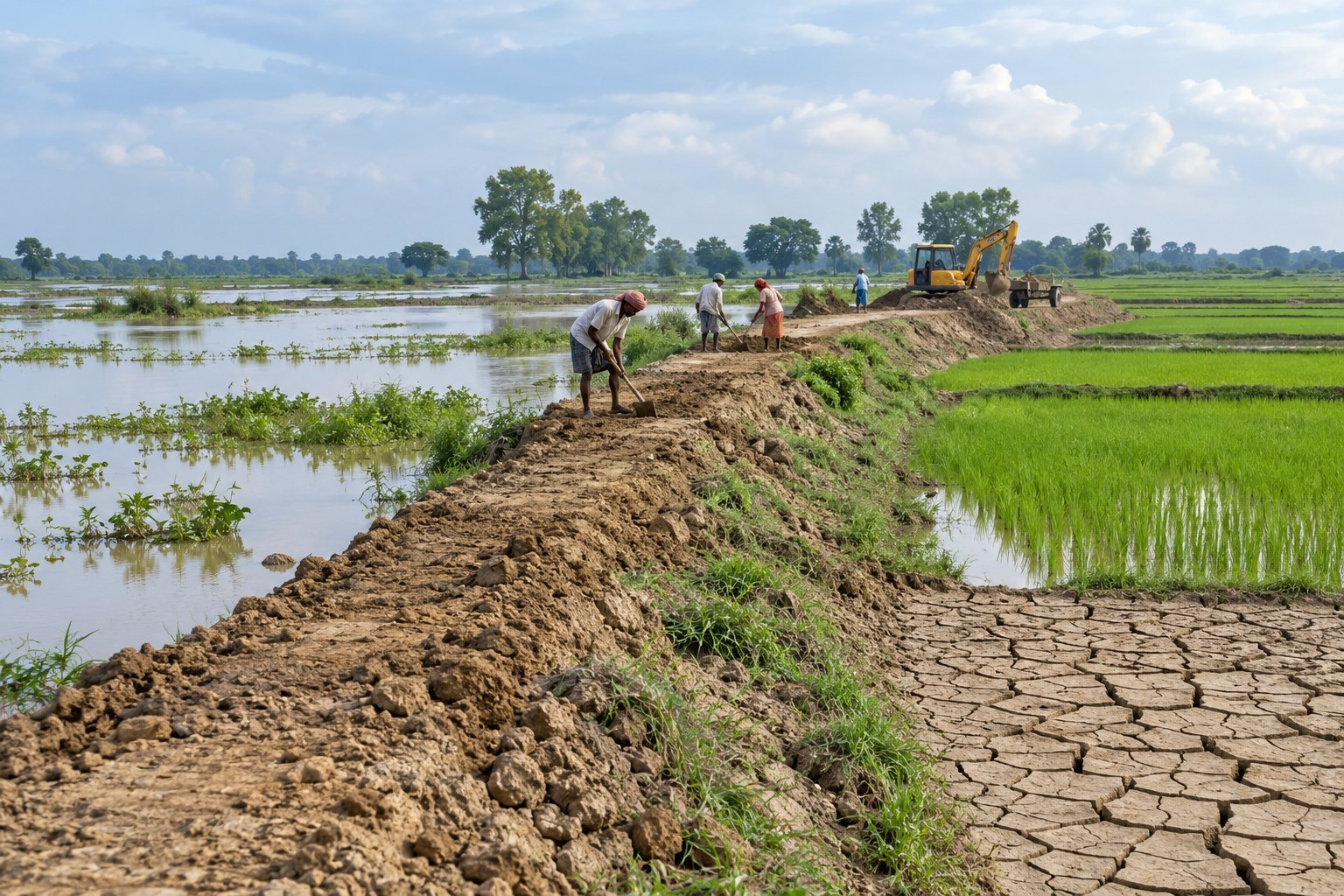
Bihar's Rural Development Department has relaxed the farm-season pause on VB-G RAM G works in 22 flood-hit and 16 drought-hit districts, it said on 21 October, so work can continue through the break notified from 22 October. The order cites flood repairs, a slump in farm jobs and workers returning home for festivals.
Syllabus: GS3 · Indian Economy & Growth; GS2 · Federalism & Local Government; GS2 · Welfare of Vulnerable Sections
Why this matters for UPSC
GS2 welfare schemes and Centre-State relations; GS3 disaster management. Prelims can ask what the VB-G RAM G Act, 2025 says on the farm-season pause and calamity relaxations; Mains, how a job guarantee should respond to floods and drought.
Why it matters
For a landless labourer in a flooded or parched Bihar village, this season offers little farm work: crops have been damaged and farmers need fewer hands. Had the pause stood, public works would have stopped too, leaving such families with neither farm wages nor scheme wages and pushing more men to leave in search of work. With the relaxation, they can earn near home by mending the roads, culverts and embankments the floods broke, and workers back for the festivals can find jobs. The larger issue is design: a pause meant to protect farm labour in a normal year can hurt the same labourers in a disaster year, so the law needs a quick, clear way to set it aside.
Prelims pointers
- Section 6 also lets a State issue distinct pause notifications for districts, blocks or Gram Panchayats by agro-climatic zones or farming patterns; each binds all authorities.
- Section 6 bars works from being commenced or executed in notified peak seasons, so works under way stop too; authorities must schedule all works outside them.
- Section 7 relaxations may include temporary expansion of permissible works, relaxed documentation norms or enhanced wage employment provisioning.
- Section 5: beyond the 125 guaranteed days, the Centre or a State may provide more work within the limits of its economic capacity and development.
- Funding: a Centrally Sponsored Scheme, with a larger Central share for North-Eastern and Himalayan States; the Centre fixes each State's normative allocation, and the State pays any excess.
- Schedule of permissible works (Ministry of Rural Development, notified October 2026): 375 works in four categories; 38 cover extreme weather events and disaster preparedness, such as embankment strengthening.
- Bihar's VB-G RAM G Scheme, 2026: in a calamity causing mass dislocation, households may register and seek work where they are relocated; those days count toward the 125-day guarantee.
- Kosi: a transboundary river of Tibet, Nepal and India, called the 'sorrow of Bihar' for its shifting course; rain in Nepal, silt and the Ganga's level shape its floods.
Practise a UPSC-style question
With reference to natural calamities under the VB-G RAM G Act, 2025, consider the following statements:
1. Special operational relaxations are made by the State Government on the recommendation of its State Gramin Rozgar Guarantee Council.
2. Relaxations made for a calamity may include relaxed documentation norms and enhanced wage employment provisioning.
Which of the statements given above is/are correct?
- (a) 1 only
- (b) 2 only
- (c) Both 1 and 2
- (d) Neither 1 nor 2
Show the answer
Answer: (b) 2 only
Answer: (b) 2 only. The Act lets a State recommend relaxations, but the Central Government makes them.
Statement 1: incorrect. Section 7 lets a State Government recommend relaxations to the Central Government, which makes them or declares them itself.
Statement 2: correct. Section 7 names temporary expansion of permissible works, relaxed documentation norms and enhanced wage employment provisioning.
Eliminate: Judge statement 1 first: under section 7 the State recommends and the Centre decides, so statement 1 is incorrect. Out: (a), (c).
Eliminate: Statement 2 repeats the relaxations section 7 names, so it is correct. Out: (d).
Trap: Swapped attribution. The power to relax is moved from the Centre to the State, which a student may assume because States run the scheme.
Remember: VB-G RAM G calamity relaxations: the State recommends, the Centre makes them (section 7).
Explainers on this topic
More from the 22 October 2026 edition
- Tamil Nadu orders State-wide rainwater harvesting drive as a mass movement Environment
- Counter-drone air defence: MoD signs BEL contract for LLLR-I low-level radars Defence
- PARAKH turns PRS 2024 learning gaps into monthly district action National
- UNEP Emissions Gap Report 2026: 1.5°C without overshoot is lost Environment
- Vienna Conventions: India presses mission protection at UN Sixth Committee World & IR
- India tells UN Third Committee its safeguards against enforced disappearance World & IR
- India reiterates call for binding PAROS treaty at UNGA First Committee World & IR
- WHO report maps within-country NCD inequalities: 35 indicators, up to eight dimensions World & IR
- Mecca Joint Defence Agreement goes to Turkey's parliament for ratification World & IR
- TV Programme Code: I&B advisory follows Inter-Departmental Committee's findings Polity
- Ladakh dissolves Kargil hill council, sets panchayat polls for 21 November Polity
- ASI begins fresh excavation at Kashipur (Govisana), Uttarakhand National