
India reiterates call for binding PAROS treaty at UNGA First Committee
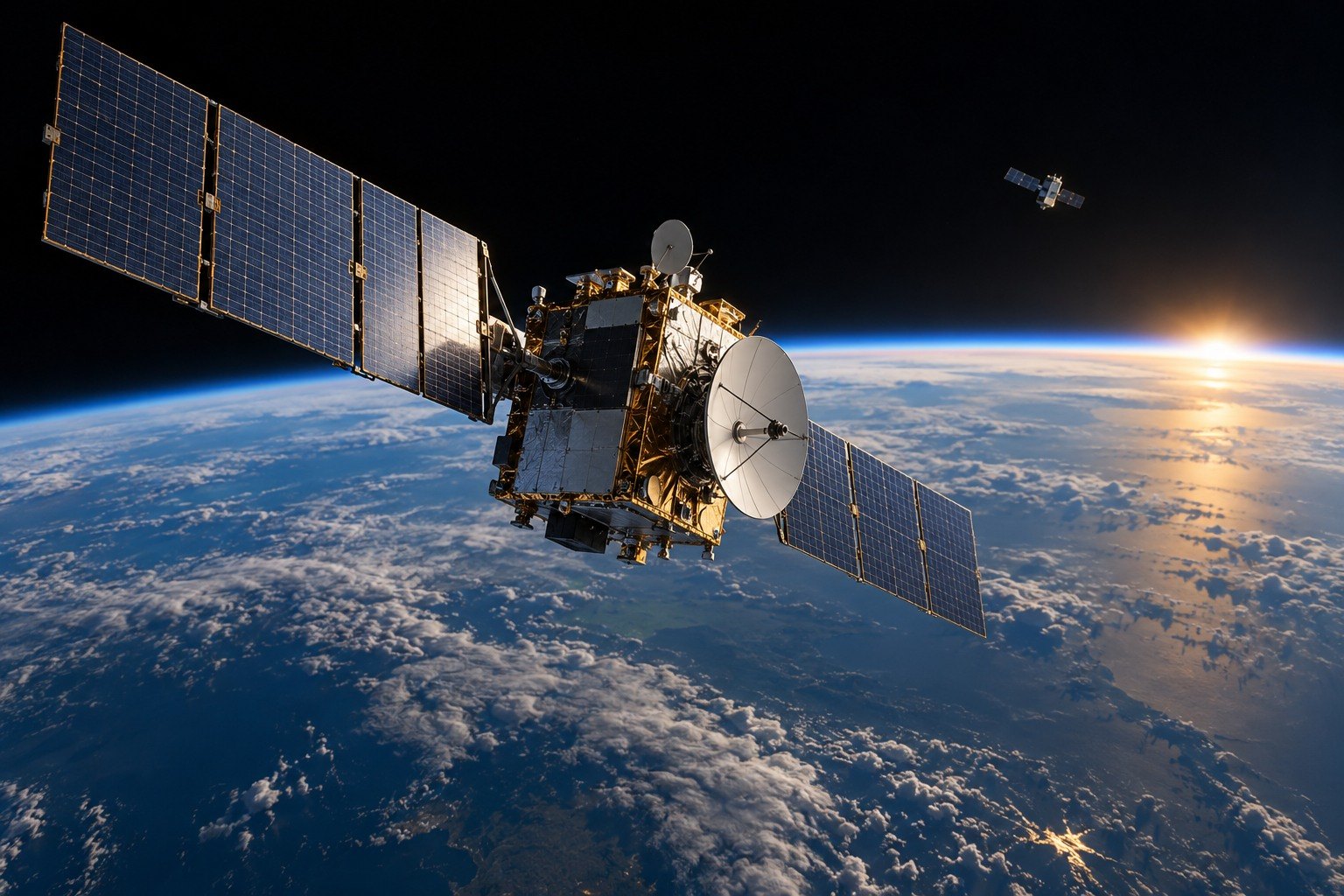
India told the UN General Assembly's First Committee on 20 October 2026 that it prefers a legally binding, verifiable instrument on the Prevention of an Arms Race in Outer Space (PAROS), negotiated at the Conference on Disarmament. Rajya Sabha MP Sudha Murty said non-binding norms can complement, not replace, it. The stand repeats India's 2025 statements.
Syllabus: Prelims · Current Affairs & IR; GS3 · IT, Space, Biotech & IPR; GS2 · Groupings & Agreements
Why this matters for UPSC
GS2 international institutions and GS3 space: Prelims can ask what Article IV of the Outer Space Treaty bans, what the Conference on Disarmament is and which UN space treaties India has ratified; Mains, on binding treaties versus norms for space security.
Why it matters
A fisherman reading a weather alert, a family making a bank payment and a district officer tracking a cyclone all lean on satellites for navigation and forecasts. If countries begin placing weapons in orbit or shooting satellites down, those services can fail at once, and debris from one strike can endanger every other satellite on the same path. India has more at stake now: it plans to send its own astronauts up and to run a national space station. That is why it wants rules every country must obey, checked by agreed means, instead of promises a state can drop when it suits. The larger question is whether a domain shared by all can stay free of an arms race while the same technologies serve both civil and military ends.
Prelims pointers
- Outer Space Treaty, 1967: opened for signature on 27 January 1967 in London, Moscow and Washington; in force 10 October 1967; depositaries Russia, the UK and the US.
- Article II of the Outer Space Treaty: outer space, the Moon and celestial bodies cannot be appropriated by any nation by claim of sovereignty, use or occupation.
- Article VI of the Outer Space Treaty: States bear international responsibility for national space activities, including those of non-governmental entities, which need authorisation and supervision.
- India's status (UNOOSA, as at 1 January 2025): ratified the Outer Space Treaty, Rescue Agreement, Liability Convention and Registration Convention; signed but not ratified the Moon Agreement.
- Draft PPWT: introduced at the Conference on Disarmament by China and Russia in 2008; a revised draft followed in 2014.
- No first placement resolutions: adopted by the UN General Assembly every year since 2014 (resolution 69/32), at Russia's initiative.
- UNGA resolution 77/41 (2022), moved by the United States, calls on States not to conduct destructive direct-ascent anti-satellite missile tests.
- Conference on Disarmament: works by consensus and reports to the UN General Assembly; it negotiated the Chemical Weapons Convention and the Comprehensive Nuclear-Test-Ban Treaty.
Practise a UPSC-style question
With reference to the Outer Space Treaty, 1967, consider the following statements:
1. It bars States Parties from placing in orbit around the Earth any object carrying nuclear weapons.
2. It bars States Parties from testing any type of weapon in orbit around the Earth.
Which of the statements given above is/are correct?
- (a) 1 only
- (b) 2 only
- (c) Both 1 and 2
- (d) Neither 1 nor 2
Show the answer
Answer: (a) 1 only
Answer: (a) 1 only. Article IV bans weapons of mass destruction in orbit; its weapon-test ban covers celestial bodies, not orbit.
Statement 1: correct. Article IV forbids placing in orbit any object carrying nuclear weapons or other weapons of mass destruction.
Statement 2: incorrect. Article IV forbids testing any type of weapon on the Moon and other celestial bodies; it says nothing of weapon tests in Earth orbit.
Eliminate: Statement 2 moves the celestial-body test ban into orbit, so it is wrong. Out: (b), (c).
Eliminate: Statement 1 is the core of Article IV. Out: (d).
Trap: Wrong scope. The weapon-test ban is real but applies to celestial bodies; the statement widens it to all of orbit.
Remember: Orbit: no WMD. Moon and celestial bodies: no bases, tests or manoeuvres.
More from the 22 October 2026 edition
- Tamil Nadu orders State-wide rainwater harvesting drive as a mass movement Environment
- Counter-drone air defence: MoD signs BEL contract for LLLR-I low-level radars Defence
- Bihar relaxes VB-G RAM G farm-season pause for 38 disaster-hit districts National
- PARAKH turns PRS 2024 learning gaps into monthly district action National
- UNEP Emissions Gap Report 2026: 1.5°C without overshoot is lost Environment
- Vienna Conventions: India presses mission protection at UN Sixth Committee World & IR
- India tells UN Third Committee its safeguards against enforced disappearance World & IR
- WHO report maps within-country NCD inequalities: 35 indicators, up to eight dimensions World & IR
- Mecca Joint Defence Agreement goes to Turkey's parliament for ratification World & IR
- TV Programme Code: I&B advisory follows Inter-Departmental Committee's findings Polity
- Ladakh dissolves Kargil hill council, sets panchayat polls for 21 November Polity
- ASI begins fresh excavation at Kashipur (Govisana), Uttarakhand National