
Centre forms Ramesh Chand committee on sugarcane farmers' pricing concerns
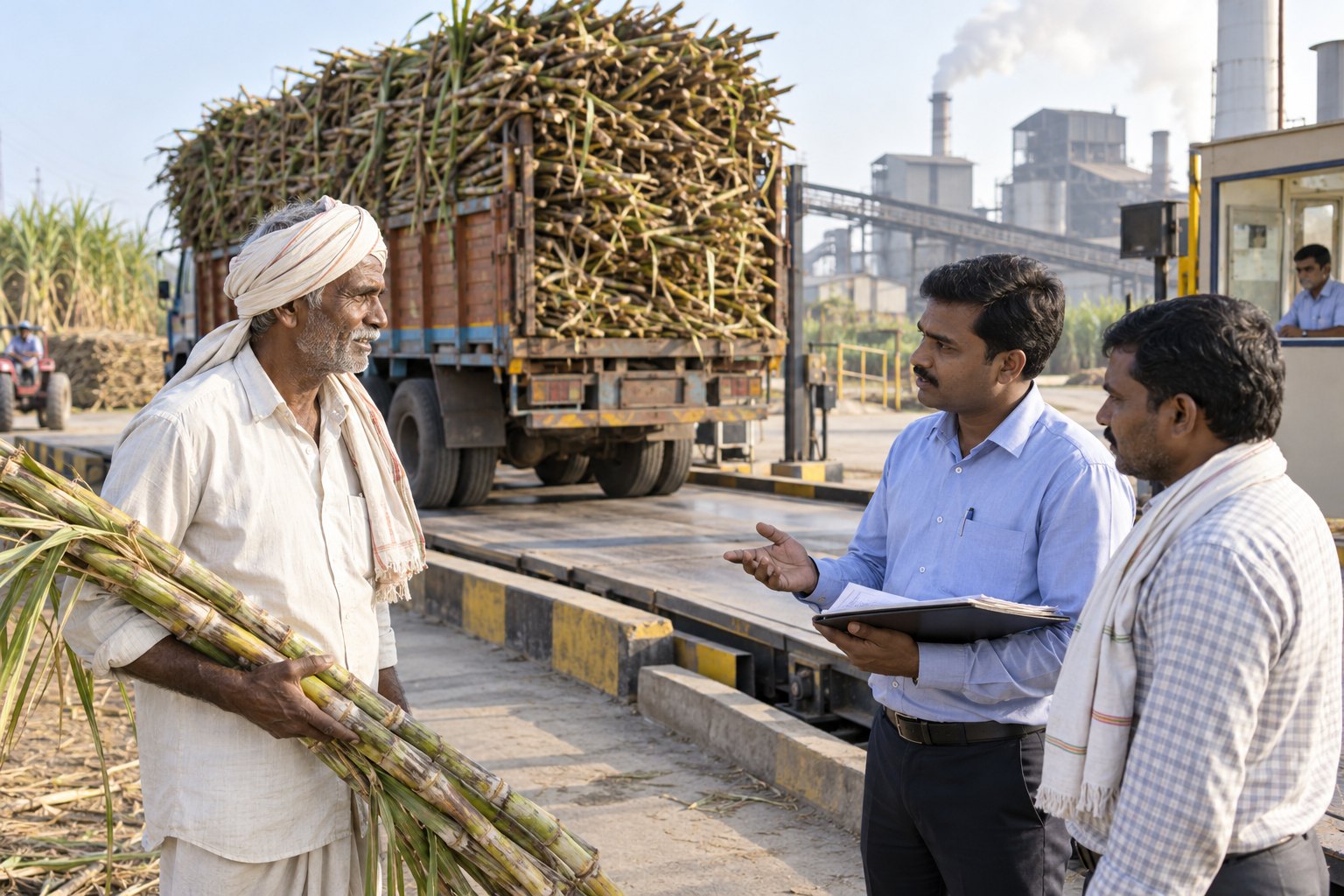
The Union government has constituted a four-member committee under Prof. Ramesh Chand, former Member of NITI Aayog, to examine sugarcane farmers' concerns, the Ministry of Consumer Affairs, Food and Public Distribution announced on 14 October 2026. It will study farmers' returns, the ex-mill Minimum Selling Price of sugar, sugar recovery testing, weighment at mills and weight deductions on machine-harvested cane.
Syllabus: GS3 · Agriculture & Irrigation; GS3 · MSP, Subsidies & Food Security; GS3 · Food Processing
Why this matters for UPSC
GS3 (agricultural pricing, farm subsidies and the sugar sector): Prelims can ask who fixes the Fair and Remunerative Price and under which Order, or what the Legal Metrology Act, 2009 covers; Mains, about fair prices and fair measurement for cane growers.
Why it matters
A cane farmer is paid by the weight of the cane delivered and by the sugar the mill says it contains. If a weighbridge reads light, or a mill cuts a fixed share from machine-harvested cane that lost less in the field, the farmer loses money on every load without seeing why. Mills sit on the other side: they can pay growers on time only if sugar sells for enough, which is why the sugar price floor is in the same review. The committee's findings could lead to clearer testing and weighing rules and a fresh look at both prices, but only after the government accepts them. The larger issue is trust between growers and mills in a crop where a few measurements set the farmer's income.
Prelims pointers
- Sugarcane (Control) Order, 1966: issued under Section 3 of the Essential Commodities Act, 1955; its clause 3 lets the Central Government fix the FRP by Gazette notification.
- FRP factors in clause 3 include cost of production, returns from alternative crops, sugar recovery, by-product realisation and reasonable margins for growers for risk and profit.
- Cane payment: under the 1966 Order a mill must pay for cane within 14 days of delivery; a later payment carries interest.
- FRP for sugar season 2026-27 (October-September): Rs 365 per quintal at 10.25% basic recovery, approved by the CCEA on 5 May 2026.
- CACP: set up in 1965 as the Agricultural Prices Commission, renamed in 1985; it works under the Ministry of Agriculture and Farmers Welfare.
- Sugar price floor: first fixed at Rs 29/kg in June 2018 under the Sugar Price (Control) Order, 2018; raised to Rs 31/kg in February 2019.
- Sugar (Control) Order, 2025: folds sugar price control into one order and covers khandsari units above 500 tonnes crushed a day (PIB, 1 May 2025).
- Legal Metrology Act, 2009: in force from 1 April 2011; it repealed the Standards of Weights and Measures Act, 1976 and its 1985 Enforcement Act.
Practise a UPSC-style question
With reference to the Fair and Remunerative Price (FRP) of sugarcane in India, consider the following statements:
1. It is fixed by the Central Government under the Sugarcane (Control) Order, 1966.
2. It is fixed on the recommendation of NITI Aayog after consultation with State Governments.
3. The recovery of sugar from sugarcane is one of the factors to be considered in fixing it.
Which of the statements given above is/are correct?
- (a) 1 and 2 only
- (b) 2 and 3 only
- (c) 1 and 3 only
- (d) 1, 2 and 3
Show the answer
Answer: (c) 1 and 3 only
Answer: (c) 1 and 3 only. The Centre fixes the FRP under the 1966 Order, and recovery is a listed factor, but the recommending body is the CACP.
Statement 1: correct. Clause 3 of the Sugarcane (Control) Order, 1966, issued under the Essential Commodities Act, 1955, lets the Central Government fix the FRP.
Statement 2: incorrect. The FRP is fixed on the recommendation of the Commission for Agricultural Costs and Prices (CACP), not NITI Aayog, after consulting State Governments.
Statement 3: correct. Clause 3 lists the recovery of sugar from sugarcane among the factors, and the FRP is set for a basic recovery rate.
Eliminate: statement 2 is the surest; the CACP, not NITI Aayog, recommends the FRP. Out: (a), (b), (d).
Trap: Swapped attribution. The FRP process is right, but the recommending body is replaced by NITI Aayog, which this news names only through its former Member.
Remember: FRP of cane: Centre fixes it under the Sugarcane (Control) Order, 1966, on the CACP's recommendation.
More from the 15 October 2026 edition
- IMF Fiscal Monitor urges better tax design as sovereign yields rise Economy
- DoT orders Calling Name Presentation on 4G and above from 1 November National
- India asks OHCHR at UN Third Committee for PoK rights report World & IR
- Article 243E: Allahabad HC orders UP panchayat polls within three months Polity
- India leads IBSAMAR IX naval exercise with Brazil, South Africa Defence
- Cholera spreads across 21 DR Congo provinces, WHO warns Sci-Tech
- NITI Aayog paper proposes 9.5% social discount rate for public projects Economy
- Supreme Court: professional course fees fixed before admission, not midstream Polity
- UN Security Council renews Haiti sanctions regime for a year World & IR
- Privacy: Supreme Court quashes police notice to X for journalist's data Polity
- Draft rules propose BS-VII emission norms for new cars from April 2029 Environment
- Keralam Bill proposes registering elder-care centres, recognising living wills National