
One Nation, One Election: Kovind committee and the 129th Amendment Bill
Why in news: On 29 July 2026 the Lok Sabha extended the JPC's tenure on the Bill to the first day of the 2026 Winter Session's last week.
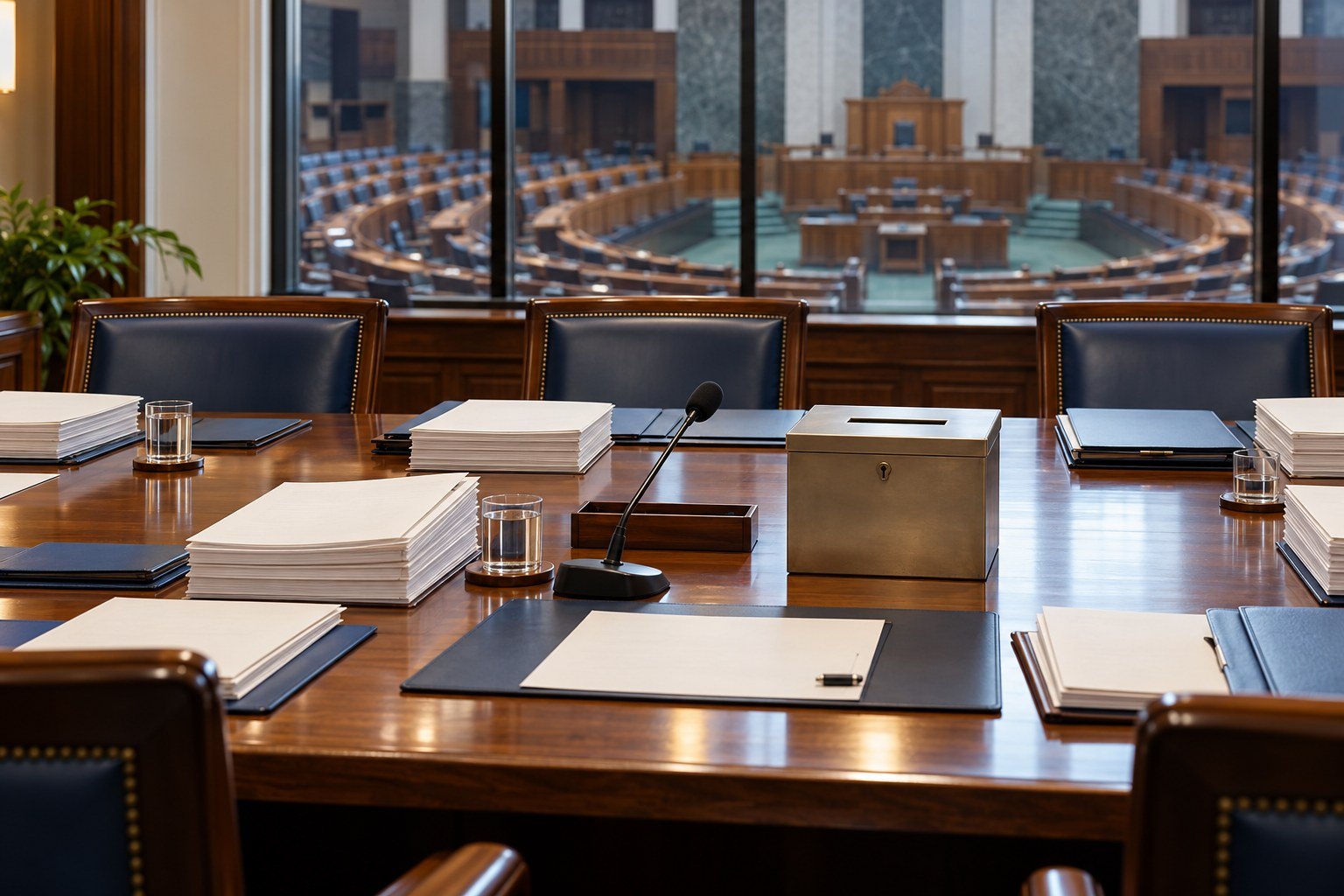
Simultaneous elections, or One Nation, One Election, means electing the Lok Sabha and all State Legislative Assemblies together, as India largely did until 1967. A High Level Committee chaired by Ram Nath Kovind recommended a two-step return in 2024. The Constitution (129th Amendment) Bill, 2024 now sits with a Joint Parliamentary Committee whose tenure runs into the 2026 Winter Session.
Syllabus: GS2 · Constitution; GS2 · Federalism & Local Government; GS2 · Parliament & State Legislatures
Why this matters for UPSC
GS2 polity: Prelims can ask Article 83, Article 172 and Article 368, and the Kovind committee's two steps; Mains asks whether simultaneous elections suit federalism and accountability.
In short
Simultaneous elections mean electing the Lok Sabha and State Legislative Assemblies on one cycle, so each voter votes for both on one day, balancing administrative saving against federal autonomy.
Simultaneous elections can save money and governing time, but they will last only if the design protects State mandates and accountability and wins wide consensus.
Why it matters
For a voter, simultaneous elections would mean one visit to the booth every five years for both the Lok Sabha and the Assembly, instead of separate campaigns in different years. Officials and security forces pulled into poll duty would return to their regular work sooner, and the Model Code of Conduct, which holds back new government schemes while a poll is on, would bind governments for fewer weeks. The cost falls on accountability: a State government that collapses midway would face voters again only for the remaining years, and critics fear that regional parties could be pushed aside when both votes are cast together. The choice is between saving money and time, and letting each State keep its own political clock.
Prelims pointers
- Article 83(2): the House of the People sits five years from its first meeting; during an Emergency, Parliament may extend it by law one year at a time.
- Article 172(1): the same five-year rule binds every State Legislative Assembly; a State Legislative Council, like the Rajya Sabha, is never dissolved.
- Article 368(2): amendments changing the Seventh Schedule's Lists or States' representation in Parliament also need ratification by the Legislatures of at least half the States.
- Article 324: the Election Commission of India superintends electoral rolls and elections to Parliament, State Legislatures, President and Vice-President.
- Article 243K: a State Election Commissioner, appointed by the Governor, conducts Panchayat elections and prepares their rolls.
- Article 243E(4): a Panchayat elected after early dissolution serves only the remainder of the dissolved Panchayat's five years.
- Article 356: a Proclamation of President's Rule lapses after two months unless both Houses of Parliament approve it.
- Earlier studies: Law Commission's 170th Report (1999), Parliamentary Standing Committee's 79th Report (2015), NITI Aayog working paper (2017), Law Commission draft report (2018).
Practise a UPSC-style question
With reference to the duration of legislatures under the Constitution of India, consider the following statements:
1. The House of the People continues for five years from the date appointed for its first meeting, unless sooner dissolved.
2. While a Proclamation of Emergency is in operation, Parliament may by law extend a State Legislative Assembly's term by up to two years at a time.
Which of the statements given above is/are correct?
- (a) 1 only
- (b) 2 only
- (c) Both 1 and 2
- (d) Neither 1 nor 2
Show the answer
Answer: (a) 1 only
Answer: (a) 1 only. Article 83(2) sets the five-year term; Article 172(1) allows extension only one year at a time.
Statement 1: correct. Article 83(2) gives the Lok Sabha five years from the date appointed for its first meeting, unless dissolved sooner.
Statement 2: incorrect. Under the proviso to Article 172(1), the extension during an Emergency is for not more than one year at a time, not two.
Eliminate: statement 2 is wrong because the extension is one year at a time. Out: (b), (c).
Eliminate: statement 1 is the plain text of Article 83(2). Out: (d).
Trap: Near-miss figure. The extension power is real, so a student who remembers it may accept two years instead of one.
Remember: Lok Sabha and Assemblies: five years; Emergency extension one year at a time (Articles 83(2), 172(1)).
More Explainers
- Who is an accredited journalist? PIB rules, Press Council, PRP Act Polity
- Financial Stability and Development Council: who sits on it, what it does Economy
- NATO: its 32 members, Articles 4 and 5, and the eastern flank World & IR
- Special Executive Magistrates under BNSS section 15: appointment and powers Polity
- Indo-Pacific Oceans Initiative (IPOI): India's seven-pillar plan for the Indo-Pacific World & IR
- Gig and platform workers under the Code on Social Security, 2020 Economy
- Bureau of Indian Standards Act, 2016: Standard Mark, QCOs and hallmarking Economy
- Kittur revolt of 1824: early resistance to the East India Company National
- Polio eradication: wild and vaccine-derived poliovirus, OPV and IPV, India's certification Sci-Tech
- International law and the UN Charter: sources, force and the ICJ World & IR
- Himalayan earthquakes and India's seismic zone map Environment
- Amur falcon: migration, protection and community conservation Environment