
International law and the UN Charter: sources, force and the ICJ
Why in news: United Nations Day, 24 October 2026, marks 81 years since the Charter of the United Nations entered into force on 24 October 1945.
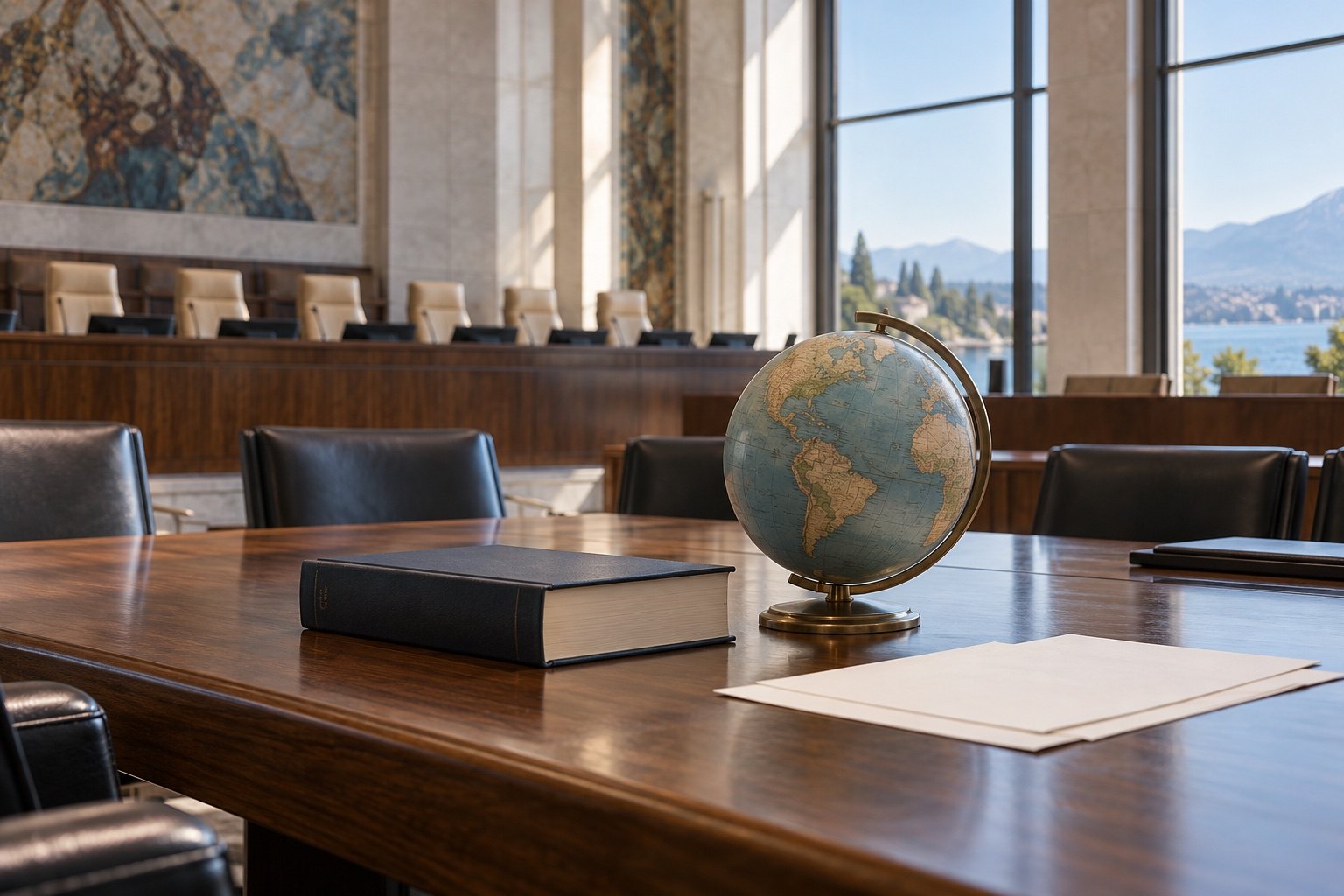
Article 38 of the ICJ Statute lists the sources of international law: treaties, custom and general principles. Judicial decisions and teachings are subsidiary means. The Charter of the United Nations bans the threat or use of force but permits self-defence against an armed attack. United Nations Day, 24 October, marks the Charter's entry into force in 1945.
Syllabus: Prelims · Current Affairs & IR; GS2 · Groupings & Agreements; GS2 · International Institutions
Why this matters for UPSC
GS2 international institutions: Prelims asks the sources in Article 38 of the ICJ Statute, Chapter VII powers and ICJ jurisdiction. GS2 Mains asks about the rules-based order, the enforcement gap and Security Council reform.
In short
International law binds states through treaties, custom and general principles; the UN Charter frames it by banning force and placing enforcement with the Security Council.
The rules on force and adjudication are settled; their credibility now depends on a Security Council reformed to enforce them even against its permanent members.
Why it matters
When an Indian national was sentenced to death abroad without consular access, India could take Pakistan to the ICJ and obtain an order that he not be executed while the case ran. That is what international law offers any country: a forum where a small state and a large one argue under the same rules. Its weakness is enforcement. A state that ignores a judgment can be reported to the Security Council, but a single permanent member may stop action there. For a sailor, a migrant worker or a soldier abroad, this decides whether rules or raw power settle a dispute.
Prelims pointers
- Article 23, UN Charter: the Security Council has 15 members; ten non-permanent members serve two-year terms and cannot be immediately re-elected.
- Article 27, UN Charter: procedural decisions need nine affirmative votes; a party to a dispute abstains on decisions under Chapter VI.
- Article 93, UN Charter: every UN Member is ipso facto a party to the ICJ Statute; a non-member joins on terms the General Assembly sets on the Council's recommendation.
- ICJ Statute, Article 60: a judgment is final and without appeal, open only to interpretation or, on a new decisive fact, revision.
- ICJ elections: one-third of the 15 seats are filled every three years in New York; terms begin on 6 February of the next year.
- Advisory proceedings are open to five UN organs and 16 specialized agencies; the General Assembly and Security Council may ask on any legal question.
- Article 103, UN Charter: a Member's Charter obligations prevail over its obligations under any other international agreement.
Practise a UPSC-style question
With reference to the sources of international law under Article 38 of the Statute of the International Court of Justice, consider the following statements:
1. Judicial decisions are listed as a primary source, ranking above international conventions.
2. International custom is listed as evidence of a general practice accepted as law.
3. The Court may decide a case ex aequo et bono if the parties agree to it.
Which of the statements given above is/are correct?
- (a) 1 and 2 only
- (b) 2 and 3 only
- (c) 1 and 3 only
- (d) 1, 2 and 3
Show the answer
Answer: (b) 2 and 3 only
Answer: (b) 2 and 3 only. Custom and ex aequo et bono are as Article 38 states; judicial decisions are subsidiary means.
Statement 1: incorrect. Article 38(1) lists judicial decisions and the teachings of publicists as subsidiary means for determining rules of law, not as a primary source.
Statement 2: correct. Article 38(1) describes international custom as evidence of a general practice accepted as law.
Statement 3: correct. Article 38(2) keeps the Court's power to decide a case ex aequo et bono when the parties agree.
Eliminate: Statement 1 is the surest: Article 38(1) calls judicial decisions subsidiary means. Out: (a), (c), (d).
Trap: Wrong scope. Statement 1 promotes a subsidiary means to a primary source, which sounds plausible because courts shape law at home.
Remember: Article 38(1): treaties, custom, general principles; decisions and teachings are subsidiary means.
More Explainers
- Who is an accredited journalist? PIB rules, Press Council, PRP Act Polity
- Financial Stability and Development Council: who sits on it, what it does Economy
- NATO: its 32 members, Articles 4 and 5, and the eastern flank World & IR
- Special Executive Magistrates under BNSS section 15: appointment and powers Polity
- Indo-Pacific Oceans Initiative (IPOI): India's seven-pillar plan for the Indo-Pacific World & IR
- Gig and platform workers under the Code on Social Security, 2020 Economy
- Bureau of Indian Standards Act, 2016: Standard Mark, QCOs and hallmarking Economy
- Kittur revolt of 1824: early resistance to the East India Company National
- Polio eradication: wild and vaccine-derived poliovirus, OPV and IPV, India's certification Sci-Tech
- Himalayan earthquakes and India's seismic zone map Environment
- Amur falcon: migration, protection and community conservation Environment
- India AI Governance Guidelines, existing laws and the proposed AI law Sci-Tech