
Amur falcon: migration, protection and community conservation
Why in news: Satellite-tagged Amur falcons Apapang and Alang returned to Tamenglong, Manipur, on 22 October 2026 after a full migratory cycle.
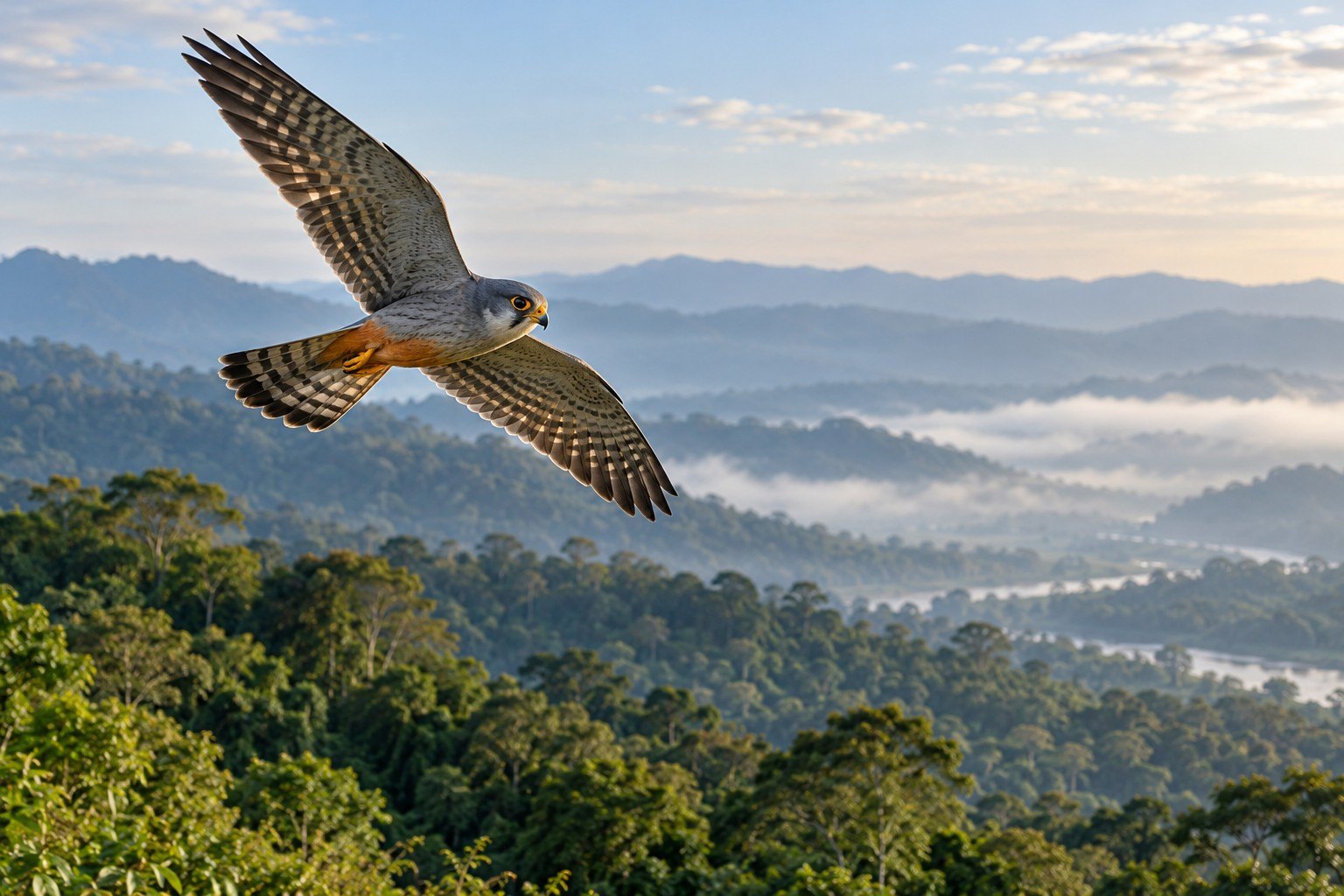
The Amur falcon (Falco amurensis) is a small, insect-eating raptor. It breeds in south-east Russia and northern China and winters in southern Africa. On the way it halts in Nagaland and Manipur, then crosses the Arabian Sea non-stop. Two falcons satellite-tagged at Tamenglong by the Wildlife Institute of India returned to Manipur on 22 October 2026.
Syllabus: Prelims · Environment & Ecology; GS3 · Environment & Conservation; GS2 · Groupings & Agreements
Why this matters for UPSC
GS3 (conservation) and Prelims environment ask a species' status, range and Schedule: the Amur falcon's IUCN, CMS Appendix II and Schedule I listings. Mains can ask about community-led conservation and protecting migratory species.
In short
The Amur falcon (Falco amurensis) is a small, insect-eating raptor whose yearly loop between East Asia and southern Africa depends on safe stopovers in north-east India.
Schedule I protects the Amur falcon on paper; village councils protect it at the roost. Their stake, backed by flyway cooperation, must be sustained.
Why it matters
A farmer in southern Africa and a villager in Tamenglong share the same bird. Each falcon eats large numbers of termites and other insects, so a healthy flock is free pest control on both continents. Because tens of thousands crowd into a handful of roosts in north-east India, a few nights of netting there can wipe out a large share of the birds that pass. The Nagaland villages that once hunted them now earn from guiding and homestays, which shows that conservation lasts when local people gain from it. The larger issue is how India protects migratory species whose fate depends on safe passage through many countries.
Prelims pointers
- Wild Life (Protection) Amendment Act, 2022: cut the Act's six Schedules to four; Schedule III lists specified plants and Schedule IV holds CITES-listed species.
- Amur falcon (Falco amurensis): entry 32 in Schedule I, Part B (Birds) of the amended Wild Life (Protection) Act, 1972, alongside the Laggar, Peregrine and Saker falcons.
- Convention on Migratory Species: concluded at Bonn in 1979; Appendix I lists endangered migratory species, Appendix II those needing international agreements.
- Amur falcon habitat: open forests, grasslands, wetlands and farmland; flocks roost on trees in forest patches near termite-rich ground.
- Raptors MoU: an agreement under CMS on migratory birds of prey in Africa and Eurasia; its coordinating office is in Abu Dhabi.
- Section 163, BNSS, 2023: a District Magistrate, Sub-divisional Magistrate or specially empowered Executive Magistrate may issue it; it may be passed ex parte in an emergency.
- Section 163 order: lasts at most two months; the State Government may extend it by notification for up to six months more.
- Doyang reservoir, Wokha district, Nagaland: one of the largest known Amur falcon roosts; Pangti is the village nearest to it.
Practise a UPSC-style question
With reference to the Amur falcon (Falco amurensis), consider the following statements:
1. It is assessed as Vulnerable on the IUCN Red List because of hunting at its stopovers.
2. It breeds in south-east Russia and northern China and winters in southern Africa.
3. It is listed on Appendix II of the Convention on Migratory Species.
Which of the statements given above is/are correct?
- (a) 1 and 2 only
- (b) 2 and 3 only
- (c) 1 and 3 only
- (d) 1, 2 and 3
Show the answer
Answer: (b) 2 and 3 only
Answer: (b) 2 and 3 only. The falcon is rated Least Concern by the IUCN; its range and CMS listing are as stated.
Statement 1: incorrect. The IUCN Red List rates the Amur falcon Least Concern, owing to its wide range and large population.
Statement 2: correct. It breeds in south-east Russia and northern China and spends the northern winter in southern Africa.
Statement 3: correct. The CMS species page lists the Amur falcon on Appendix II, for migrants that need international agreements.
Eliminate: statement 1 is wrong, which removes every option that contains it. Out: (a), (c), (d).
Trap: Sounds right. A bird once netted in tens of thousands sounds threatened, but its global population keeps it at Least Concern.
Remember: Amur falcon: IUCN Least Concern, CMS Appendix II, Schedule I of the Wild Life (Protection) Act.
More Explainers
- Who is an accredited journalist? PIB rules, Press Council, PRP Act Polity
- Financial Stability and Development Council: who sits on it, what it does Economy
- NATO: its 32 members, Articles 4 and 5, and the eastern flank World & IR
- Special Executive Magistrates under BNSS section 15: appointment and powers Polity
- Indo-Pacific Oceans Initiative (IPOI): India's seven-pillar plan for the Indo-Pacific World & IR
- Gig and platform workers under the Code on Social Security, 2020 Economy
- Bureau of Indian Standards Act, 2016: Standard Mark, QCOs and hallmarking Economy
- Kittur revolt of 1824: early resistance to the East India Company National
- Polio eradication: wild and vaccine-derived poliovirus, OPV and IPV, India's certification Sci-Tech
- International law and the UN Charter: sources, force and the ICJ World & IR
- Himalayan earthquakes and India's seismic zone map Environment
- India AI Governance Guidelines, existing laws and the proposed AI law Sci-Tech