
India's marine turtles: nesting sites, arribada and protection
Why in news: On 23 November 2026, PIB reported the release of the Wildlife Institute of India's pan-India marine turtle assessment at the 92nd SC-NBWL meeting.
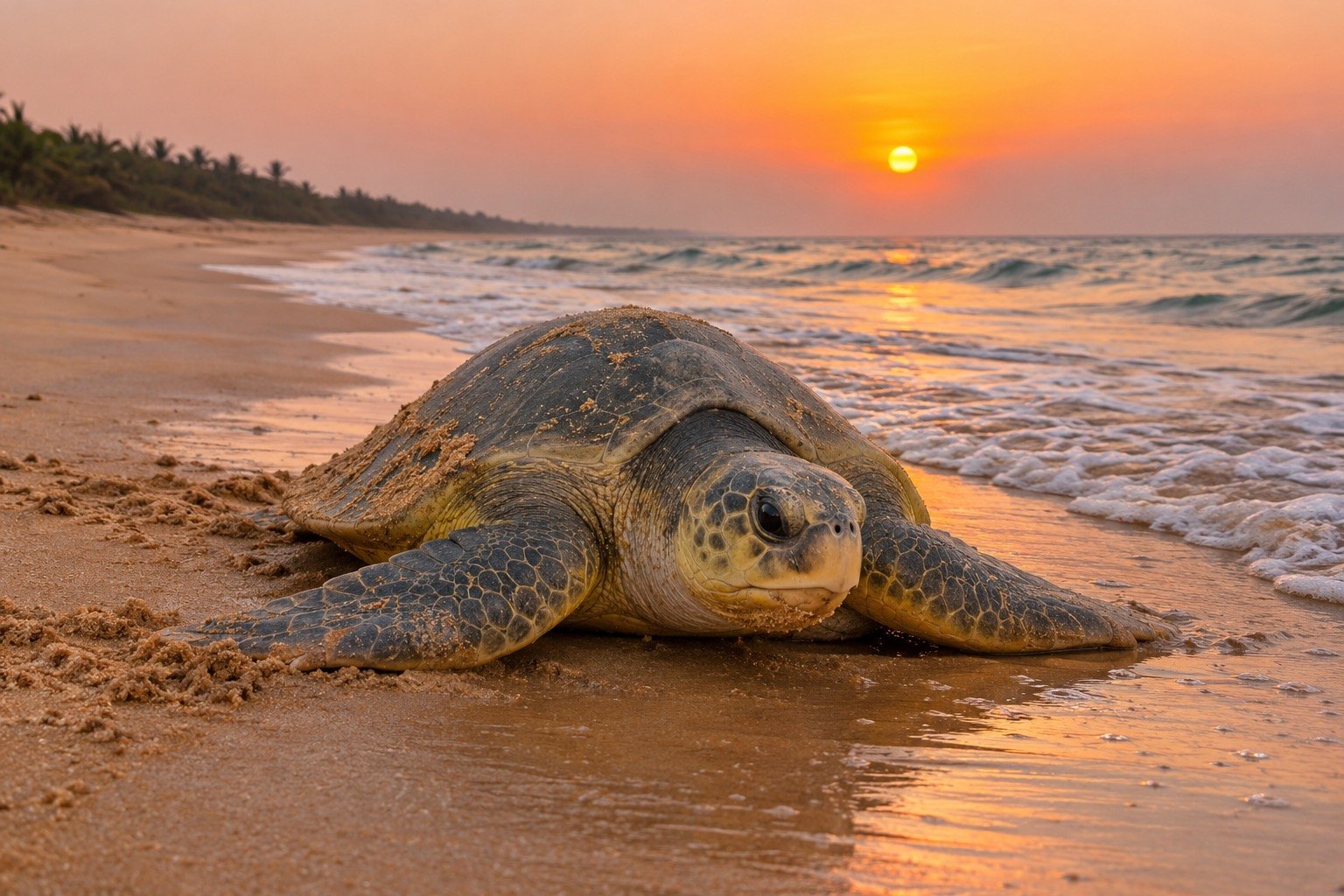
Four marine turtle species nest on India's coast: the Olive Ridley, Green, Leatherback and Hawksbill. Olive Ridleys nest along both mainland coasts and gather to nest en masse in Odisha. All four are listed in Appendix I of CITES. A Wildlife Institute of India assessment released in November 2026 mapped nesting across 360 beach stretches.
Syllabus: Prelims · Environment & Ecology; GS3 · Environment & Conservation
Why this matters for UPSC
GS3 environment: species conservation, coastal regulation and fisheries bycatch. Prelims asks IUCN status, CITES appendix and nesting sites such as Gahirmatha and Galathea Bay.
In short
Four of the five sea turtle species in Indian waters nest on India's coast; law and conventions protect them, yet shrinking beaches and fishing nets threaten them.
India's turtle laws are strong on paper; their test is keeping nesting beaches, river mouths and nearshore waters intact where coastal development presses hardest.
Why it matters
A fisher trawling off Odisha must fit a device that lets turtles escape the net and keep out of protected waters in the breeding season, because nets drown turtles that come to breed. A forest guard on a beach chooses whether eggs stay where they were laid or move to a hatchery, and that choice shapes how many young reach the sea. Knowing which beach each species uses tells a State which stretch to guard. When river mouths close or beaches stop forming, as in Gujarat, nesting falls away. The larger issue is the coast itself: ports, lights and construction compete for the sand turtles return to.
Prelims pointers
- IUCN Red List (global): Olive Ridley and Leatherback are Vulnerable, Green turtle Endangered, Hawksbill Critically Endangered; all four populations are decreasing.
- Arribada is the Olive Ridley's mass nesting, seen in Odisha's mass nesting areas; the WII assessment's mainland nest counts are of solitary nests.
- Gahirmatha Marine Sanctuary in Odisha bans trawling; offshore waters of Gahirmatha, Devi and Rushikulya are closed to fishing in the breeding season.
- Turtle Excluder Devices are mandatory for trawlers in Odisha, West Bengal and Andhra Pradesh.
- Do not swap the sanctuaries: Gahirmatha Marine Sanctuary (Odisha) protects Olive Ridleys; Galathea Bay Sanctuary is on Great Nicobar, a Leatherback nesting coast.
- Green turtles nest mainly in Gujarat, also in Lakshadweep and the Andaman and Nicobar Islands; Hawksbills nest sparsely in the two island groups.
- India is a signatory to the IOSEA Marine Turtles MoU of the Convention on Migratory Species and runs a National Marine Turtle Action Plan (2021-2026).
Practise a UPSC-style question
With reference to the IUCN Red List status of sea turtles that nest in India, consider the following statements:
1. The Hawksbill turtle is assessed as Endangered on the IUCN Red List.
2. The Leatherback turtle is assessed as Vulnerable on the IUCN Red List.
3. The Green turtle is assessed as Endangered on the IUCN Red List.
Which of the statements given above is/are correct?
- (a) 1 and 2 only
- (b) 2 and 3 only
- (c) 1 and 3 only
- (d) 1, 2 and 3
Show the answer
Answer: (b) 2 and 3 only
Answer: (b) 2 and 3 only. The Hawksbill sits one step higher, at Critically Endangered.
Statement 1: incorrect. The IUCN Red List assesses the Hawksbill (Eretmochelys imbricata) as Critically Endangered, the gravest of the four.
Statement 2: correct. The Leatherback (Dermochelys coriacea) is listed globally as Vulnerable, with a decreasing population.
Statement 3: correct. The Green turtle (Chelonia mydas) is listed globally as Endangered on the IUCN Red List.
Eliminate: Statement 1 is the surest error, since the Hawksbill is Critically Endangered. Out: (a), (c), (d).
Trap: Near-miss figure. Endangered is one category below Critically Endangered, so a student who recalls the Hawksbill as threatened but not its exact grade accepts statement 1.
Remember: Hawksbill CR, Green EN, Olive Ridley and Leatherback VU.
More Explainers
- Kalinga's maritime heritage: Boita Bandana and Bali Jatra National
- Eighth Schedule: India's 22 Scheduled Languages Polity
- Basavanna, the Vachanas and the Lingayat tradition Miscellany
- Ibisbill: the wader of the Himalaya's braided, stony rivers Environment
- Dancing Girl of Mohenjo-daro and Harappan ornaments: what Indus craftsmen made Miscellany
- BNSS safeguards for women and police powers over assemblies Polity
- Geographical indications: how a GI is registered, opposed and protected Economy
- Malus and clawback: the RBI's pay rules for bank executives Economy
- Contempt of court: who can punish it, and how far Polity
- New START's end: strategic arms control and the NPT's disarmament duty World & IR
- Gyan Bharatam Mission and the National Mission for Manuscripts National
- The Ahom kingdom and the Battle of Saraighat National