
Ibisbill: the wader of the Himalaya's braided, stony rivers
Why in news: On 26 November 2026, a news report used the ibisbill to show why Himalayan rivers need their sediment.
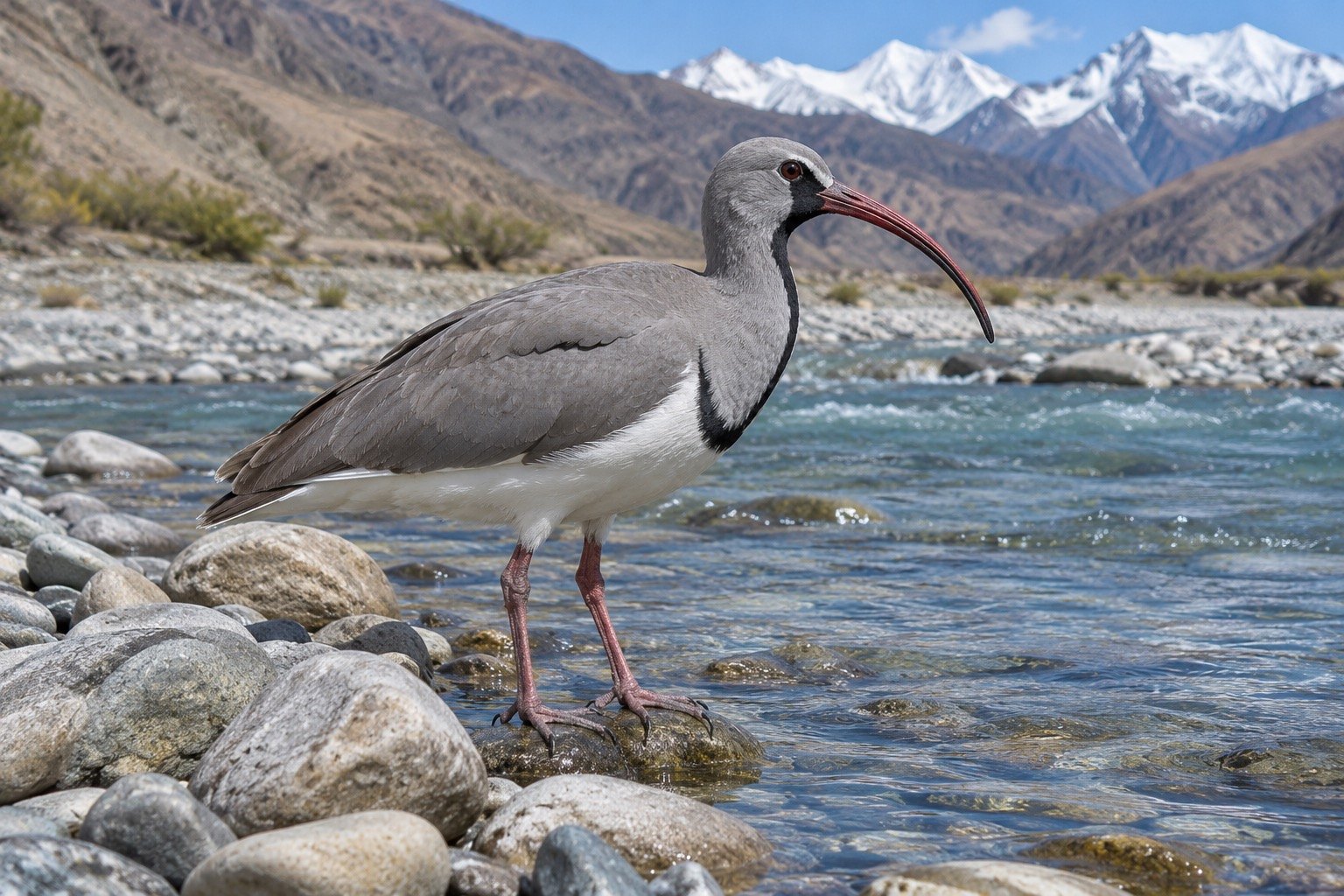
The ibisbill (Ibidorhyncha struthersii) is a slate-grey wader of stony rivers across the Himalaya and the Tibetan Plateau. It feeds on aquatic insects among pebbles and nests on bare gravel beds that braided rivers keep renewing. A November 2026 report tied its future to Himalayan rivers keeping their sediment.
Syllabus: Prelims · Environment & Ecology; GS1 · Geophysical Phenomena; GS3 · Environment & Conservation
Why this matters for UPSC
GS3 environment and GS1 geography: Himalayan species and braided river processes. Prelims can ask the ibisbill's habitat; Mains, riverbed mining's harm.
In short
The ibisbill is a wader of the stony braided rivers of the Himalaya and Tibetan Plateau; it lives on the gravel that these rivers keep moving and replenishing.
The ibisbill survives only where braided rivers keep their gravel; extraction must stay within replenishment and breeding bars must be left undisturbed.
Why it matters
A family in a Himalayan valley that draws water from wells near the river feels the effect first. When too much gravel is dug out, the riverbed drops, and the groundwater beside it falls with it, so wells run lower. Bridges and pipelines lose the ground under their supports. The same gravel bars are where the ibisbill raises its young, so a bird that is hard to find becomes harder still. The larger issue is that a Himalayan river is a moving system of water and stone: treat its bed as a quarry, and the people, fish and birds that rely on it all lose. Where mining stays within what the river brings down each year, the river can keep giving.
Prelims pointers
- At Lachung-Yumthang, the ibisbill uses river shingle beds, while the globally threatened Wood Snipe is seen in the Rhododendron-Fir forest of Shingba.
- Shingba Rhododendron Sanctuary in North Sikkim holds the endemic Rhododendron niveum, Sikkim's State Tree.
- The Lachung-Yumthang site sits where the Eurasian High Montane (Alpine and Tibetan) biome meets the Sino-Himalayan Temperate Forest biome.
- Extraction below the water level, or below the thalweg, generally alters a river's hydrology more than extraction kept above it.
- A small straight channel with a narrow floodplain is harmed more by excavation than a braided channel with a wide floodplain.
- The 2016 guidelines rule out extraction where erosion may occur, such as the concave bank, and recommend off-channel or floodplain pits.
Practise a UPSC-style question
With reference to the ibisbill (Ibidorhyncha struthersii), consider the following statements:
1. It is a wader of stony Himalayan and Tibetan Plateau rivers.
2. It lays its eggs in tree hollows of the forests that line Himalayan rivers.
3. It picks aquatic insects and their larvae from among river pebbles and boulders.
Which of the statements given above is/are correct?
- (a) 1 and 2 only
- (b) 2 and 3 only
- (c) 1 and 3 only
- (d) 1, 2 and 3
Show the answer
Answer: (c) 1 and 3 only
Answer: (c) 1 and 3 only. The bird feeds and nests on the riverbed itself, not in riverside trees.
Statement 1: correct. Its range is the stony rivers of the Himalaya and Tibetan Plateau, moving within the Greater, Middle and Shivalik ranges by season.
Statement 2: incorrect. The ibisbill nests on exposed gravel beds in the river; in North Sikkim it breeds on shingle beds beside the Yumthang-Lachung river.
Statement 3: correct. It forages among pebbles and boulders for aquatic insects and larvae.
Eliminate: statement 2 is surest wrong, since the bird is a gravel-bed nester. Out: (a), (b), (d).
Trap: Look-alike names. Many Himalayan riverside birds nest in forest; the question swaps the ibisbill's open gravel nest for a forest-bird habit.
Remember: Ibisbill: feeds among river pebbles, nests on bare gravel and shingle beds.
More Explainers
- Kalinga's maritime heritage: Boita Bandana and Bali Jatra National
- Eighth Schedule: India's 22 Scheduled Languages Polity
- Basavanna, the Vachanas and the Lingayat tradition Miscellany
- Dancing Girl of Mohenjo-daro and Harappan ornaments: what Indus craftsmen made Miscellany
- BNSS safeguards for women and police powers over assemblies Polity
- India's marine turtles: nesting sites, arribada and protection Environment
- Geographical indications: how a GI is registered, opposed and protected Economy
- Malus and clawback: the RBI's pay rules for bank executives Economy
- Contempt of court: who can punish it, and how far Polity
- New START's end: strategic arms control and the NPT's disarmament duty World & IR
- Gyan Bharatam Mission and the National Mission for Manuscripts National
- The Ahom kingdom and the Battle of Saraighat National