
Dancing Girl of Mohenjo-daro and Harappan ornaments: what Indus craftsmen made
Why in news: The Union Cabinet approved the Yuge Yugeen Bharat Museum on 11 November 2026; its first gallery, on Adornment, will show the Dancing Girl.
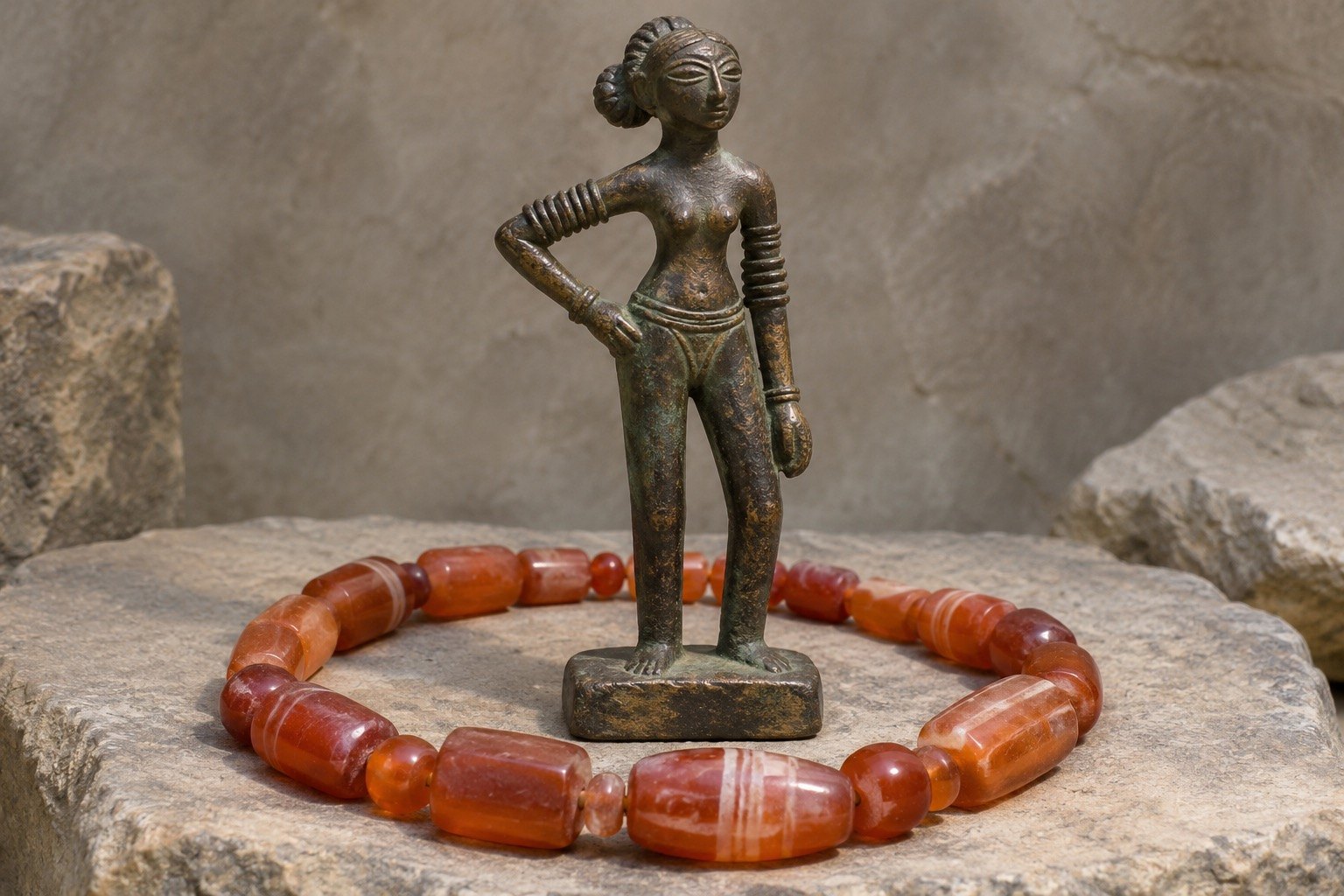
The Dancing Girl of Mohenjo-daro is a Harappan bronze figure that the Union Culture Secretary calls the first image of the ornaments women wore in its time. Alongside metalwork, Harappan workshops shaped, etched and strung beads in large numbers. The figure is to open a planned national gallery on Indian ornaments in New Delhi.
Syllabus: GS1 · Art & Culture; Prelims · History & Culture
Why this matters for UPSC
GS1 Indian culture: Harappan bronze casting and bead-making crafts. Prelims can match artefacts, materials and sites; Mains, what crafts reveal.
In short
Harappan craftsmen turned bronze, stone, metal, shell and man-made faience into figures and ornaments; the Dancing Girl and the Kalibangan beads best show that skill.
Harappan ornaments are firm evidence of specialised craft; a gallery should show each object's findspot and layer, keeping evidence apart from guesswork.
Why it matters
A schoolgirl in Delhi who has seen the Dancing Girl only as a textbook photograph will be able to see it beside other Harappan jewellery. Seen together, they show that people more than four thousand years ago chose stones, fired clay and metal with care, and that bead-making at a site like Kalibangan was a flourishing industry. Pooling objects from many museums also raises a practical question: fragile finds must travel safely, and each must keep the record of where it was dug up. The larger issue is how India presents its oldest past to the public, as evidence that can be checked rather than as legend.
Prelims pointers
- Kalibangan, a Harappan site in Rajasthan, has yielded beads of agate, jasper, carnelian, steatite, faience, gold, copper, shell and bone.
- At Kalibangan, agate beads are more frequent than carnelian beads, while lapis lazuli beads are rare.
- Unlike agate, jasper and carnelian, which are natural semi-precious stones, faience is a manufactured material and appears only in a few Kalibangan beads.
- Steatite occurs in Rajasthan's Ajmer, Alwar, Banswara, Dungarpur, Jaipur, Jodhpur and Udaipur districts.
- Taxila's jewellery, from Bhir Mound and Sirkap, is gold and silver of the 4th century BCE to 1st century AD, far later than Harappan beads.
- The Nizam's jewels belong to the Asaf Jahi dynasty of Hyderabad (1724-1948) and include the 184.75-carat Jacob Diamond.
Practise a UPSC-style question
With reference to beads found at the Harappan site of Kalibangan, consider the following statements:
1. Beads of lapis lazuli are rare in the Kalibangan collection.
2. Steatite, used widely for the beads, is a hard crystalline variety of quartz.
3. Terracotta spacers with one to six holes point to necklaces of one to six strings.
Which of the statements given above is/are correct?
- (a) 1 and 2 only
- (b) 2 and 3 only
- (c) 1 and 3 only
- (d) 1, 2 and 3
Show the answer
Answer: (c) 1 and 3 only
Answer: (c) 1 and 3 only. Lapis was scarce and spacers held several strings, but steatite is a soft talc.
Statement 1: correct. The ASI report on Kalibangan records lapis lazuli beads as rare, beside common agate and steatite.
Statement 2: incorrect. Steatite is a soft, massive variety of talc, which is why it was easy to carve and drill into hundreds of beads.
Statement 3: correct. Kalibangan yielded many terracotta spacers pierced with one to six holes, indicating necklaces of as many strings.
Eliminate: Statement 2 is wrong because steatite is talc, not quartz. Out: (a), (b), (d).
Trap: Look-alike names. Steatite and quartz are both pale stones used for beads; the question swaps a soft talc for a hard quartz.
Remember: Steatite is soft talc; faience, not steatite, is the material made with quartz.
More Explainers
- Kalinga's maritime heritage: Boita Bandana and Bali Jatra National
- Eighth Schedule: India's 22 Scheduled Languages Polity
- Basavanna, the Vachanas and the Lingayat tradition Miscellany
- Ibisbill: the wader of the Himalaya's braided, stony rivers Environment
- BNSS safeguards for women and police powers over assemblies Polity
- India's marine turtles: nesting sites, arribada and protection Environment
- Geographical indications: how a GI is registered, opposed and protected Economy
- Malus and clawback: the RBI's pay rules for bank executives Economy
- Contempt of court: who can punish it, and how far Polity
- New START's end: strategic arms control and the NPT's disarmament duty World & IR
- Gyan Bharatam Mission and the National Mission for Manuscripts National
- The Ahom kingdom and the Battle of Saraighat National