
Gyan Bharatam Mission and the National Mission for Manuscripts
Why in news: On 22 November 2026 the mission held a session on language, script and manuscript traditions at the first SCO Civilization Dialogue Forum, New Delhi.
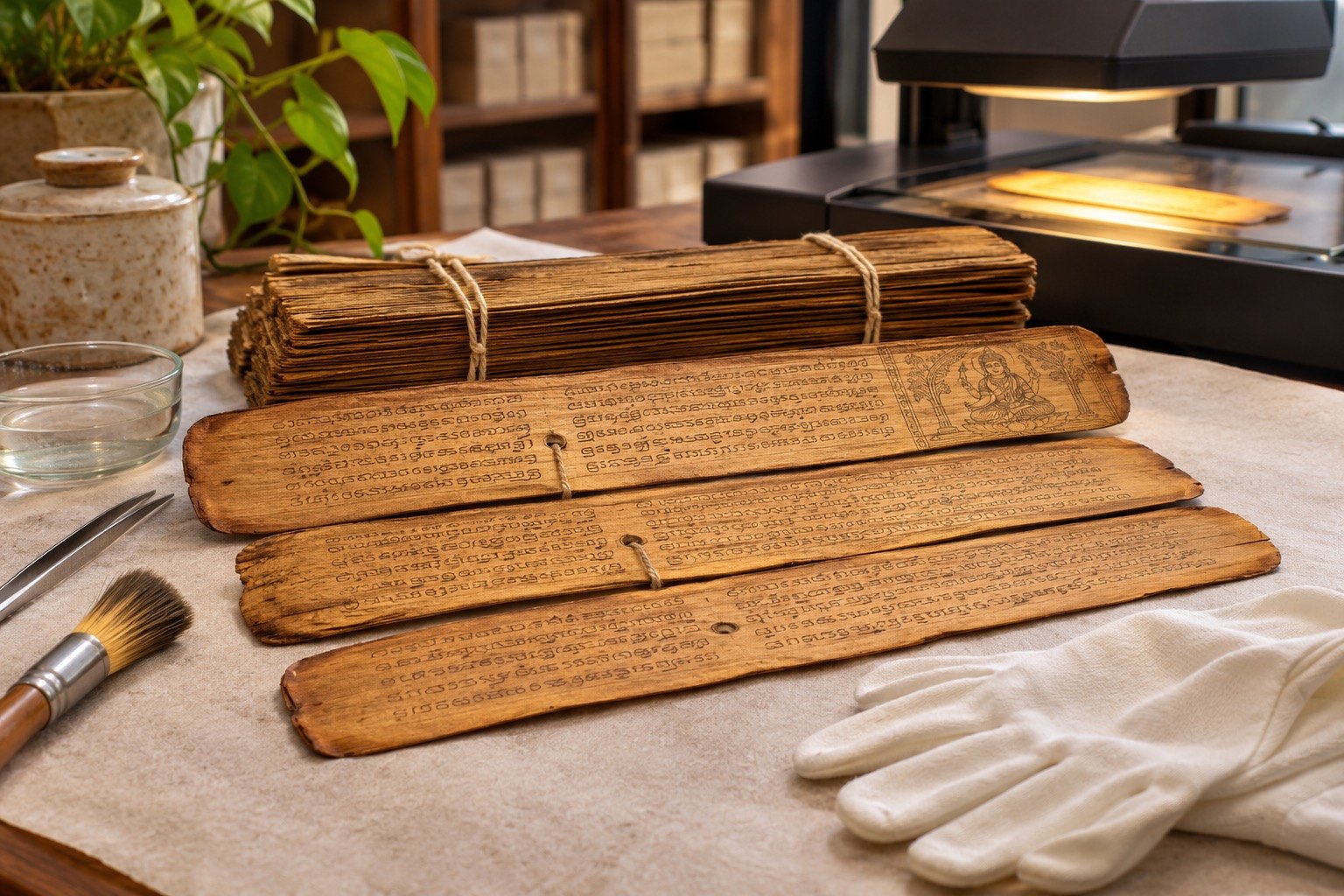
The Gyan Bharatam Mission is the Ministry of Culture's programme to survey, document, conserve and digitise India's manuscripts, aiming to cover more than one crore of them. It is the restructured and renamed National Mission for Manuscripts of 2003. On 22 November 2026 it convened a session at the first SCO Civilization Dialogue Forum in New Delhi.
Syllabus: GS1 · Art & Culture; Prelims · Current Affairs & IR; GS2 · Government Policies
Why this matters for UPSC
GS1 Indian culture: the Gyan Bharatam Mission and the National Mission for Manuscripts. Prelims can ask the ministry, scheme type and IGNCA's role; Mains, digitising heritage while respecting custodians' rights.
In short
The Gyan Bharatam Mission, a Central Sector Scheme of the Ministry of Culture, recasts the National Mission for Manuscripts to survey, conserve, digitise and share India's manuscript heritage.
Gyan Bharatam will be judged by manuscripts conserved, read and shared with custodians' consent, not by survey counts, and by scholars trained to read them.
Why it matters
A student of old Indian medicine, mathematics or astronomy often cannot reach a text kept by a family, a religious institution or a distant library, and may never learn that it exists. A record of who holds which text, joined to digital copies that can be read online, lets that student find and study it from anywhere. Custodians gain as well: they get help to conserve fragile pages and still decide who may see them. Each digital copy also means the original is handled less. The larger issue is who controls traditional knowledge. Shared with consent, it feeds research and translation across Asia; copied without it, it can be pirated or misappropriated.
Prelims pointers
- Look-alikes: the NMM worked through IGNCA as its nodal agency; Gyan Bharatam is headed by a CEO who is a Joint Secretary in the Ministry of Culture.
- The mission's stated objectives include publishing manuscripts in book and machine-readable form, and aiding conservation through training, awareness and financial support.
- Its objectives also include boosting scholarship in Indian languages and manuscriptology, and using advanced technology to speed up digitisation and documentation.
- Rights-protected, sensitive or restricted manuscripts may carry access conditions under the mission, while other material may be opened for scholarly use.
- Under the NMM, Manuscript Resource Centres (MRCs) and Manuscript Conservation Centres (MCCs) were set up in host institutions, including in Uttar Pradesh.
- Three Bihar repositories have onboarded with the mission: Nava Nalanda Mahavihar at Nalanda, Khuda Bakhsh Oriental Public Library at Patna and Shri Bodh Gaya Math at Bodh Gaya.
- Capacity building under the restructured mission covers training in manuscriptology, paleography and conservation, to create a new generation of manuscriptologists.
Practise a UPSC-style question
With reference to the Gyan Bharatam Mission, consider the following statements:
1. It is an initiative of the Union Ministry of Education, Government of India.
2. It was formed by restructuring the National Mission for Manuscripts as a Central Sector Scheme.
3. Building a National Digital Repository of manuscripts is one of its stated objectives.
Which of the statements given above is/are correct?
- (a) 1 and 2 only
- (b) 2 and 3 only
- (c) 1 and 3 only
- (d) 1, 2 and 3
Show the answer
Answer: (b) 2 and 3 only
Answer: (b) 2 and 3 only. The mission belongs to the Ministry of Culture; the other two statements hold.
Statement 1: incorrect. Gyan Bharatam, announced in the Union Budget 2025-26, is an initiative of the Ministry of Culture, not of the Ministry of Education.
Statement 2: correct. A Ministry of Culture reply of March 2025 says the National Mission for Manuscripts was restructured as the Gyan Bharatam Mission, a Central Sector Scheme for 2024-31.
Statement 3: correct. The ministry lists building a National Digital Repository (NDR) among the mission's objectives, and the Budget speech proposed one.
Eliminate: statement 1 is the surest, since the Ministry of Culture runs the mission. Out: (a), (c), (d).
Trap: Swapped attribution. Manuscripts sound like a subject for the education ministry, so the statement pins a culture mission on the wrong ministry.
Remember: Gyan Bharatam: Ministry of Culture, Central Sector Scheme, successor to the NMM.
More Explainers
- New START's end: strategic arms control and the NPT's disarmament duty World & IR
- The Ahom kingdom and the Battle of Saraighat National
- How a State is renamed: Articles 3 and 4 Polity
- Radiation fog over north India and how it differs from smog Environment
- Submarine cables to India's islands: CANI, KLI and a second route Sci-Tech
- Mercury in cosmetics and the Minamata Convention on Mercury Environment
- How a High Court gets a permanent bench Polity
- Tholpavakoothu: Kerala's leather shadow-puppet theatre Miscellany
- BioE3 Policy and the Biotechnology Research and Innovation Council (BRIC) Sci-Tech
- Alchi Chokhor, Ladakh: the Buddhist monastic complex and its protection National
- The four Labour Codes: what they merged and what they changed Economy
- National HPV Vaccination Campaign and cervical cancer prevention National