
How poverty is measured: MPI, poverty lines and the HDI family
Why in news: The UNDP and OPHI published the Global MPI 2026 on 12 October 2026; the World Bank's India Poverty & Equity Brief followed in October 2026.
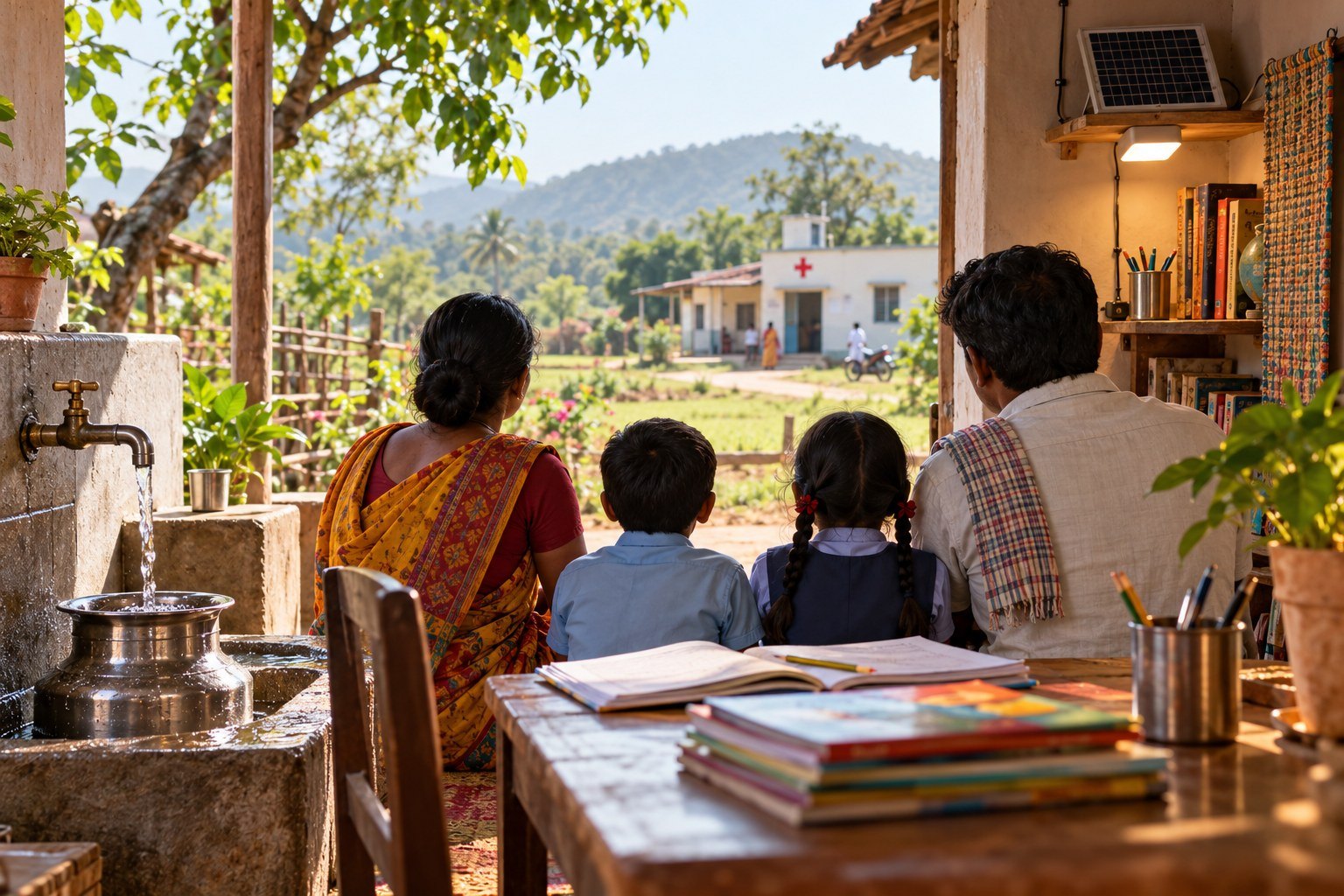
Poverty is measured in two ways: income or consumption against a money line, and overlapping deprivations in health, education and living standards, which the Multidimensional Poverty Index (MPI) counts. The UNDP and OPHI released the Global MPI 2026 on 12 October, and the World Bank's October 2026 India brief updated its income-poverty figures.
Syllabus: GS3 · Inclusive Growth; Prelims · Economy & Social Development; GS2 · Poverty & Hunger
Why this matters for UPSC
GS2 (poverty and hunger) and GS3 (inclusive growth) turn on how poverty is counted. Prelims asks the Global MPI's indicators and cut-offs, NITI Aayog's National MPI and the World Bank lines; Mains asks why measurement matters.
In short
Poverty measurement fixes who counts as poor: by a money line for income or consumption, or by overlapping deprivations, as the Multidimensional Poverty Index (MPI) does.
India needs regular, comparable surveys and both money and deprivation measures, so falling headline numbers are not mistaken for the end of poverty.
Why it matters
A family can earn just above a poverty line and still cook on wood, lack a toilet or have a child out of school. Counting only money would call that family non-poor; counting deprivations shows what it still lacks. The choice of measure therefore shapes which needs a government sees: a money line tracks spending power, while a deprivation count points to missing houses, water, clean fuel and schooling. When surveys are old or methods change, the poor can disappear from the numbers without their lives changing, so a reliable, regular measure is what keeps public money pointed at the households that need it.
Prelims pointers
- Global MPI origin: introduced in the 2010 Human Development Report; since 2018 the UNDP's Human Development Report Office and OPHI publish it jointly, using the Alkire-Foster dual-cutoff method.
- Global MPI indicators: nutrition and child mortality (health); years of schooling and school attendance (education); cooking fuel, sanitation, drinking water, electricity, housing and assets (standard of living).
- MPI cut-offs: a deprivation score of 1/5 to below 1/3 means vulnerable; 1/2 or more means severe poverty; the MPI value runs from 0 to 1.
- National MPI: NITI Aayog is the nodal body under the Global Indices for Reforms and Growth (GIRG) initiative; its baseline report (November 2021) used NFHS-4 data.
- SDG target 1.2: reduce at least by half, by 2030, the share of people living in poverty in all its dimensions; national MPIs can monitor SDG indicator 1.2.2.
- World Bank lines (2021 PPP): $3.00 extreme, $4.20 lower-middle-income and $8.30 upper-middle-income; $3.00 rounds the median ($3.04) of 23 low-income countries' national lines.
- Rangarajan group: constituted by the Planning Commission in June 2012; it anchored the food basket to calorie, protein and fat norms (2,155 kcal rural, 2,090 kcal urban).
- HDI method: life expectancy at birth, mean and expected years of schooling, and GNI per capita, combined as a geometric mean of the three dimension indices.
Practise a UPSC-style question
With reference to the Global Multidimensional Poverty Index (MPI) published by the UNDP and OPHI, consider the following statements:
1. The indicators for a country may be drawn from different household surveys.
2. A person deprived in one-fifth or more but less than one-third of the weighted indicators is counted as vulnerable to multidimensional poverty.
Which of the statements given above is/are correct?
- (a) 1 only
- (b) 2 only
- (c) Both 1 and 2
- (d) Neither 1 nor 2
Show the answer
Answer: (b) 2 only
Answer: (b) 2 only. The MPI uses a single survey per country and treats the 1/5 to 1/3 band as vulnerable.
Statement 1: incorrect. All the indicators needed to construct the Global MPI for a country must come from the same household survey.
Statement 2: correct. A deprivation score of 1/5 or more but below 1/3 marks vulnerability; 1/3 or more marks poverty.
Eliminate: Statement 1 is wrong because the MPI needs one survey for all ten indicators. Out: (a), (c).
Eliminate: Statement 2 matches the UNDP's vulnerability band. Out: (d).
Trap: Sounds right. Mixing surveys seems a practical way to fill gaps, but it would break the overlap of deprivations in one household that the MPI measures.
Remember: Global MPI: one survey; poor at 1/3, vulnerable at 1/5, severe at 1/2.
In the news
More Explainers
- Who is an accredited journalist? PIB rules, Press Council, PRP Act Polity
- Financial Stability and Development Council: who sits on it, what it does Economy
- NATO: its 32 members, Articles 4 and 5, and the eastern flank World & IR
- Special Executive Magistrates under BNSS section 15: appointment and powers Polity
- Indo-Pacific Oceans Initiative (IPOI): India's seven-pillar plan for the Indo-Pacific World & IR
- Gig and platform workers under the Code on Social Security, 2020 Economy
- Bureau of Indian Standards Act, 2016: Standard Mark, QCOs and hallmarking Economy
- Kittur revolt of 1824: early resistance to the East India Company National
- Polio eradication: wild and vaccine-derived poliovirus, OPV and IPV, India's certification Sci-Tech
- International law and the UN Charter: sources, force and the ICJ World & IR
- Himalayan earthquakes and India's seismic zone map Environment
- Amur falcon: migration, protection and community conservation Environment