
Global MPI 2026: multidimensional poverty rises to 1.2 billion
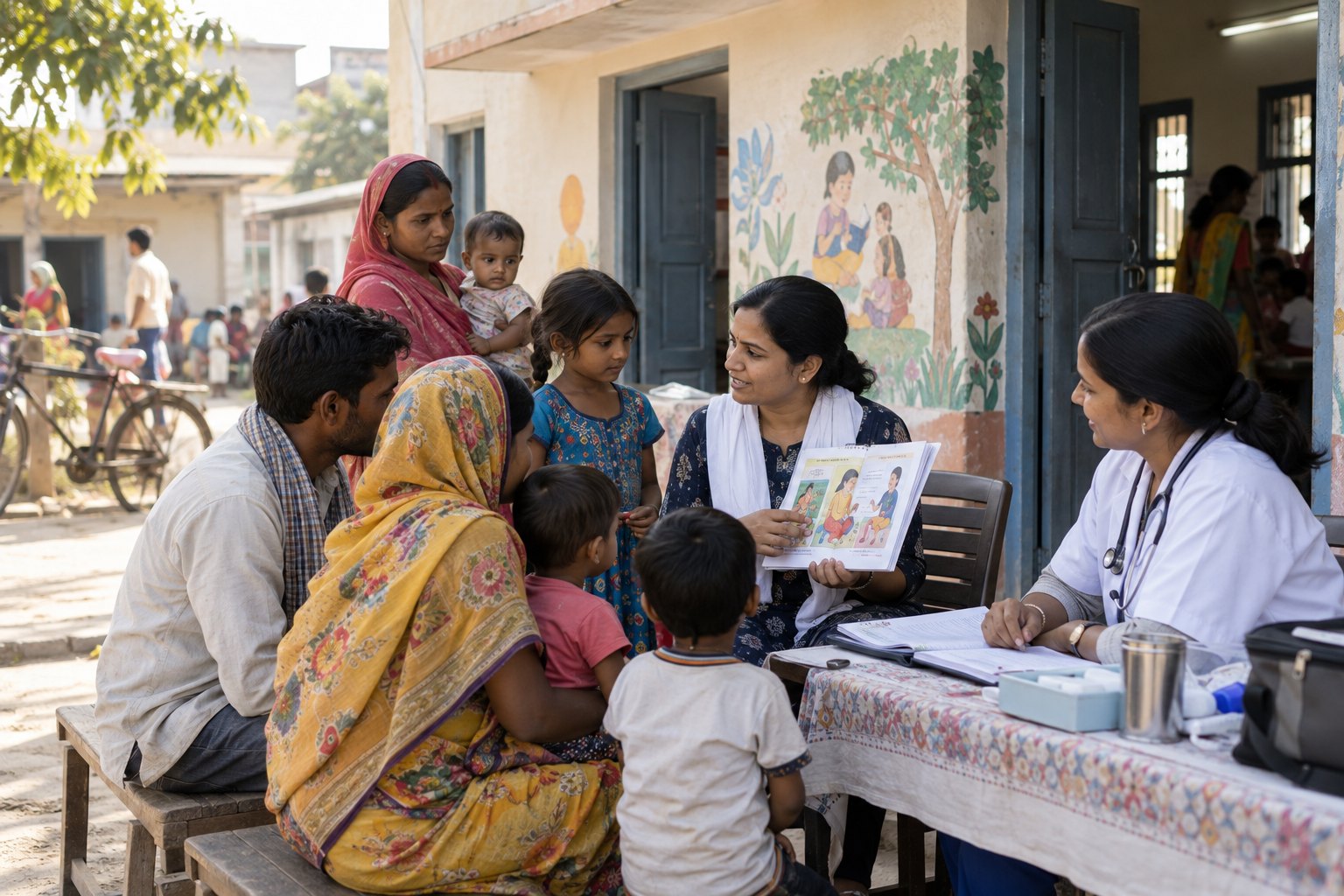
The 2026 global Multidimensional Poverty Index, released on 12 October by the UNDP and Oxford University, counts 1.2 billion people in acute poverty across 108 countries, 51.5 million more than in 2025 and the first rise in 15 years, per UNDP. Children make up 617 million. India's incidence fell from 55.1% in 2005/06 to 16.4% in 2019/21.
Syllabus: GS3 · Inclusive Growth; Prelims · Economy & Social Development; GS2 · Poverty & Hunger
Why this matters for UPSC
GS2 poverty and hunger, GS3 inclusive growth. Prelims can ask who publishes the global Multidimensional Poverty Index, its dimensions, indicators and cut-offs; Mains can ask about measuring poverty beyond income and India's progress.
Why it matters
A family can earn just above an income poverty line and still go without clean water, electricity, schooling or enough food. The MPI counts those overlapping gaps, so it shows where a household actually struggles. The 2026 rise means more children are growing up hungry or out of school, mostly in Sub-Saharan Africa and South Asia. For India, the steep fall in incidence since 2005/06 shows what wider access to cooking fuel, sanitation, housing and schooling can do, but its latest data point is from 2019/21. The larger issue is whether the world can still halve poverty in all its dimensions by 2030, as the Sustainable Development Goals promise.
Prelims pointers
- Global MPI: launched in 2010 by UNDP's Human Development Report Office and the Oxford Poverty and Human Development Initiative (OPHI).
- Three equally weighted dimensions: health (nutrition, child mortality), education (years of schooling, school attendance), standard of living (six indicators).
- Standard-of-living indicators: cooking fuel, sanitation, drinking water, electricity, housing and assets. Income is not an indicator.
- Cut-offs: poor at one-third or more of weighted deprivations; severely poor at half or more; vulnerable at 20 to 33.3 per cent.
- MPI value = H × A: incidence (headcount ratio) times intensity (average share of weighted deprivations among the poor); it ranges from 0 to 1.
- Alkire-Foster method: the counting approach behind both the global MPI and NITI Aayog's national MPI.
- NITI Aayog's national MPI uses National Family Health Survey data and twelve indicators, adding maternal health and bank account to the global ten.
- SDG target 1.2: halve by 2030 the proportion of people living in poverty in all its dimensions, according to national definitions.
Practise a UPSC-style question
With reference to the global Multidimensional Poverty Index (MPI), consider the following statements:
1. It is published jointly by the World Bank and the Oxford Poverty and Human Development Initiative.
2. It was first developed in 2010 to measure poverty beyond what people earn.
Which of the statements given above is/are correct?
- (a) 1 only
- (b) 2 only
- (c) Both 1 and 2
- (d) Neither 1 nor 2
Show the answer
Answer: (b) 2 only
1 is incorrect: the global MPI is published by the UNDP Human Development Report Office with OPHI at the University of Oxford, not the World Bank. 2 is correct: the index was developed in 2010 to look at poverty beyond income.
More from the 13 October 2026 edition
- India wants terrorist acts in UN crimes against humanity convention World & IR
- NHAI makes independent proof-checking of complex highway designs mandatory Economy
- UNGA adopts pandemic declaration; WHO Pandemic Agreement awaits PABS annex World & IR
- IPC Alert flags rising Famine risk in Sudan's Darfur and Kordofan World & IR
- IMF's World Economic Outlook lifts India's 2026-27 growth forecast to 7% Economy
- Tribal Affairs Ministry launches financial literacy drive for PVTG villages National
- ECI publishes Punjab's final electoral roll after Special Intensive Revision Polity
- RSETIs get uniform training standards under MoRD pact with RUDSETI academy Economy
- Lakshadweep declared fully literate under ULLAS literacy scheme National
- IMD dedicates WebGIS cyclone and marine warning system to the nation Sci-Tech
- Army signs five-year MoU with Food Corporation of India, launches Bharat Rice National
- PM-SETU: AM/NS India pacts to upgrade nine ITIs in Surat, Visakhapatnam Economy