
Counter-drone defence: how India detects and defeats drones
Why in news: On 21 October 2026 the Defence Ministry signed a contract of nearly Rs 770 crore with BEL for Improved Low Level Light Weight Radars (LLLR-I).
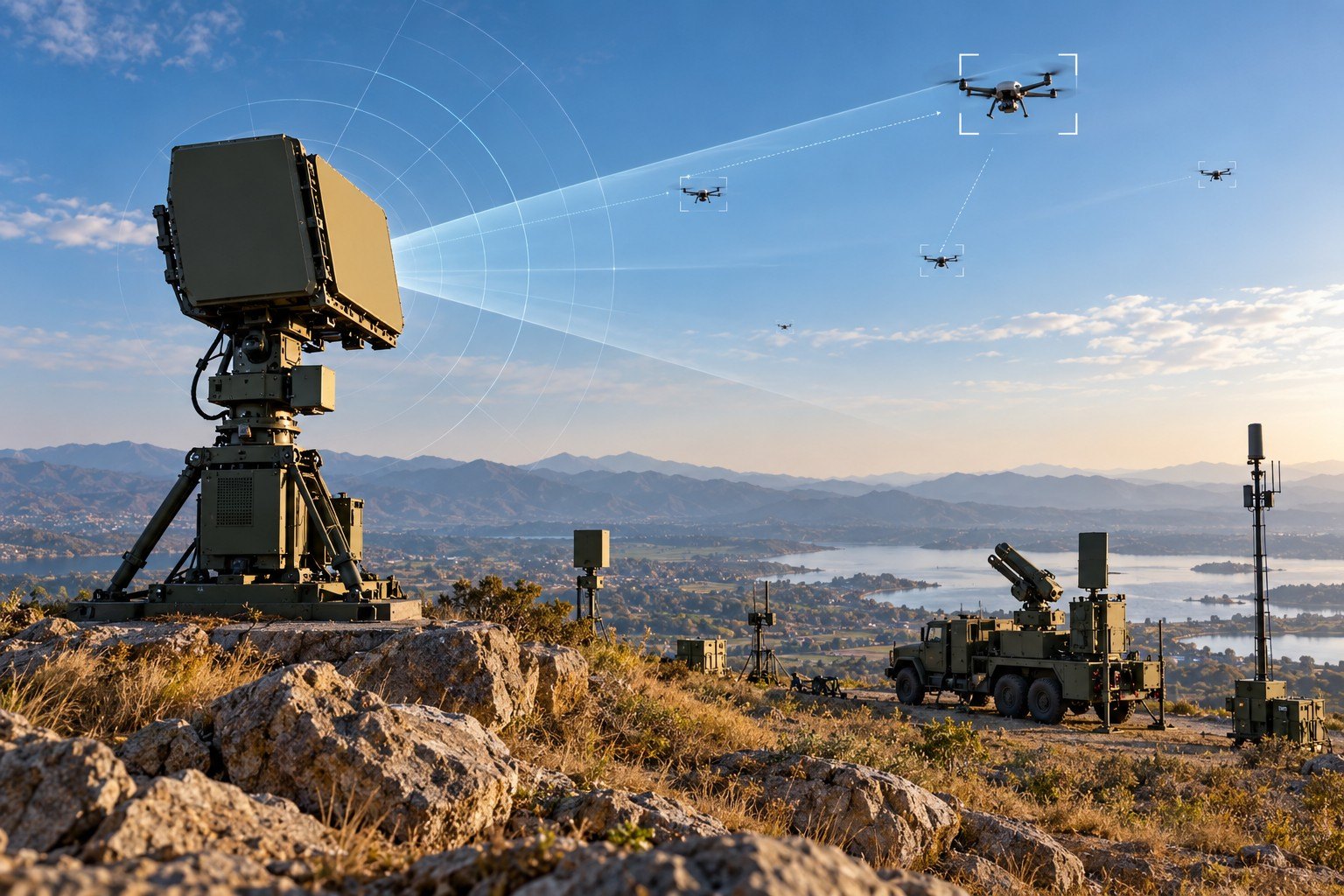
Counter-drone defence is the chain that finds, identifies and defeats hostile drones. Radars, radio-frequency detectors and electro-optical sensors find them; jammers and spoofers disable them, a soft kill; guns, missiles and lasers destroy them, a hard kill. On 21 October 2026 the Defence Ministry contracted BEL for improved low-level radars that track small drones.
Syllabus: GS3 · Science & Technology; GS3 · Indian Achievements in S&T; GS3 · Border Security & Organised Crime
Why this matters for UPSC
GS III security and science and technology: Prelims asks how soft kill and hard kill work and what Akashteer, IADWS and the ARDTC are; Mains asks about drones on the border and indigenous air defence.
In short
Counter-drone defence is the layered chain of sensors, command systems and weapons that detects, identifies and defeats hostile unmanned aircraft, balancing protection against cost and civilian safety.
India has the sensors and lasers; the test is joining them into one cross-agency grid that defeats swarms without disrupting civilian life.
Why it matters
A soldier at a border post, a farmer near the Punjab border and a passenger at an airport all live under skies where a small drone can carry drugs, weapons or a camera. Such drones are hard to see on an ordinary radar and often come in numbers. Better low-level radars and jammers mean smuggling runs can be caught before the drop, and air bases and towns are warned in time. The larger issue is that attacks now come from many small machines in the air, so a country must defend cities, railways and hospitals, not only military bases, and build the means at home.
Prelims pointers
- Integrated Air Defence Weapon System (IADWS): QRSAM, VSHORADS missiles and a high-power laser DEW; DRDL is the nodal laboratory and developed its command centre.
- VSHORADS is developed by DRDO's Research Centre Imarat; the laser DEW by the Centre for High Energy Systems and Sciences (CHESS), Hyderabad.
- Akashteer joins with the Indian Air Force's IACCS and the Indian Navy's TRIGUN, giving the three services one real-time air picture.
- The D4 System is DRDO's counter-drone system, productionised by BEL: radar, EO/IR cameras, RF detection and jamming, GPS jamming or spoofing, and a laser.
- The Naval Anti Drone System (NADS) of DRDO and BEL was contracted by the Navy in 2021 as the first indigenous anti-drone system to be inducted into the armed forces.
- Drone Rules, 2021 (Ministry of Civil Aviation) replaced the UAS Rules, 2021: green, yellow and red zones on the Digital Sky platform; no permission needed in green zones.
- Drone Rules, 2021 cover drones up to 500 kg; DGCA licenses remote pilots and oversees drone schools.
Practise a UPSC-style question
With reference to drone detection, consider the following statements:
1. A radio-frequency detector can locate a drone by sensing the frequency used by its controller.
2. An electro-optical or infrared sensor detects a drone by sending out radio waves and timing their echoes.
Which of the statements given above is/are correct?
- (a) 1 only
- (b) 2 only
- (c) Both 1 and 2
- (d) Neither 1 nor 2
Show the answer
Answer: (a) 1 only
Answer: (a) 1 only. An RF detector listens for the control signal; sending radio waves and timing echoes is what a radar does.
Statement 1: correct. DRDO's Naval Anti Drone System uses RF detectors that find the frequency used by the drone's controller, which is then jammed.
Statement 2: incorrect. Electro-optical and infrared sensors are cameras that see light and heat; emitting radio waves and timing echoes describes radar.
Eliminate: Statement 2 describes radar, not an EO/IR camera, so it is wrong. Out: (b), (c).
Eliminate: Statement 1 matches how RF detection works. Out: (d).
Trap: Swapped attribution. The working principle of radar is pinned on electro-optical and infrared sensors, which are passive cameras.
Remember: Radar sends and times echoes; RF detectors listen to the control link; EO/IR cameras see light and heat.
In the news
More Explainers
- Who is an accredited journalist? PIB rules, Press Council, PRP Act Polity
- Financial Stability and Development Council: who sits on it, what it does Economy
- NATO: its 32 members, Articles 4 and 5, and the eastern flank World & IR
- Special Executive Magistrates under BNSS section 15: appointment and powers Polity
- Indo-Pacific Oceans Initiative (IPOI): India's seven-pillar plan for the Indo-Pacific World & IR
- Gig and platform workers under the Code on Social Security, 2020 Economy
- Bureau of Indian Standards Act, 2016: Standard Mark, QCOs and hallmarking Economy
- Kittur revolt of 1824: early resistance to the East India Company National
- Polio eradication: wild and vaccine-derived poliovirus, OPV and IPV, India's certification Sci-Tech
- International law and the UN Charter: sources, force and the ICJ World & IR
- Himalayan earthquakes and India's seismic zone map Environment
- Amur falcon: migration, protection and community conservation Environment