
Black holes, accretion discs and quasi-periodic oscillations (QPOs)
Why in news: On 23 October 2026, PIB released an ARIES simulation study, published in the Journal of High Energy Astrophysics, linking black-hole spin to QPO frequency.
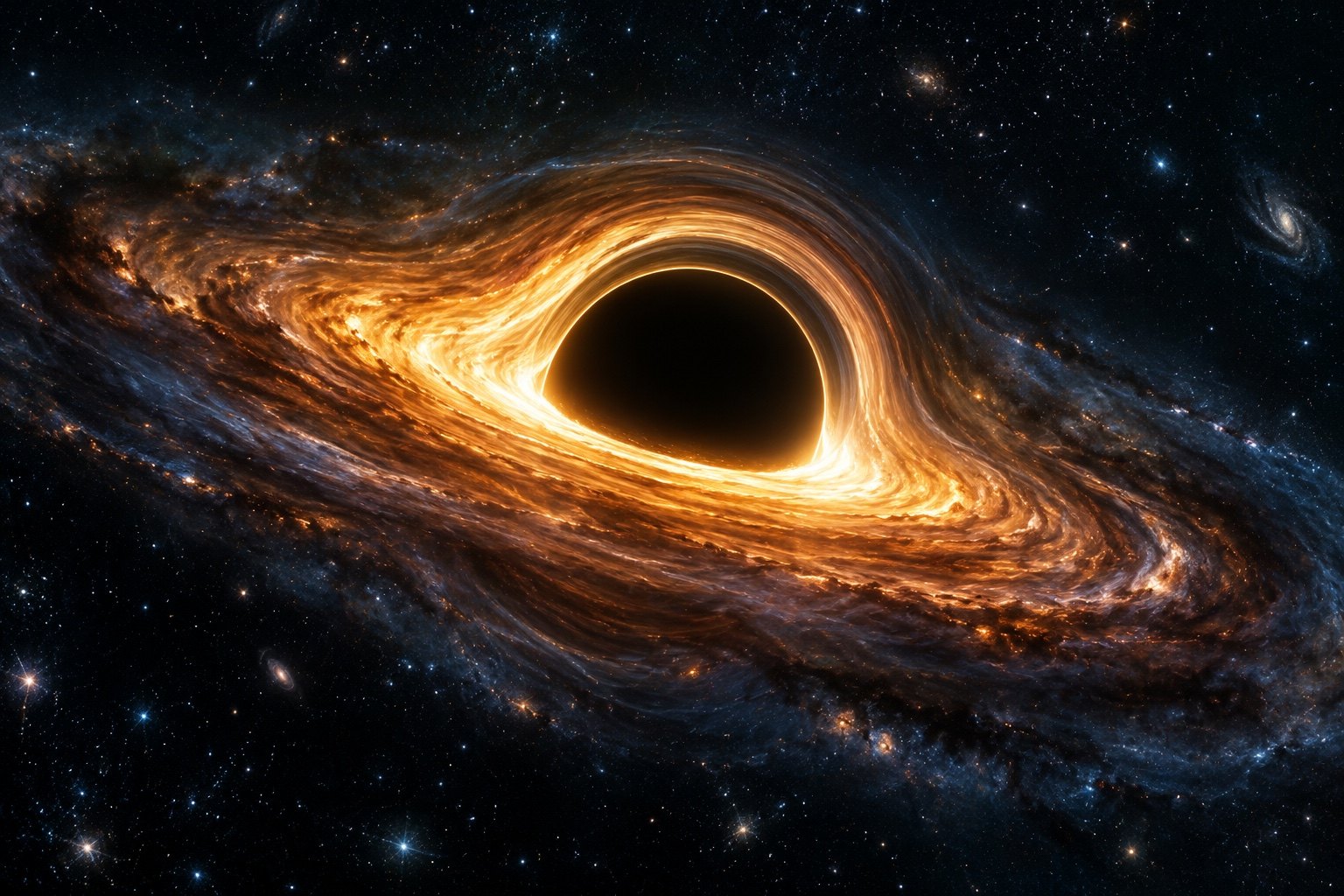
A black hole traps even light. Astronomers therefore study it through the hot accretion disc of matter spiralling into it, which shines in X-rays. That light often flickers almost regularly, in quasi-periodic oscillations (QPOs). A simulation by ARIES, an autonomous DST institute, now links faster black-hole spin to a wider, higher range of QPO frequencies.
Syllabus: Prelims · Science & Technology; GS3 · Science & Technology; GS3 · Indian Achievements in S&T
Why this matters for UPSC
GS3 science and space: Prelims can ask what an event horizon, accretion disc or quasi-periodic oscillations are, and AstroSat's and XPoSat's payloads; Mains, about India's achievements in X-ray astronomy.
In short
Quasi-periodic oscillations (QPOs) are near-regular flickers in X-rays from gas falling into a black hole; their frequencies carry clues to the black hole's mass, spin and surrounding flow.
Spin-dependent QPO models give India's X-ray satellites a physical key to read black holes; their value now rests on careful testing against real observations.
Why it matters
An astronomer can never see a black hole itself, only the glow of gas swirling into it. Decoding the rhythm of that glow turns a flicker recorded by a satellite into a measuring tape. It can show how heavy the black hole is, how fast it turns and how close matter can get before it falls in. That makes Indian-built X-ray satellites far more useful, because their timing data can be read against a physical model instead of a guess. It also tests Einstein's general relativity where gravity is strongest, and it trains Indian researchers in the computer modelling that modern astronomy now runs on.
Prelims pointers
- AstroSat: India's first dedicated astronomy mission, launched on 28 September 2015 by PSLV-C30 from Sriharikota; observes ultraviolet, limited optical and X-rays (0.3-100 keV).
- AstroSat carries five payloads; its X-ray instruments include LAXPC (Large Area X-ray Proportional Counter) and SXT (Soft X-ray Telescope).
- XPoSat: India's first dedicated polarimetry mission; POLIX (8-30 keV) developed by the Raman Research Institute with URSC; XSPECT (0.8-15 keV) gives spectroscopy and timing.
- ARIES (Aryabhatta Research Institute of Observational Sciences): an autonomous institute of the Department of Science and Technology (DST), Government of India.
- Event horizon shadow: the dark zone made by the horizon capturing light and by gravitational lensing; NASA puts it at roughly twice the black hole's actual surface.
- Sagittarius A*: the supermassive black hole at the Milky Way's centre, about 4 million solar masses; tracking the stars orbiting it won the 2020 Nobel Prize.
- GRS 1915+105: a black-hole X-ray binary about 28,000 light-years away; ISRO puts its black hole at about 12 solar masses, NASA calls it the fastest-known spinner.
Practise a UPSC-style question
With reference to the structure around a black hole, consider the following statements:
1. The event horizon is the boundary inside which the escape velocity exceeds the speed of light.
2. The corona above the inner accretion disc emits X-rays of lower energy than the disc itself.
3. Particle jets from near the inner disc blast material away in opposite directions at close to light speed.
Which of the statements given above is/are correct?
- (a) 1 and 2 only
- (b) 2 and 3 only
- (c) 1 and 3 only
- (d) 1, 2 and 3
Show the answer
Answer: (c) 1 and 3 only
Answer: (c) 1 and 3 only. The corona gives harder, not softer, X-rays than the disc.
Statement 1: correct. NASA describes the event horizon as the boundary inside which escape needs more than light speed, so even light stays in.
Statement 2: incorrect. The billion-degree corona is a source of X-rays with much higher energies than those from the accretion disc, per NASA.
Statement 3: correct. A small part of the inflowing matter can be redirected into a pair of opposite jets moving at nearly light speed.
Eliminate: statement 2 is wrong because the corona is far hotter than the disc. Out: (a), (b), (d).
Trap: Reversed direction. The statement keeps the right parts, corona and disc, but turns the energy comparison the wrong way round.
Remember: Disc glows in X-rays; the hotter corona glows in harder X-rays.
More Explainers
- Who is an accredited journalist? PIB rules, Press Council, PRP Act Polity
- Financial Stability and Development Council: who sits on it, what it does Economy
- NATO: its 32 members, Articles 4 and 5, and the eastern flank World & IR
- Special Executive Magistrates under BNSS section 15: appointment and powers Polity
- Indo-Pacific Oceans Initiative (IPOI): India's seven-pillar plan for the Indo-Pacific World & IR
- Gig and platform workers under the Code on Social Security, 2020 Economy
- Bureau of Indian Standards Act, 2016: Standard Mark, QCOs and hallmarking Economy
- Kittur revolt of 1824: early resistance to the East India Company National
- Polio eradication: wild and vaccine-derived poliovirus, OPV and IPV, India's certification Sci-Tech
- International law and the UN Charter: sources, force and the ICJ World & IR
- Himalayan earthquakes and India's seismic zone map Environment
- Amur falcon: migration, protection and community conservation Environment