
Battery management systems (BMS) in EVs and Bluetooth-connected battery risk
Why in news: MeitY told the Lok Sabha on 22 July 2026 that it had ordered BMS apps enabling remote control of e-rickshaw batteries removed on 3 July.
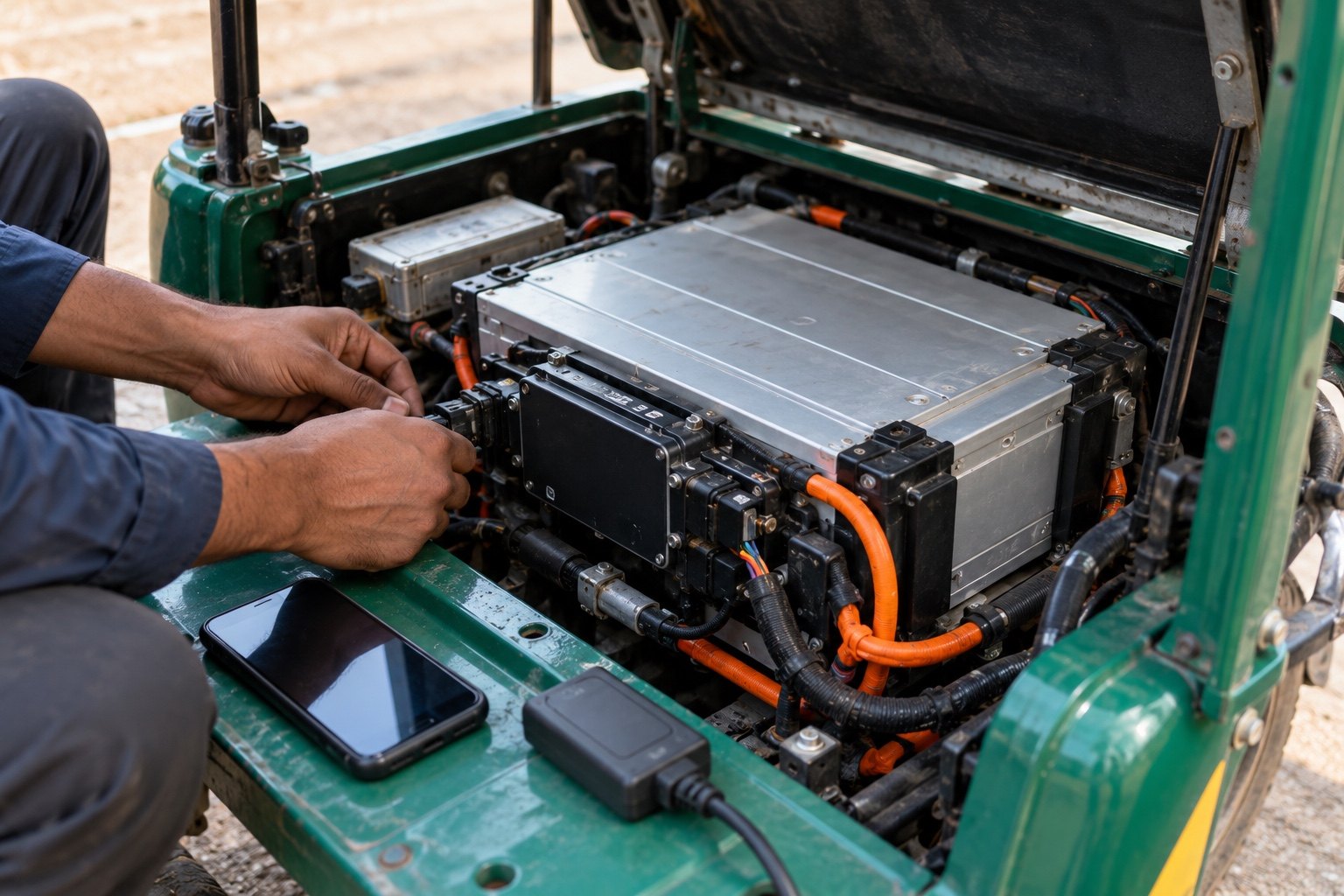
A battery management system (BMS) is the electronic unit that runs an electric vehicle's lithium-ion battery. It tracks voltage, current, temperature and state of charge, and controls charging and discharging. Some e-rickshaw BMS units accept Bluetooth commands without authentication. After apps were misused to switch such batteries off, the government ordered the apps removed on 3 July 2026.
Syllabus: GS3 · Infrastructure; GS3 · Science & Technology; GS3 · IT, Space, Biotech & IPR
Why this matters for UPSC
GS III science and technology and cyber security. Prelims can ask what AIS-156 and AIS-038 (Rev 2) cover, what thermal runaway is and what section 70B of the IT Act, 2000 gives CERT-In. Mains asks about securing connected vehicles and imported electronics.
In short
A battery management system (BMS) is the electronic brain of an EV battery: it measures cells and controls charging and discharging. Wireless access makes it a cyber security point too.
India's battery rules now test fire safety; the next gap is digital, needing authenticated wireless BMS, vetted firmware and enforcement among informal assemblers.
Why it matters
An e-rickshaw driver whose battery is switched off mid-route loses fares, may leave passengers stranded, and must find a mechanic with the right app before the vehicle moves again. The ignition key is of no use, because the battery itself has stopped supplying power. The same wireless link can also reach protection settings, so a careless or hostile user could push a pack outside its safe limits, and an overheated lithium-ion cell can set its neighbours alight. Three-wheelers carry people and goods over the last mile in cities, so one weak, cheap, imported part turns into a public safety problem. The larger lesson is that vehicles are now partly software, and a test that checks only fire and short circuits misses an attacker holding a phone.
Prelims pointers
- Vehicle categories under the CMVR: L is a motor vehicle with fewer than four wheels, plus quadricycles; M carries passengers and N goods, each with at least four wheels.
- IT Act, 2000: section 70A provides for the NCIIPC to protect critical information infrastructure; the National Cyber Coordination Centre is implemented by CERT-In.
- BIS standards for lithium-ion: IS 16893 (Parts 2 and 3): 2018 cover reliability, abuse testing and safety of cells propelling electric road vehicles; IS 18237: 2023 covers transport safety.
- Battery Waste Management Rules, 2022 (MoEFCC) replaced the Batteries (Management and Handling) Rules, 2001, cover EV batteries and bar landfilling and incineration of waste batteries.
- NITI Aayog's draft Battery Swapping Policy (April 2022) mainly targets L-category vehicles and e-rickshaws or e-carts, and supports only Advanced Chemistry Cell batteries.
- PLI scheme for Advanced Chemistry Cells (Ministry of Heavy Industries): Rs 18,100 crore to build 50 GWh of domestic cell manufacturing capacity over seven years.
- Rule 126 of the CMVR, 1989 makes prototype testing and type approval certification compulsory before a vehicle model is sold.
- Bluetooth Low Energy: NIST rates Security Mode 1 Level 4 strongest, as it requires authenticated Secure Connections pairing with ECDH-based encryption.
Practise a UPSC-style question
With reference to battery safety standards for electric vehicles in India, consider the following statements:
1. AIS-156 prescribes requirements for L-category vehicles, that is, those with fewer than four wheels and quadricycles.
2. AIS-038 (Rev 2) prescribes electric power train requirements for two-wheelers and three-wheelers.
3. The Ministry of Road Transport and Highways has notified Conformity of Production requirements for electric vehicles, e-rickshaws included.
Which of the statements given above is/are correct?
- (a) 1 and 2 only
- (b) 2 and 3 only
- (c) 1 and 3 only
- (d) 1, 2 and 3
Show the answer
Answer: (c) 1 and 3 only
Answer: (c) 1 and 3 only. AIS-038 (Rev 2) is for four-wheeled M and N vehicles, not two- or three-wheelers.
Statement 1: correct. AIS-156 covers L-category electric power train vehicles: motor vehicles with fewer than four wheels, and quadricycles.
Statement 2: incorrect. AIS-038 (Rev 2) covers M category (passenger) and N category (goods) vehicles, each with at least four wheels.
Statement 3: correct. MoRTH's notification G.S.R 888(E) of 19 December 2022 set Conformity of Production requirements for all EV categories, e-rickshaws included.
Eliminate: Statement 2 is the surest; two- and three-wheelers are L-category, the domain of AIS-156. Out: (a), (b), (d).
Trap: Look-alike names. AIS-156 and AIS-038 (Rev 2) are both EV battery standards; the question swaps the vehicle categories they serve.
Remember: AIS-156 for L (under four wheels); AIS-038 (Rev 2) for M and N (four wheels or more).
More Explainers
- Who is an accredited journalist? PIB rules, Press Council, PRP Act Polity
- Financial Stability and Development Council: who sits on it, what it does Economy
- NATO: its 32 members, Articles 4 and 5, and the eastern flank World & IR
- Special Executive Magistrates under BNSS section 15: appointment and powers Polity
- Indo-Pacific Oceans Initiative (IPOI): India's seven-pillar plan for the Indo-Pacific World & IR
- Gig and platform workers under the Code on Social Security, 2020 Economy
- Bureau of Indian Standards Act, 2016: Standard Mark, QCOs and hallmarking Economy
- Kittur revolt of 1824: early resistance to the East India Company National
- Polio eradication: wild and vaccine-derived poliovirus, OPV and IPV, India's certification Sci-Tech
- International law and the UN Charter: sources, force and the ICJ World & IR
- Himalayan earthquakes and India's seismic zone map Environment
- Amur falcon: migration, protection and community conservation Environment