
NMCG approves two Yamuna sewage plants in Delhi under Namami Gange
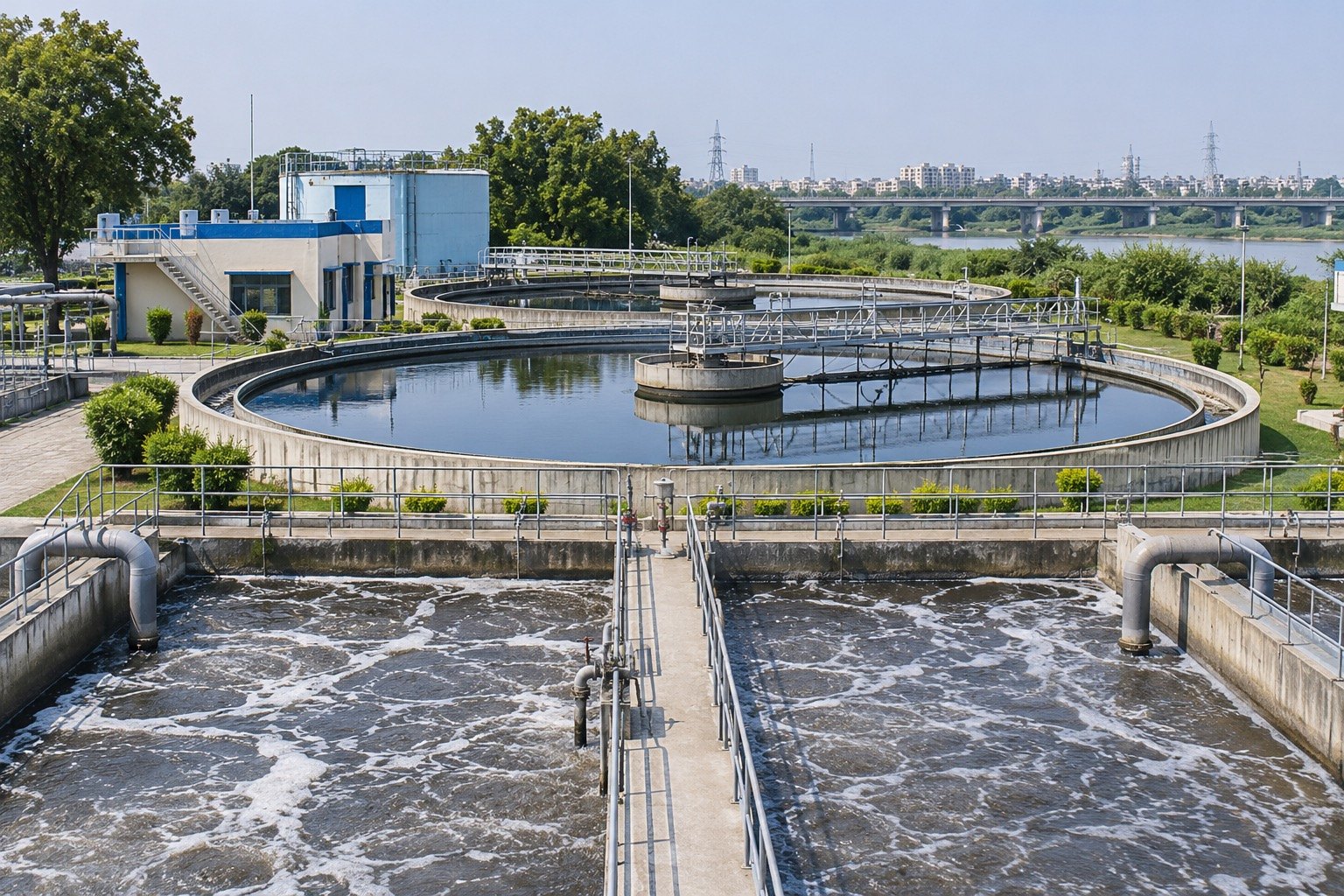
The National Mission for Clean Ganga (NMCG), through its empowered committee, approved two sewage treatment plants (STPs) for the Yamuna in Delhi on 12 November 2026. Together they will treat 250 million litres a day (MLD) at an estimated Rs 874.49 crore. Namami Gange Mission-III will fund both, built through a hybrid annuity model (HAM) public-private partnership.
Syllabus: Prelims · Environment & Ecology; GS2 · Government Policies; GS3 · Investment Models
Why this matters for UPSC
GS3 environment: river pollution and the Namami Gange Programme. Prelims can ask NMCG's legal status and the hybrid annuity model; Mains, why sewage treatment lags.
Why it matters
A family living by the Yamuna in Delhi, or a devotee who wades in at Chhath, meets the river after the city's drains have emptied into it. When a drain carries sewage that no plant treats, that waste goes straight into the water people bathe in and live beside. Catching a drain at its mouth and treating what it carries is the most direct way to change that. How the plants are paid for matters too. Under the annuity model, a private operator receives most of its money only if the plant keeps working for years. A plant built and then left idle costs the operator, not just the public. The larger issue is cities growing faster than their sewage systems.
Prelims pointers
- The Ganga's five-tier set-up runs from the National Ganga Council, through the Empowered Task Force, NMCG and State Ganga Committees, to District Ganga Committees.
- Look-alike: the National Ganga Council is chaired by the Prime Minister; the Empowered Task Force on the Ganga is chaired by the Union Minister of Jal Shakti.
- NMCG has a two-tier management of a Governing Council and an Executive Committee, both headed by its Director General, an Additional Secretary to the Government of India.
- Namami Gange's stated features include full central funding, a non-lapsable fund, the hybrid annuity model and 15 years of operation and maintenance cost.
- NMCG's vision for the Ganga pairs Aviral Dhara (continuous flow) with Nirmal Dhara (unpolluted flow), along with geologic and ecological integrity.
- Look-alike: the National River Conservation Plan covers 41 major rivers of India; Namami Gange works on the Ganga basin, main stem and tributaries.
- Under NMCG's 'One City One Operator' approach, a single operator handles a city's new and existing sewage plants under the hybrid annuity model.
- The Ganga River Basin Management Plan was prepared by a consortium of seven Indian Institutes of Technology.
Practise a UPSC-style question
With reference to the National Mission for Clean Ganga (NMCG), consider the following statements:
1. It has been declared an authority under the Water (Prevention and Control of Pollution) Act, 1974.
2. It was registered as a society under the Societies Registration Act, 1860.
3. It served as the implementing arm of the National Ganga River Basin Authority.
Which of the statements given above is/are correct?
- (a) 1 and 2 only
- (b) 2 and 3 only
- (c) 1 and 3 only
- (d) 1, 2 and 3
Show the answer
Answer: (b) 2 and 3 only
Answer: (b) 2 and 3 only. NMCG is a registered society that served as the NGRBA's implementing arm; its authority status comes from the 1986 environment law.
Statement 1: incorrect. NMCG was declared an authority under the Environment (Protection) Act, 1986 in October 2016, not under the Water Act, 1974.
Statement 2: correct. NMCG was registered as a society on 12 August 2011 under the Societies Registration Act, 1860.
Statement 3: correct. NMCG acted as the implementing arm of the National Ganga River Basin Authority, itself set up under the Environment (Protection) Act, 1986.
Eliminate: statement 1 names the Water Act instead of the Environment (Protection) Act, so it is wrong. Out: (a), (c), (d).
Trap: Swapped attribution. Both laws deal with pollution, so the question pins NMCG's authority status on the older Water Act, which a student may half-remember.
Remember: NMCG = society under the 1860 Act + NGRBA's implementing arm + authority under the Environment (Protection) Act, 1986.
Explainers on this topic
More from the 22 November 2026 edition
- Himachal Assembly passes Bill: 80% industry jobs for residents, single window Polity
- India joins OceanEye alliance for GOOS, pledges to double Indian Ocean network Environment
- NCB and US DEA disrupt transnational drug network in Operation Monsoon Thunder National
- Karnataka to renew ST bid for Kadugolla, Hattigolla after five RGI rejections Polity
- Maharashtra Uniform Civil Code committee opens district-wise public hearings Polity
- IRDAI fines Star Health Rs 2 crore for breaking claim-settlement rules Economy
- Manipur's Chandel liquor deaths: district advisory, State announces enquiry Polity
- US, China, Russia Shenzhen declaration: ICC limits, nuclear-risk dialogue, UN reform World & IR