
NCB and US DEA disrupt transnational drug network in Operation Monsoon Thunder
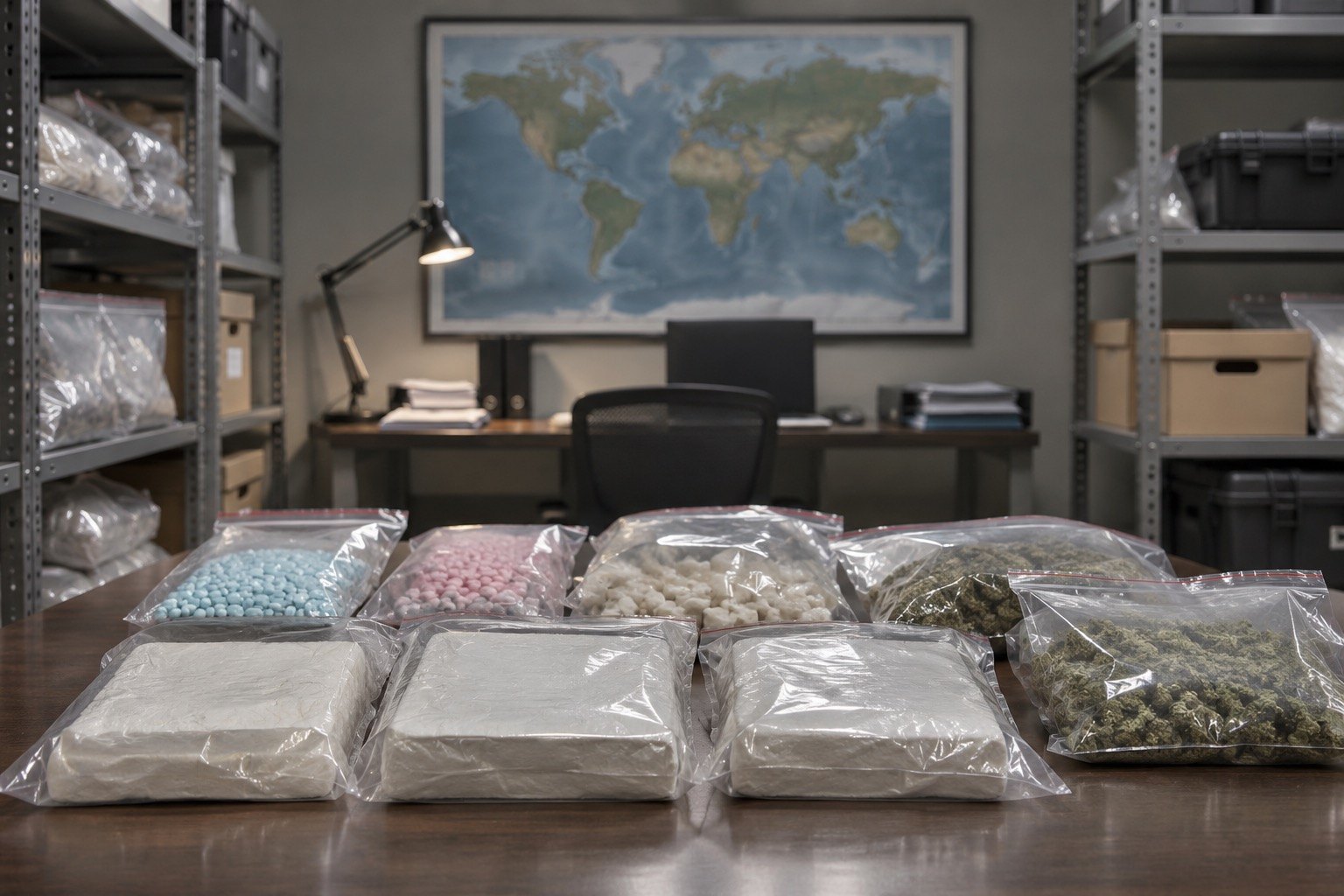
India's Narcotics Control Bureau (NCB) and America's Drug Enforcement Administration (DEA) disrupted a network supplying illegal drugs across the United States, the Home Ministry said on 21 November 2026. The joint effort was called Operation Monsoon Thunder. Six people were arrested in four Indian cities. Data on over 59,000 US subjects went to the DEA.
Syllabus: GS2 · Statutory & Regulatory Bodies; GS2 · Groupings & Agreements; GS3 · Border Security & Organised Crime
Why this matters for UPSC
GS3 security: the NCB, the NDPS Act, 1985 and India-US counter-narcotics cooperation. Prelims can ask the NCB's parent Act and Ministry; Mains, intelligence sharing against drug networks.
Why it matters
For an investigator, a parcel that leaves one country and is opened in another is a trail that neither police force can follow alone. When one agency arrests the senders and passes on what it learns, its partner can stop packages already on the road, so a network loses its suppliers and its deliveries together. Families and patients gain when fewer illegal pills reach homes through the post. For India, such cases also shape how partners judge its pharmaceutical exports and its willingness to act against misuse. The larger issue is organised crime that hides inside ordinary trade, couriers and online sales, which pushes governments to share data quickly while respecting each country's laws.
Prelims pointers
- Article 47, a Directive Principle of State Policy, asks the State to try to prohibit the consumption of intoxicating drinks and harmful drugs, except for medicinal purposes.
- The NDPS Act, 1985 received assent in September 1985 and came into force in November 1985.
- The NDPS Act, 1985 regulates operations involving both narcotic drugs and psychotropic substances; the Prevention of Illicit Traffic in Narcotic Drugs and Psychotropic Substances (PITNDPS) Act, 1988 adds preventive detention.
- The NCB, under the Ministry of Home Affairs, handles coordination, intelligence and enforcement; the Department of Revenue, Ministry of Finance, administers the NDPS Act and the PITNDPS Act.
- India is a Party to the Single Convention on Narcotic Drugs, 1961 (amended in 1972), the Convention on Psychotropic Substances, 1971 and the 1988 UN convention against illicit traffic.
- NCB officers led India's side in the CNWG and the Drug Policy Executive Working Group; the Office of National Drug Control Policy led the latter's US side.
Practise a UPSC-style question
With reference to the Narcotics Control Bureau (NCB), consider the following statements:
1. It was constituted under the Narcotic Drugs and Psychotropic Substances Act, 1985.
2. It now functions under the Department of Revenue of the Ministry of Finance.
3. Carrying out India's international obligations on drug control is one of its tasks.
Which of the statements given above is/are correct?
- (a) 1 and 2 only
- (b) 2 and 3 only
- (c) 1 and 3 only
- (d) 1, 2 and 3
Show the answer
Answer: (c) 1 and 3 only
Answer: (c) 1 and 3 only. The NCB rests on the NDPS Act and has an international role, but it is a Home Ministry body.
Statement 1: correct. The Centre constituted the NCB in March 1986 using its power under Section 4 of the NDPS Act, 1985.
Statement 2: incorrect. The NCB began under the Department of Revenue but moved to the Ministry of Home Affairs in February 2003.
Statement 3: correct. Its tasks include carrying out India's international obligations and assisting foreign authorities and international organisations.
Eliminate: Statement 2 is wrong, since the NCB sits in the Home Ministry. Out: (a), (b), (d).
Trap: Swapped attribution. The Department of Revenue still administers the NDPS Act, so pinning the NCB itself on the Finance Ministry looks right.
Remember: NCB: constituted under the NDPS Act, 1985; Ministry of Home Affairs since 2003.
More from the 22 November 2026 edition
- Himachal Assembly passes Bill: 80% industry jobs for residents, single window Polity
- India joins OceanEye alliance for GOOS, pledges to double Indian Ocean network Environment
- Karnataka to renew ST bid for Kadugolla, Hattigolla after five RGI rejections Polity
- Maharashtra Uniform Civil Code committee opens district-wise public hearings Polity
- IRDAI fines Star Health Rs 2 crore for breaking claim-settlement rules Economy
- Manipur's Chandel liquor deaths: district advisory, State announces enquiry Polity
- NMCG approves two Yamuna sewage plants in Delhi under Namami Gange Environment
- US, China, Russia Shenzhen declaration: ICC limits, nuclear-risk dialogue, UN reform World & IR