
ISRO: Aditya-L1 and Proba-3 coronagraphs jointly study coronal mass ejections
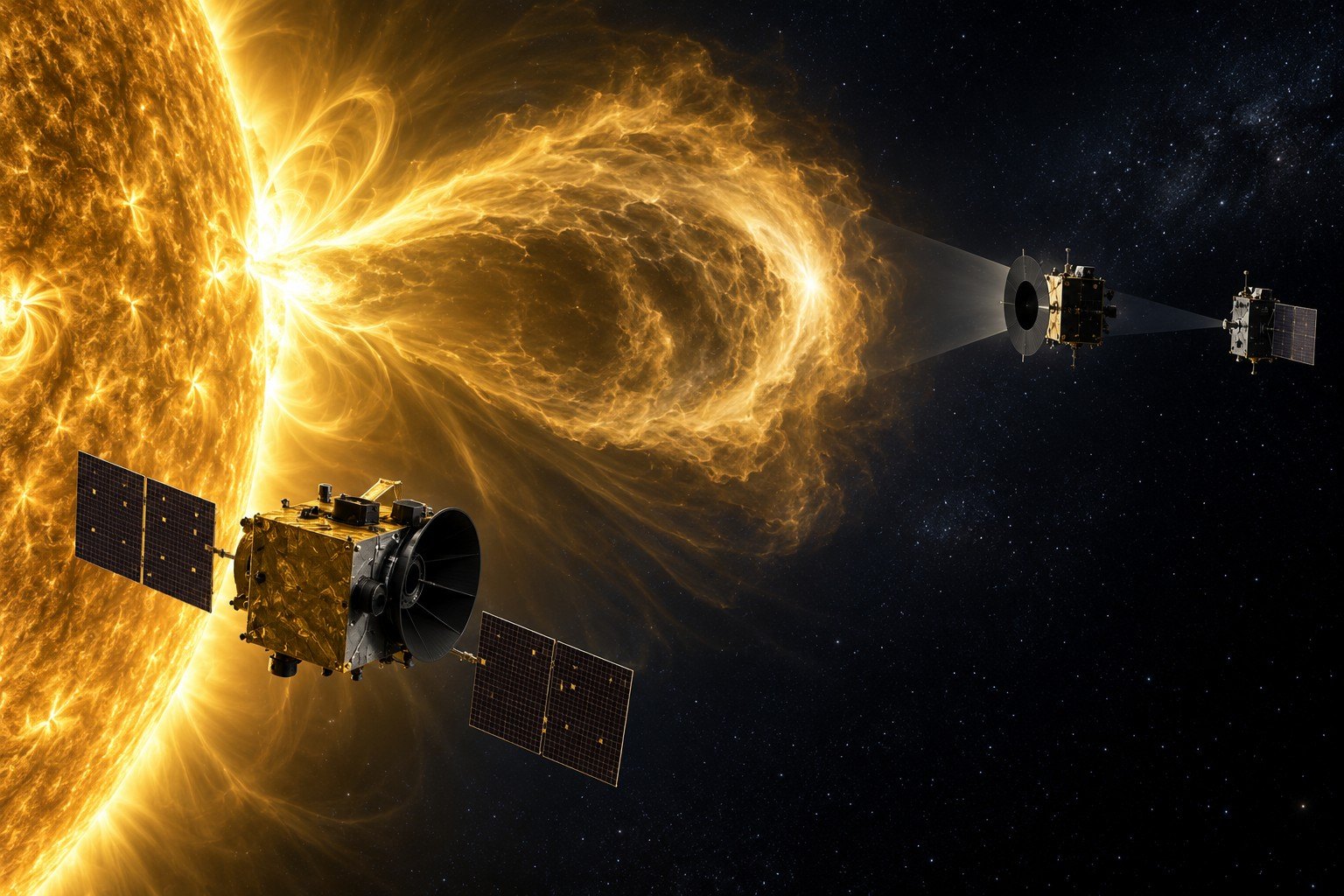
Observations of the same solar eruptions by India's Aditya-L1 and the European Space Agency's Proba-3 have been jointly analysed and published for the first time, ISRO said on 15 October 2026. Indian Institute of Astrophysics scientists combined data from the two coronagraphs, VELC and ASPIICS, on two coronal mass ejections of September 2025 in the journal Astronomy & Astrophysics.
Syllabus: Prelims · Current Affairs & IR; Prelims · Science & Technology; GS3 · Indian Achievements in S&T
Why this matters for UPSC
GS3 Science and Technology, space: Prelims can ask about the Lagrange point L1 and halo orbit, Aditya-L1's payloads, Proba-3's precision formation flying and coronal mass ejections; Mains, about space weather and India's space cooperation.
Why it matters
A coronal mass ejection aimed at Earth can set off a geomagnetic storm that disturbs satellites and communication and power networks on Earth. A satellite operator or a grid engineer gets a useful warning only if scientists can judge, soon after an eruption, how heavy and energetic it is and how it will grow. That judgement is weakest close to the Sun, where eruptions are born and are hardest to see. Two coronagraphs that check each other's numbers make that early picture more reliable. The study also shows Indian-built instruments doing frontline science, and a European mission that an Indian rocket put into orbit now feeding joint research with an Indian one.
Prelims pointers
- Sun-Earth system has five Lagrange points: L1, L2 and L3 lie on the Sun-Earth line and are unstable; L4 and L5 are stable.
- L1 gives an uninterrupted view of the Sun and is home to the SOHO solar observatory; L2 suits telescopes looking into deep space.
- Aditya-L1's payloads are meant to study coronal heating, coronal mass ejections, pre-flare and flare activity, space-weather dynamics and the propagation of particles and fields.
- Proba stands for PRoject for OnBoard Autonomy: ESA's in-orbit demonstration series (Proba-1, 2001; Proba-2, 2009; Proba-V, 2012; Proba-3, 2024).
- Proba-3's 1.4 m occulting disc casts an 8 cm shadow held on the telescope to millimetre accuracy, giving eclipses of up to six hours each 19 h 36 min orbit.
- Proba-3 orbits Earth between about 600 km and 60,530 km, flying in formation near apogee where Earth's gravity disturbs the pair least.
- CMEs travel from under 250 km/s to nearly 3,000 km/s; the fastest Earth-directed ones arrive in 15 to 18 hours (NOAA).
- The Indian Institute of Astrophysics, Bengaluru, runs the Vainu Bappu Observatory at Kavalur, Tamil Nadu.
Practise a UPSC-style question
With reference to the Sun-Earth Lagrange point L1, consider the following statements:
1. It lies on the line joining the Sun and Earth, between the two bodies.
2. A spacecraft in a halo orbit around it can watch the Sun continuously, without being eclipsed.
Which of the statements given above is/are correct?
- (a) 1 only
- (b) 2 only
- (c) Both 1 and 2
- (d) Neither 1 nor 2
Show the answer
Answer: (c) Both 1 and 2
Answer: (c) Both 1 and 2. L1 sits between the Sun and Earth, and a halo orbit there keeps the Sun always in view.
Statement 1: correct. L1, L2 and L3 lie on the line joining the Sun and Earth; L1 is the one between them, about 1.5 million km from Earth.
Statement 2: correct. ISRO notes that a satellite in a halo orbit around L1 views the Sun continuously without any occultation or eclipse.
Eliminate: Statement 2 is the surest: an eclipse-free view is why Aditya-L1 went to L1. Out: (a), (d).
Eliminate: Statement 1 holds too, since L1 lies between the Sun and Earth. Out: (b).
Trap: Look-alike names. L1 is easily confused with L2, which lies beyond Earth on the side away from the Sun and suits deep-space telescopes.
Remember: L1 is between the Sun and Earth with the Sun always in view; Aditya-L1 orbits it.
More from the 16 October 2026 edition
- Black Sea and the Turkish Straits: drone strikes hit merchant shipping World & IR
- India approves rollover of ₹30 billion currency swap for the Maldives World & IR
- Census Rules, 1990 amended to spell out who can be enumerators Polity
- Sports Ministry issues norms for revised National Sports Federations assistance scheme National
- Section 163 BNSS order and park closure curb Connaught Place assembly Polity
- India presses terrorism, connectivity norms at CICA's Baku summit World & IR
- Centre cancels paraquat herbicide's registration; Madhya Pradesh orders stocks destroyed Environment
- UN DESA's World Social Report 2026 scores 168 countries on inclusive transformation World & IR
- AT-1 bonds: Supreme Court upholds quashing of Yes Bank write-down Economy
- CERT-In issues critical advisory on AI agents reaching Indian systems Sci-Tech
- UN report urges limits on neurotechnology and neural data in justice Sci-Tech
- Kunming-Montreal biodiversity framework off track, finds first global review report Environment