
UN report urges limits on neurotechnology and neural data in justice
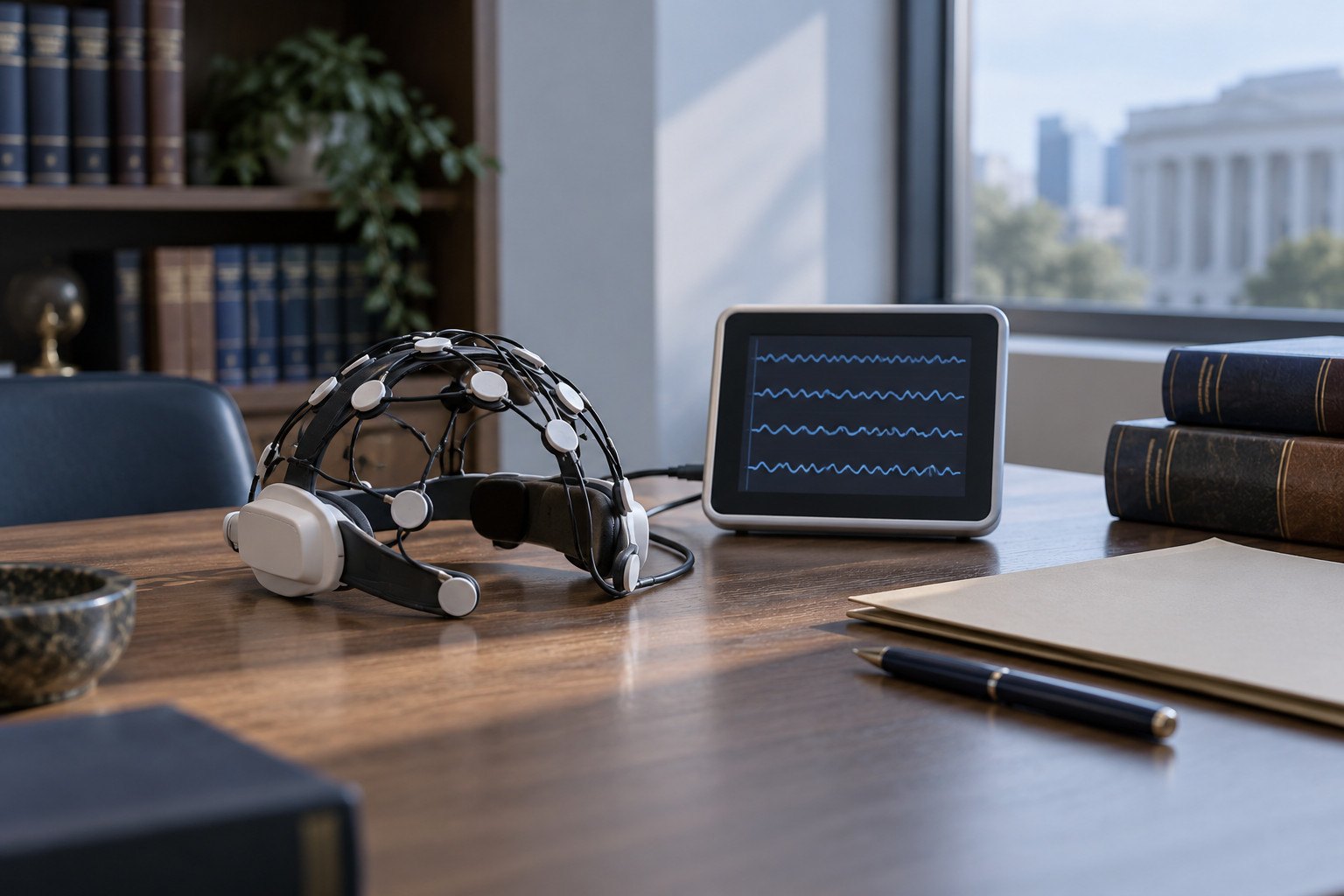
The UN Secretary-General's report on human rights in the administration of justice, presented to the General Assembly's Third Committee on 15 October 2026, urges States to prohibit coercive uses of neurotechnology in justice systems. It asks that neural data be protected as highly sensitive personal data and that any use rest on free, informed and revocable consent.
Syllabus: GS3 · Science & Technology; GS3 · IT, Space, Biotech & IPR; GS2 · International Institutions
Why this matters for UPSC
GS3 science and technology and GS2 rights: Prelims can ask what neural data, electroencephalography and brain-computer interfaces are, and what Article 20(3) protects; Mains, how to regulate neurotechnology while protecting privacy and a fair trial.
Why it matters
A person who buys a meditation headband or a gaming headset may be handing a company recordings of their brain activity. Under weak laws those recordings could reach the police or be produced in court, where a probabilistic brain signal might be taken as proof of lying or guilt. The danger is sharper for people with little power: a prisoner offered early release in return for a brain treatment cannot freely refuse, and tools trained on narrow data can misread women, minorities or neurodivergent people. The larger question is whether the mind stays the one fully private space as such devices spread from clinics into homes, workplaces and police stations.
Prelims pointers
- Human Rights Council: created by General Assembly resolution 60/251 (15 March 2006) in Geneva, replacing the Commission on Human Rights; 47 members serve three-year terms.
- HRC resolution 58/6 (2 April 2025, adopted without a vote) asks its Advisory Committee to draft neurotechnology guidelines for the Council's sixty-fourth session.
- UNESCO's General Conference adopted the neurotechnology Recommendation at its 43rd session after an intergovernmental experts' meeting in May 2025; it calls for national coordinating bodies.
- ICCPR Article 18 (freedom of thought) is non-derogable even in a public emergency; Article 14 guarantees a fair trial and the privilege against self-incrimination.
- Article 359: an Emergency order cannot suspend enforcement of Articles 20 and 21, a limit added by the Constitution (Forty-fourth Amendment) Act, 1978.
- OECD Recommendation on Responsible Innovation in Neurotechnology (2019): adopted by the OECD Council, with nine guiding principles including safeguarding personal brain data.
Practise a UPSC-style question
With reference to neurotechnology, consider the following statements:
1. Functional magnetic resonance imaging measures brain activity by recording electrical signals through sensors placed on the scalp.
2. Electroencephalography is a non-invasive technique that records the brain's electrical activity through external sensors.
Which of the statements given above is/are correct?
- (a) 1 only
- (b) 2 only
- (c) Both 1 and 2
- (d) Neither 1 nor 2
Show the answer
Answer: (b) 2 only
Answer: (b) 2 only. EEG records electrical activity from outside the head; fMRI tracks blood flow instead.
Statement 1: incorrect. Functional magnetic resonance imaging is neuroimaging that measures brain activity by detecting changes in blood flow, not scalp electrical signals.
Statement 2: correct. Electroencephalography uses external sensors to record the brain's electrical activity, which makes it a non-invasive neurotechnology.
Eliminate: Statement 1 describes EEG, not fMRI, so it is wrong. Out: (a), (c).
Eliminate: Statement 2 is the standard description of EEG. Out: (d).
Trap: Look-alike names. Two brain-scanning tools are confused: the electrical method of EEG is pinned on fMRI, which actually reads blood flow.
Remember: EEG reads electricity through external sensors; fMRI reads blood flow.
More from the 16 October 2026 edition
- Black Sea and the Turkish Straits: drone strikes hit merchant shipping World & IR
- India approves rollover of ₹30 billion currency swap for the Maldives World & IR
- Census Rules, 1990 amended to spell out who can be enumerators Polity
- Sports Ministry issues norms for revised National Sports Federations assistance scheme National
- Section 163 BNSS order and park closure curb Connaught Place assembly Polity
- India presses terrorism, connectivity norms at CICA's Baku summit World & IR
- ISRO: Aditya-L1 and Proba-3 coronagraphs jointly study coronal mass ejections Sci-Tech
- Centre cancels paraquat herbicide's registration; Madhya Pradesh orders stocks destroyed Environment
- UN DESA's World Social Report 2026 scores 168 countries on inclusive transformation World & IR
- AT-1 bonds: Supreme Court upholds quashing of Yes Bank write-down Economy
- CERT-In issues critical advisory on AI agents reaching Indian systems Sci-Tech
- Kunming-Montreal biodiversity framework off track, finds first global review report Environment